
Among the millions who joined up to serve their country during World War 1 were thousands of young boys who were keen not to miss out on the action regardless of their age.
One of the boy soldiers was BBC Wales broadcaster Gareth Lewis’ great grandfather Frederick Oswald Reginald Hinks, known by his family as Oswald. He was born on 5 May 1899, a fact vital to his story.
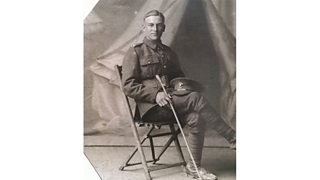
Oswald Hinks in uniform
Oswald came from an ordinary family. His father Frederick was born in Shropshire in 1873. His mother, Alice Kate Cook, was born in 1876 in Gloucester. In 1901 the Hinks family lived at 21 Hopkin Street in Treherbert and the 1911 census shows that the family had moved to 26 Aberdare Road in Abercynon. It was from here that the young Oswald Hinks decided on 25 January 1915 that it was time he served his country.
He was aged just 15 years and 8 months but obviously felt very strongly that he could wait no longer to sign up.
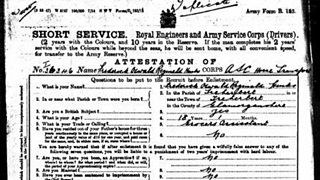
Hinks Attestation Papers dated January 25th 1915, courtesy of The National Archives
Having been recruited in Mountain Ash he signed his attestation papers in Abercynon claiming to be a grocer’s assistant aged 18 years and 1 month and 5 ft 11½ inches tall. He was sent for training in Aldershot, aiming to serve for the duration of the war in the Horse Transport section of the Army Service Corps and was given the service number I36346.
He was obviously naive because despite lying about his age he provided his father’s full name and address as next of kin. Imagine the shock then when five days later his father read the details of his son’s name printed on page 5 of the Aberdare Leader.
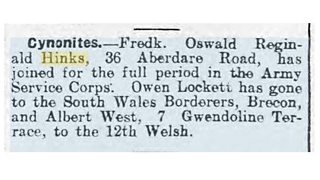
Hinks Paper Clipping courtesy of http://welshnewspapers.llgc.org.uk/en/home
On 11 March 1915 a young Oswald Hinks was discharged from the army having served only 46 days.
I can only assume that his father (presumably having seen the notice in the paper) informed the authorities that his son was aged just 15 years and ten months (never mind the fact that his height was only 5 ft 4¼ inches tall) and arranged for him to return home. Recruitment officers were reputedly paid two shillings per man they signed up and it seems that all too often the vital details such as actual age were overlooked.
Gareth Lewis is lucky. Six pages of service papers recording Hinks’ time as Recruit I36436 survived the blitz intact. The last page provides the reason for his discharge in typical blunt military language:
“Having made a mis-statement as to age on enlistment para (VI)A R.R. 1912”
There are no medals linked to this record because Oswald did not serve overseas.
But this is not the end of the story. Information held in the WWI Medal Rolls Index (MRI) Cards offers a different entry for Frederick O. R. Hinks, a Private in the Somerset Light Infantry with the regimental number: 36437.
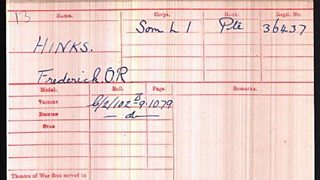
Oswald Hinks MRI Card. Courtesy of the National Archives
The details on this image confirm that Oswald, not content with being prevented from enlisting in January 1915 tried again, and succeeded the second time. He went on to serve overseas, and was given the Victory and British War Medals. This honour is reserved for men or boys only when they reach the age of 19 (or perhaps in Oswald’s case when they lie and pretend to be 19 years of age).
The MRI card also confirms that Hinks was not entitled to the 1914-1915 Star; which means that he did not go abroad until after 1 January 1916. But without the details of which battalion it is impossible to know where and when he went. Battalion details are usually to be found in the Absent Voters’ List which reveal specifically the section of the services that every man from each street in every town served with.
Oswald is not listed here because ironically he was not old enough to vote! So his battalion details were identified using the Medal Rolls which are held at the National Archives (WO 329/892 page 1079). This confirms that Oswald served with the 7th Battalion of the Somersetshire Light Infantry until the end of the war. His final destination on 21 January 1919 is shown to be “Z Reserve”; a contingent consisting of discharged soldiers held in "Reserve" just in case of further problems. Class Z reserve was abolished on 31 March 1920.
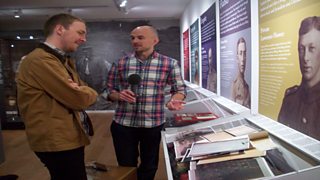
Gareth Lewis interviewing Sam Astill at the Somerset Light Infantry Regimental Museum
In October Gareth and I took a trip to the regimental museum in Taunton which is based inside the magnificent castle walls. While there we explored the various exhibitions and displays of militaria.
Sam Astill, Assistant Curator from Somerset Heritage Service helped explain the regiment’s role and how the battalion war diaries and other documents can help provide additional details. I always find it’s best to ask an expert, and this was especially true in this since during WW1 the SLI had 19 battalions, each one involved in different operations, activities and in some cases even in different theatres of war.
But one question remains; when did Private Hinks 36437 enlist into the 7th Battalion?
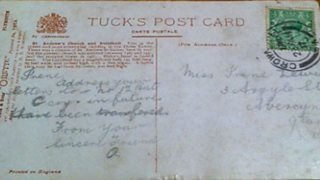
Hinks postcard reverse
In August 1917 Oswald sent a postcard to his then girlfriend Irene from his barracks in Plymouth, having reached the ripe old age of 18 years and 3 months. This postcard is one of Gareth’s grandmother’s most treasured possessions - Oswald Hinks went on to marry Irene Lewis in 1921.
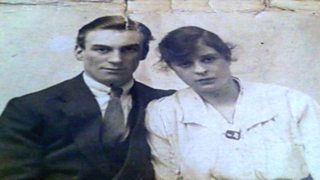
Oswald Hinks with Irene Lewis, his wife-to be.
Had Oswald stayed in the army after January 1921 then a record of his extended long service would be held at the Army Personnel Centre in Glasgow.
There is however one final fact which should be considered.
On 12 December 1915 Private Glastonbury enlisted into the Somerset Light Infantry and was given the service number of 36460. Three days before that date on 9 December 1915 Private Warman was issued with the service number 36453. This implies that service number 36437 ( Oswald Hinks’ service number) would have been issued sometime around November 1915.
Could this possibly mean that Oswald joined up for a second time aged just 16 years and 6 months?
Sadly this is a question that will never be answered - the service papers recording Oswald’s time with the Somerset Light Infantry have not survived.
Teenage Tommies will be broadcast on Tuesday 11 November at 21:00 GMT on BBC Two. Or catch up later on BBC iPlayer.
