
East versus West: Let the battle commence!
For the first time this winter, after a relentless spell of westerly winds, many areas are expected to see a general change to colder conditions as we head through the weekend and into next week.
As the colder air becomes established it will be competing with milder air from the Atlantic. Where the two meet, snow is likely, with western areas most at risk.
Here in Yorkshire there is a risk of some patchy snow later in the weekend and into monday mainly in western areas - although it is unlikely to be heavy. At the same time wintry showers may affect coastal areas.
But the exact location of this battle between cold air from the east and milder air from the west is still a source of uncertainty, and getting the detail right will cause problems.
Much of the country will then have a period of quiet, settled & cold weather as we head through next week, with sharp overnight frosts developing.
After that, the outlook remains a major headache for forecasters, as it has for some time. In fact I can't remember the last time there has been so much disagreement between the major forecasting models.
As I've explained before, each computer model runs many times, and each time the initial starting conditions of the atmosphere are changed by a very small amount, in order to see what happens.
An example of this can be seen below, from the American GFS model, from midnight.
It clearly shows that after a few days, when all the model runs are in broad agreement, each separate run of the model thereafter yields different results - with some solutions showing a 15 Celsius difference in temperature at 5000ft.
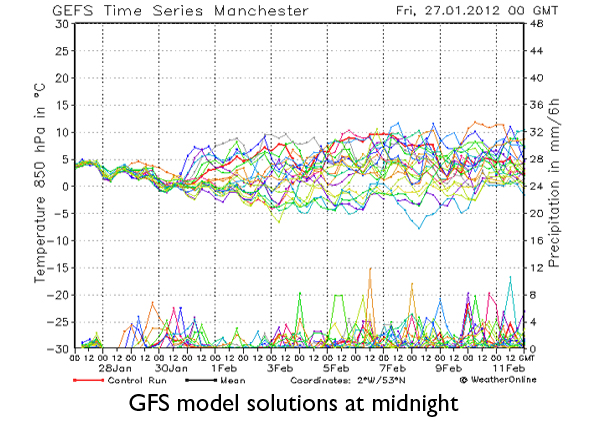
In fact model solutions from yesterday summed up the dilemma forecasters have had for days now, in that 50% had a milder south-westerly in the further outlook period; the other 50% had a colder east or south-easterly.
The latest information gathered so far today shows a shift away from the milder south-westerly scenario described above - but such run to run changes have been common this week and until there's more consistency it's impossible with any degree of confidence to determine which scenario will ultimately win.
That said, a cold early February is the more likely scenario.
Finally, since my blog has featured articles in the past about the merits of different private forecasting companies before, and how some newspapers often use their long range forecasts for front page headlines, I thought you might be interested in this article about Positive Weather Solutions which appeared in the Guardian yesterday.
Follow me on twitter @Hudsonweather.
 Hello, I’m Paul Hudson, weather presenter and climate correspondent for BBC Look North in Yorkshire and Lincolnshire. I've been interested in the weather and climate for as long as I can remember, and worked as a forecaster with the Met Office for more than ten years locally and at the international unit before joining the BBC in October 2007. Here I divide my time between forecasting and reporting on stories about climate change and its implications for people's everyday lives.
Page 1 of 2
Comment number 1.
At 17:06 27th Jan 2012, Sheffield_city wrote:I still think we are in for the reverse of last year, cold after Christmas, warm before. Snow came very late to the Alps, but when it did, they had record levels.
Complain about this comment (Comment number 1)
Comment number 2.
At 17:22 27th Jan 2012, Katherine Birkett wrote:Thanks again for a fascinating blog, Paul! Still hoping for at least one good spell of the white stuff....
Complain about this comment (Comment number 2)
Comment number 3.
At 17:50 27th Jan 2012, weather12 wrote:Hi Paul, Thanks for the update.
As you had so much fun with Netweather's summer forecast do you know what they forecast for this winter?
Complain about this comment (Comment number 3)
Comment number 4.
At 18:10 27th Jan 2012, jkiller56 wrote:Let battle commence.
It does shed interesting light on old addages:
"If Candlemas be fair and bright, winter will have another flight; but if Candlemas be clouds and rain, winter is gone and will not come again".
Ie, if anticyclonic and cold in early Feb.- it is likely to last a while and perhaps become severe. Groundhog Day concerns the same idea. Although a North American (eastern) custom it was brought over from Europe by settlers, (I believe). The European marmot was substituted by the closely related American "wood chuck", or groundhog. As we know, the fortunes of eastern North American weather and our own are often close, so it worked on both sides of the Atlantic.
Nonsense perhaps, but not entirely if interpreted fairly loosely.
Complain about this comment (Comment number 4)
Comment number 5.
At 18:22 27th Jan 2012, Pkthinks wrote:The GFS charts for next week are very dramatic indeed, reading about cold Februarys I came across this, re infamously cold Feb 1947
'The strangest thing about 1947, was the first part of the winter was very mild, with only 2 failed cold spells...The weather in fact, turned unseasonably mild for a time. On the 15th January, the temperature in Leeming, North Yorkshire, didn't fall below 11.7c'
interesting...
More at Netweather's 'famous British Winters'
https://www.netweather.tv/index.cgi?action=famous-winters;sess=
Complain about this comment (Comment number 5)
Comment number 6.
At 08:25 28th Jan 2012, Sheffield_city wrote:Pkthinks. Interesting article. It does look like we are in for a prolonged cold spell and all the false warnings have to come true eventually.
Complain about this comment (Comment number 6)
Comment number 7.
At 10:20 28th Jan 2012, newdwr54 wrote:6. Sheffield_city:
How did your car battery stick the winter?
I remember you were worried it wouldn't survive the -20 C you were anticipating in November - then December - then January - and now February...
Who knows, it might even make through to the snows of June?
Complain about this comment (Comment number 7)
Comment number 8.
At 17:18 28th Jan 2012, Sheffield_city wrote:newdwr54. I replaced it at the end of October and it certainly made a difference when starting the car. Bearing in mind winter didn't start until January in 1947, it maybe me who has the last laugh.
Complain about this comment (Comment number 8)
Comment number 9.
At 17:36 28th Jan 2012, newdwr54 wrote:8. Sheffield_city:
Feb and Mar 1947 were record cold months in the UK, but August that year was the second warmest, and summer (Jun-Aug) was the seventh warmest in the UK record.
Don't know about record cold Feb and March, but I'd settle for a top ten warmest August this year.
Complain about this comment (Comment number 9)
Comment number 10.
At 18:05 28th Jan 2012, Sheffield_city wrote:Newdw54. I think we have to go back to 2005/2006 for the last decent summer. However it disappeared very early. That was the time I was working for a Carbon Management organisation and went from believer to unbeliever. If the current weather front was 200 miles further to the West, then we would be in a very cold snowy weather, but it hasn't moved across yet, as expected. However if it has now set in, anything could start to happen. I have been looking at the 10 day forecasts and temperatures are going to be around freezing for the next ten days. This is what started to happen last winter before the really cold spell. Thankfully this year my garage can take everything the weather throws at it, as it is now steel corrugated. I agree that it would be nice to see record temperatures at the right time of year.
Complain about this comment (Comment number 10)
Comment number 11.
At 19:06 28th Jan 2012, newdwr54 wrote:It's weird.
Netweather.tv is currently (~19:00 GMT) forecasting that on Monday ~ 3pm the temperature in North Wales will be -1.0C; while in Galway - same latitude, 400 miles west, it will be +10.0C!
An +11.0C temperature increase east to west in 400 miles. Isn't that a bit unusual?
Complain about this comment (Comment number 11)
Comment number 12.
At 20:23 28th Jan 2012, QuaesoVeritas wrote:#11. - newdwr54 wrote:
"An +11.0C temperature increase east to west in 400 miles. Isn't that a bit unusual?"
There is a warm front positioned across the Irish Sea at on Monday, with a cold front over the west of Ireland, so it may be that it is warmer in between the fronts, with warm air coming from the South. It does seem to be warmer in Ireland on Monday as a result.
The warm front never seems to reach the UK, and we never seem to get the benefit of the warmer air from the South.
That's my explanation anyway!
Complain about this comment (Comment number 12)
Comment number 13.
At 20:35 28th Jan 2012, newdwr54 wrote:12. QuaesoVeritas:
This is something that the Irish Tourist Board need to be trumpeting.
'Escape the ravages of the British winter. Fly a few hundred miles west to Galway!'
(The Guinness is a lot better too, if the stuff I had on Teeside last week is anything to go by.)
Complain about this comment (Comment number 13)
Comment number 14.
At 09:03 29th Jan 2012, Sheffield_city wrote:Ireland has already had some really bad snow this year from the weather reports I have seen.
Complain about this comment (Comment number 14)
Comment number 15.
At 09:12 29th Jan 2012, greensand wrote:Just just had a look at the UK mainland wide radar, large bank of preciptiation coming in from the west with showers approaching from the east, less than 100 miles seperation?
Next 24 hrs could be fun to watch. Looks as though the cold from the east is gaining momentum?
Complain about this comment (Comment number 15)
Comment number 16.
At 09:31 29th Jan 2012, Sheffield_city wrote:The met office have announced that there has been no warming for 15 years, without a fan fare. https://www.dailymail.co.uk/sciencetech/article-2093264/Forget-global-warming--Cycle-25-need-worry-NASA-scientists-right-Thames-freezing-again.html.
Complain about this comment (Comment number 16)
Comment number 17.
At 10:58 29th Jan 2012, QuaesoVeritas wrote:#16. - Sheffield_city wrote:
"The met office have announced that there has been no warming for 15 years, without a fan fare. "
As far as I can tell, the data referred to in this article is simply the normal HadCRUT3 dataset and of course while that may show no warming for 15 years, the "warmists" will argue that 15 years is too short a period to be significant, although it will become harder to argue that case as the period is extended and actual temperatures divert increasingly from the model predictions.
Personally, I am not convinced by the predictions of a weak solar cycle 25 and talk of "little ice ages". To say that we should now be at the peak of cycle 24 is nonsense. It is based on the premise that solar cycles are exactly 11 years, but that is only an average and in practice it is more a question of cycle 24 being late than low.
That said, I do think that the MO has an unfortunate "institutional bias" towards warming which may not be intentional, but which means that they find it difficult to produce balanced forecasts.
Complain about this comment (Comment number 17)
Comment number 18.
At 12:33 29th Jan 2012, Sheffield_city wrote:Quaesoveritas. The warmists were quite happy to argue global warming on only 10 years of data, but you say they object when we only have 15 years of data arguing the opposite, when C02 levels have accelerated. I personally think we need to look at a 50 year period, but if we go back to 1000AD, then the middle ages, we know the true origin is the sun. I wonder where out friends Paul Briscoe and John Cogger are, I suspect we will hear even less of them, as the theory is turned on its head.
Complain about this comment (Comment number 18)
Comment number 19.
At 13:05 29th Jan 2012, Pkthinks wrote:newdwr54 and QV
Talking of temperature gradients in Irealnd we saw even more dramatic gradients in Ireland last winter
https://www.flickr.com/photos/17008570@N00/6781782047/in/photostream
Quite scary temperatures are predicted for the alps where I am going next weekend. Its not uncommon to see or hear reported on the morning news in Val D'isere -25 to -30 forecast at 2-3000m, but below -40 would be intimidating.
https://www.flickr.com/photos/17008570@N00/6781782121/in/photostream
Complain about this comment (Comment number 19)
Comment number 20.
At 14:19 29th Jan 2012, john_cogger wrote:Still here. Still waiting for -20's (11 weeks now is it?). Still waiting for the theory to be turned on it's head.
Complain about this comment (Comment number 20)
Comment number 21.
At 14:22 29th Jan 2012, Lazarus wrote:Sheffield_city wrote:
"The met office have announced that there has been no warming for 15 years, without a fan fare."
No they didn't. What the Met office actually says is that the "Decline in solar output unlikely to offset global warming".
Do you realise that this is a Daily Fail article by the infamous David Rose?
Complain about this comment (Comment number 21)
Comment number 22.
At 16:30 29th Jan 2012, Sheffield_city wrote:John_cogger. Sometimes the wait is worth the end result. Being a Wednesday supporter and to just pip United to promotion at the last minute, makes the promotion even more sweet, after United dominance the last 10 years. Similar to the weather really when you consider man made global warming has been dominant the last ten years, but the sun causing global warming is now in ascendancy for ever more. My greatest concern is the effect on food production, but then again barren African countries, can probably grow more food.
Complain about this comment (Comment number 22)
Comment number 23.
At 19:13 29th Jan 2012, QuaesoVeritas wrote:#20. - john_cogger wrote:
"Still waiting for the theory to be turned on it's head."
As Paul Briscoe told me, be patient!
Complain about this comment (Comment number 23)
Comment number 24.
At 19:24 29th Jan 2012, john_cogger wrote:@22 Sheffield_city
"Sometimes the wait is worth the end result."
Not if you make a time specific forecast or prediction.....
Complain about this comment (Comment number 24)
Comment number 25.
At 22:07 29th Jan 2012, newdwr54 wrote:14. Sheffield_city wrote:
"Ireland has already had some really bad snow this year from the weather reports I have seen."
Not very much of it fell on me. I work in the airport industry, and it's been a very relaxed year for the sprayers so far. Some airports here will be trying to sell off their winter urea stockpile soon.
Any takers in Sheffield?
(BTW, increased winter precipitation (snow) is a specific projection of increased warming.)
Complain about this comment (Comment number 25)
Comment number 26.
At 22:16 29th Jan 2012, newdwr54 wrote:19. Pkthinks:
"Quite scary temperatures are predicted for the alps where I am going next weekend."
Your choice of holiday destination may prove to be unfortunate indeed.
Bad enough to be frozen solid on a ski-tow journey; but for that to happen during a period of intense global warming, and to a God-fearing 'sceptic', would push irony to its extremes.
Let us know of your safe return.
Complain about this comment (Comment number 26)
Comment number 27.
At 11:56 30th Jan 2012, QuaesoVeritas wrote:#25. - newdwr54 wrote:
(BTW, increased winter precipitation (snow) is a specific projection of increased warming.)
Do you have a source for this?
Not according to the UKMO!
The most specific predictions of the effects of "climate change" I can find on the UKMO website are in relation to horticulture.
While there is mention of increased rainfall in the winter, there is no mention of snow. It also goes on to say:
"Mild winters may reduce the yield of fruit trees, because colder temperatures are needed to break the buds."
That doesn't sound like an increase in snowfall to me.
https://www.metoffice.gov.uk/climate-change/guide/impacts/horticulture
Unfortunately the link to the "research" by the National Trust, "Gardening in the Global Greenhouse" pdf file on the above paged no longer works, but I did find the following link:
https://www.globalgardening.org/uploads/pdf/climate_summary.pdf
This document includes the following paragraph:
"winter minimum temperatures rising faster than winter maximums, leading to milder
winters with a reduced temperature range and fewer frosts. In many parts of the UK, especially in the south west, frosts will be rare and might occur in Cornwall only
about once every 10 years by the 2080s, although local variations will occur.
Snowfall will decrease everywhere in lowland and coastal regions by as much as
90 per cent by the 2080s, and by 60 per cent in high snowfall areas such as the
Scottish Highlands;"
And the following:
https://climatex.org/articles/climate-change-info/gardening-global-greenhouse/
This included the following:
"Less snowfall, frosts and ice, increases in winter flooding."
So less snowfall, not more!
Complain about this comment (Comment number 27)
Comment number 28.
At 13:10 30th Jan 2012, greensand wrote:@27 QuaesoVeritas
A Defra/MO take on future UK snow levels
"defra UK Climate Projections"
• Technical note on snow projections
Key findings for snow projections by the 2080s (Medium emission scenario):
• Mean of the ensemble shows reductions in snow days in all regions.
• Largest reductions (typically >70%) occur in spring and autumn, with 40–70% reductions in winter.
• Reductions are smallest for the highlands of Scotland.
• The general pattern of heavy snow events shows large reductions but with greater intra-ensemble uncertainty.
• For the whole of the UK the reductions in heavy snow events may be >80% for winter and autumn while reductions in spring may be >40%.
https://ukclimateprojections.defra.gov.uk/content/view/1175/548/
Further notes on interpretation:-
Interpretation and use of future snow projections from the 11-member Met Office Regional Climate Model ensemble
https://ukclimateprojections.defra.gov.uk/images/stories/Tech_notes/ukcp09_snow_technote.pdf
Complain about this comment (Comment number 28)
Comment number 29.
At 14:42 30th Jan 2012, QuaesoVeritas wrote:greensand,
Thanks for the link to the defra report.
There seems to be no doubt that the projections are for less snow, not more.
Of course, that is by the end of the century!
Complain about this comment (Comment number 29)
Comment number 30.
At 16:10 30th Jan 2012, lateintheday wrote:Our local rag reports that the Government has sponsored and released a comprehensive assessment of projected climate change impacts for the UK - a requirement under the Climate Change Act.
According to the article, it identifies the top 100 likely impacts. The Yorkshire and Humber region is at risk of a significant increase in flooding by 2080 - due to climate change. The report also says there is a risk of water shortages in the same region by 2020 - due to climate change.
The piece ends with "The report will feed into a national programme to adapt to climate change - some of which is already inevitable - which will be published next year."
Is it just me or does that report sound like a waste of £2.8m.
I'll write the next one for half of that! Let's see, it might be wetter, then again it might be drier . . .etc.
Complain about this comment (Comment number 30)
Comment number 31.
At 16:52 30th Jan 2012, QuaesoVeritas wrote:I have no doubt that the Yorkshire and Humber region *IS* at risk of flooding by 2080, but it's nothing to do with "climate change".
I am reminded of a recent item on the BBC news channel about an elderly woman who had lived in the same house for 105 years.
She reminisced that when she was a child the local river frequently flooded and they had to just leave the doors open and let the water run through, until the rivers subsided.
In 1771, all of the bridges in the Tyne Valley were destroyed by floods following torrential rainfall:
https://www.hexhamcourant.co.uk/news/business/lament-of-the-tyne-ferryman-1.526094?referrerPath=business
The weather and climate back then were totally stable, without any extremes.
Whereas all of the "extreme" weather we experience now is due entirely to "climate change".
Complain about this comment (Comment number 31)
Comment number 32.
At 18:03 30th Jan 2012, Lazarus wrote:Today the Mail on Sunday published a story written by David Rose entitled “Forget global warming – it’s Cycle 25 we need to worry about”.
This article includes numerous errors in the reporting of published peer reviewed science undertaken by the Met Office Hadley Centre and for Mr. Rose to suggest that the latest global temperatures available show no warming in the last 15 years is entirely misleading.
I see that the Met Office have responded to David Rose's article in the Mail;
"Despite the Met Office having spoken to David Rose ahead of the publication of the story, he has chosen to not fully include the answers we gave him to questions around decadal projections produced by the Met Office or his belief that we have seen no warming since 1997."
Full press release with graphs and detail here;
https://metofficenews.wordpress.com/2012/01/29/met-office-in-the-media-29-january-2012/
Complain about this comment (Comment number 32)
Comment number 33.
At 18:40 30th Jan 2012, jkiller56 wrote:Gloomy, damp, dark, drizzly, numb and stagnant. This is the weather we have been missing all winter.
So near to Candlemas - I fear the worst.
Complain about this comment (Comment number 33)
Comment number 34.
At 18:43 30th Jan 2012, QuaesoVeritas wrote:#32. - Lazarus wrote:
"Today the Mail on Sunday published a story written by David Rose entitled “Forget global warming – it’s Cycle 25 we need to worry about”."
NeilHamp also posted about this on the previous blog topic (one of the hazards of having two topics going at once!
I re-post my response to his post here:
It is interesting that the MO have responded to the MOS article in the form of a blog entry. Also, they have countered the claim that there has been no warming in 15 years (1997-2011), by pointing out that the decade 2000-2009 was the warmest on record, and that 2010 was by some measures (although not HadCRUT3), the warmest year on record, neither of which disproves the MOS claim.
Of course, it is equally possible for 2000-2009 to be the warmest decade and for there to have been no warming since 1997.
On the other hand, if you actually calculate the trend since 1997, you get a figure of 0.0013c/year, using annual figures, and 0.0012c/year using monthly figures, so there has been a slight warming trend over that period. Maybe the UKMO thought that figure was too close to zero to argue the point.
Complain about this comment (Comment number 34)
Comment number 35.
At 19:23 30th Jan 2012, lateintheday wrote:jkiller says . . .
'Gloomy, damp, dark, drizzly, numb and stagnant'
You're not the AGW version of Snow White are you?
Complain about this comment (Comment number 35)
Comment number 36.
At 20:50 30th Jan 2012, millennia wrote:Just read a tweet from Joe Bastardi, his shot at the global anomaly this year is the same as last - so I believe that was +0.2C on the scale the MO predict on.
Complain about this comment (Comment number 36)
Comment number 37.
At 20:57 30th Jan 2012, millennia wrote:@BigJoeBastardi: So ukmet people, in an effort to be objective, we will take your figure against 1981-2010 to be .28, I will take normal, for 12
Complain about this comment (Comment number 37)
Comment number 38.
At 21:27 30th Jan 2012, john_cogger wrote:"@BigJoeBastardi -
2011 duel with ukmet people, who dont use 1981-2010 data, but 1961-1990 ended in draw. midway between mine and theirs"
I thought it was closer to the Met office's figure?
Complain about this comment (Comment number 38)
Comment number 39.
At 10:39 31st Jan 2012, lateintheday wrote:Paul Briscoe.
Firstly, apologies for bringing this up from the last thread, but your comments @92 were in reply to Mango and so I felt disinclined to interfere with your discussion. You have recently linked to a number of 'belief has no place in science' type articles and offered
"Sudden and catastrophic rises in temperatures at several points in the fossil record concurrent with large increases in CO2"
Don't you mean with a several hundred year time lag? Or that actually, atmospheric CO2 increases are expected as an ocean outgassing response to warmer temperatures? How much the raised levels of CO2 aided and abetted the warming is a matter of opinion, not fact. Logically, you can't support the current disputed GG affect, by applying the same possibly incorrect values to the fossil record.
"Much higher global temperatures in the past when solar intensity was much lower can only be explained by CO2"
I refer you to the answer above - another logical error.
"Global warming over recent times that cannot be explained without a substantial CO2 effect"
I refer you to the answer above - another logical error.
"The planet's escape from "Snowball Earth" can only be explained by CO2 warming"
That you feel able to bring this up as evidence is astonishing! The evidence for snowball earth is so pathetically thin, it's little more than fanciful musings. By including this as evidence betrays your propensity to believe anything that fits your pre-conceived ideas of AGW. Moreover, it shows a willingness to accept shockingly little evidence as solid proof of extremely tentative scientific speculation.
And finally @83 you said
"Ultimately, each of us has to apply inductive logic and decide whether the available evidence is sufficient to convince us"
Psychologically speaking, to be convinced of something is to 'own' a belief - nothing more. Do you realise that despite the dressing up, in the above posts you have displayed precisely the same 'cringeworthy' belief characteristics which you accuse others of?
Complain about this comment (Comment number 39)
Comment number 40.
At 10:57 31st Jan 2012, QuaesoVeritas wrote:#37. - millennia wrote:
"@BigJoeBastardi: So ukmet people, in an effort to be objective, we will take your figure against 1981-2010 to be .28, I will take normal, for 12"
Is J.B. saying his prediction for the 2012 UAH is "normal", by which I assume he means zero?
I make the mean HadCRUT3 anomaly over 1981-2010 to be 0.26c, but as you say, the J.B. figure we were using for last year was 0.2c. I remember that there was a lot of confusion last year over what his figure was, and wasn't there a change in the UAH base period as well? I don't know why he can't just quote a figure, instead of using the ambiguous word "normal". The mean temp. for 1981-2010 isn't any more "normal" than the average for the period 1961-90 is.
Complain about this comment (Comment number 40)
Comment number 41.
At 11:08 31st Jan 2012, QuaesoVeritas wrote:From the previous topic, now closed:
#113. - Paul Briscoe wrote:
"You really are being cynical, QV! The IPCC will base its projections on the best available science at the time. If this shows that previous projections were too high, it is not in the IPCC's interests to hide this."
I am prepared to bet that the long-term multi-model mean projections in AR5 will be higher than those in AR4, (although they may be lower in the short-term), despite evidence that so far that the projections in AR4 have been too high. Of course, defenders of the IPCC will say that will be because the science predicts higher temperatures, but I say it is because it would be too embarrassing to forecast lower temperatures.
Complain about this comment (Comment number 41)
Comment number 42.
At 11:21 31st Jan 2012, QuaesoVeritas wrote:On the subject of predictions of the 2012 HadCRUT3 anomaly, I notice that so far we have had no figures from some of the most ardent "warmist" persuasion here, and I wonder why.
I suppose that the argument will be that while it is possible to be confident of long-term warming, it is not possible to forecast individual years accurately.
Yet the UKMO does indulge in such activities, and it would be very interesting to see whether anyone is prepared stick their neck out and say that they agree with the MO prediction or even think that it might be too low.
Of course the MO has vast resources at it's disposal, although they didn't seem to be of much use in relation to the 2011 prediction.
Complain about this comment (Comment number 42)
Comment number 43.
At 11:27 31st Jan 2012, Adrian Buckland wrote:Setting aside the usual climate stuff written on here (There is actually an interesting article in this Week's New Scientist about warming from greenhouse gases, the effects of waste heat and the potential effects of Green energy that I would recommend reading) this is a remarkable synoptic situation we are surely witnessing.
Last winter we had the incredible temperature contrast over the Greenland ice cap mid-December which undoubtedly was connected to the Arctic front that swept over us on I think the 17th. This winter it is this gargantuan High pressure centred over Northern Russia. Its influence is to here in the west and to the Bering Straits in the east.
That means it stretches for 10,000 miles by my estimate. Has there ever been such a large single synoptic entity? No wonder the computer models have been all over the place. It's a wonder there hasn't been an error in the code somewhere, tripped by such an extreme synoptic event that hasn't led to the model runs falling over.
Also although I recall seeing 492 and even 474 thicknesses in Northern Norway in the mid 1980s I cannot remember seeing 492 in mainland Europe before. Hence the stark temperatures forecast for the North Eastern Europe area midweek.
Complain about this comment (Comment number 43)
Comment number 44.
At 11:56 31st Jan 2012, QuaesoVeritas wrote:#32. -Lazarus wrote:
"Today the Mail on Sunday published a story written by David Rose entitled “Forget global warming – it’s Cycle 25 we need to worry about”.
This article includes numerous errors in the reporting of published peer reviewed science undertaken by the Met Office Hadley Centre and for Mr. Rose to suggest that the latest global temperatures available show no warming in the last 15 years is entirely misleading."
Yes it is misleading to say there has been no warming over the last 15 years, when the actual period is only 14 years and 9 months, although the actual warming figure over the full 15 years is only 0.0175c, and if we were talking about cooling, I am sure that we would be being told that it was not statistically significant.
It is also "entirely misleading" of the UKMO to say that there has been warming over the last 15 years, on the basis that the decade 2000-2009 was the warmest on record or that 2010 was possibly the warmest year on record, although only 3rd warmest according to their partners, the CRU, which they do not mention, although they do mention NCDC/NOAA and NASA/GISS, which supports their case. This is blatant bias! I dare say that Mr. Rose decided not to include the MO comments on decadal projections or warming since 1997 because he detected the bias in those comments which made them misleading.
Unfortunately, some people are so biased in favour of warming, that they are only able to detect the misleading statement in the Mail on Sunday, but not the ones made by the MO.
I realise that some people would probably like to make it illegal for anyone to deny "climate change" or contradict in any way, the propaganda issued by the MO.
However, we haven't reached that stage yet, and it is fortunate that people are allowed to put forward the opposite point of view.
Complain about this comment (Comment number 44)
Comment number 45.
At 12:05 31st Jan 2012, newdwr54 wrote:34. QuaesoVeritas:
A better response by the Met Office to the MoS article would have been simply to direct readers to the WMO advice: 30 years is the 'classic period' over which climate trends may be best inferred from temperature data.
When you use 30 years' data from HadCRUT3, NASA, NOAA, UAH and RSS they *all* show a warming trend of ~0.17 C/decade (+/- 0.01 C) 1982-2011.
Complain about this comment (Comment number 45)
Comment number 46.
At 12:36 31st Jan 2012, newdwr54 wrote:44. QuaesoVeritas wrote:
"I dare say that Mr. Rose decided not to include the MO comments on decadal projections or warming since 1997 because he detected the bias in those comments which made them misleading."
_______________________________
No doubt Mr Rose has a very keen sense of bias and was trying to avoid issuing any misleading statements.
Here he is in January 2010 claiming "The mini ice age starts here" because it was cold outside: https://www.dailymail.co.uk/sciencetech/article-1242011/DAVID-ROSE-The-mini-ice-age-starts-here.html
As it turned out, David Rose's *new ice age* started off with the warmest year ever recorded by surface instruments, and with Arctic sea ice reaching its second lowest extent and lowest volume on record. Also, the Arctic reached a new instrument temperature record in 2010 (only for this to be beaten immediately by another new one in 2011, as the ice age progressed).
I've searched, but I can't find any record of David Rose updating his Jan 2010 article with these facts. This is odd for someone who you believe is so meticulous about not allowing bias to enter his journalism.
Complain about this comment (Comment number 46)
Comment number 47.
At 13:10 31st Jan 2012, lateintheday wrote:newdr54 said
"This is odd for someone who you believe is so meticulous about not allowing bias to enter his journalism."
compare this with what QV actually said . .
"Unfortunately, some people are so biased in favour of warming, that they are only able to detect the misleading statement in the Mail on Sunday, but not the ones made by the MO."
Complain about this comment (Comment number 47)
Comment number 48.
At 13:13 31st Jan 2012, newdwr54 wrote:47. lateintheday:
I quoted what QV said at 46. He said Rose avoided using the Met Office statement for fear of introducing bias into his article.
That's a bit of a laugh really, isn't it?
Complain about this comment (Comment number 48)
Comment number 49.
At 14:18 31st Jan 2012, Paul Briscoe wrote:lateintheday @ #39
Sorry, but I don't have a lot of time just now, so just briefly.....
"Don't you mean with a several hundred year time lag? Or that actually, atmospheric CO2 increases are expected as an ocean outgassing response to warmer temperatures? "
This has NOTHING to do with the ice core record, which the tiresome "lag" argument has been appended to so many times. It's to do with the FOSSIL record and MUCH larger increases in CO2 than the outgassing during deglaciation. If you want clarification of this, I suggest that you go and find one of the Youtube videos of lectures by Richard Alley.
"I refer you to the answer above - another logical error." x2
Not at all - it's simply a matter of you not getting the point!
"That you feel able to bring this up as evidence is astonishing! The evidence for snowball earth is so pathetically thin, it's little more than fanciful musings. By including this as evidence betrays your propensity to believe anything that fits your pre-conceived ideas of AGW. Moreover, it shows a willingness to accept shockingly little evidence as solid proof of extremely tentative scientific speculation."
This is utter NONSENSE, lateintheday. All it shows is your inability to apply empirical science. Sorry to be so blunt, but it's true.
"Psychologically speaking, to be convinced of something is to 'own' a belief - nothing more. Do you realise that despite the dressing up, in the above posts you have displayed precisely the same 'cringeworthy' belief characteristics which you accuse others of?"
Do we believe in the Theory of Evolution, or are we merely convinced by the evidence and lack of evidence for alternative explanations? In science, I think this is known as inductivism - ultimately it all boils down to common sense.
Paul
Complain about this comment (Comment number 49)
Comment number 50.
At 14:37 31st Jan 2012, newdwr54 wrote:39. lateintheday wrote:
" ["Sudden and catastrophic rises in temperatures at several points in the fossil record concurrent with large increases in CO2"]
Don't you mean with a several hundred year time lag? Or that actually, atmospheric CO2 increases are expected as an ocean outgassing response to warmer temperatures?"
______________________________________
The CO2 response you're referring to here is the recovery from glacial maximums. These are not forced by CO2, as has long been known. CO2 lags recovery from glacial maximums. It acts as a feedback to warming once it is released from oceans and soils as the ice retreats.
Evidence that high levels of atmospheric CO2 forced warmer temperatures in the past is provided by the flood basalts. These widespread and deep areas of basalt resulted from 'prolonged' volcanic activity ~ 145-65 Ma in the Cretaceous. These eruptions pushed atmospheric CO2 concentration much higher than today's.
During the early-mid Cretaceous the Arctic had no permanent ice and was thickly forested, despite long periods of winter darkness even then (the polar latitudes weren't that different from today). Since solar output was weaker back then, CO2 is very strongly in the running for being the prime forcer of this warmer world.
You can go back further to periods when CO2 concentrations were even higher, yet temperatures were apparently lower; but you have to consider that the further back you go in geological time the less intense the sun's radiative forcing becomes. Even very high levels of CO2 can not compensate for greatly reduced solar forcing.
Complain about this comment (Comment number 50)
Comment number 51.
At 16:33 31st Jan 2012, NeilHamp wrote:Here are our forcasts for 2012
Met Office are the warmest
I have put Joe in at 0.2 but we don't know if he is tweeting about hadcrut3
New entries or revisions welcome through until the end of February
+0.48 Met Office (+0.44)
+0.45 Newdwr54 (N/A)
+0.43 John Cogger (N/A)
+0.42 NeilHamp (+0.27)
+0.41 quake (+0.36)
+0.40 Gagetfriend (+0.30)
+0.34 QuaesoVeritas (+0.31)
+0.29 millinia (+0.24)
+0.28 ukpahonta (+0.35) (2011 winning entry)
+0.2 joe bastardie (+0.2)
Wow, Ukpahonta!
If you are right again in 2012 it will certainly put the polar bear amongst the penguins
forecasts not yet noted
SmokingDeepThroat (+0.39)
LabMunkey( +0.25)
Ken Sharples( +0.18)
nibor25( +0.15)
Complain about this comment (Comment number 51)
Comment number 52.
At 16:58 31st Jan 2012, lateintheday wrote:newdwr54 and Paul Briscoe
We don't really know what the Earth's climate was like during the MWP. Various studies show different results - one minute it goes missing (Mann) and the next it's back (Mann). One minute it's local, the next it's global. Even the time period isn't fixed. Now remember, in comparison with the deep past, the MWP was minutes, if not seconds ago.
Try as they do, there's only so much scientists can infer from the scattered evidence. Explanations for ancient, multi-million year old events are little more than speculation. Even the events are speculation half the time. The whole field is a house of cards built on another house of cards. Now don't get me wrong - I'm pleased as punch that they try. I'm happy to accept what they do as hard science - it's real detective work but it involves giant leaps of faith.
You speak of the cretaceous as though you know it intimately. Reality check please. If this were a witness statement describing a suspect it would read something like . . .
white (possibly black) male (possibly female) between 2ft -10ft tall, blonde (or possibly a wig), wearing trousers, skirt, jacket, tie with overcoat or bikini. Accompanied by a dog (might have been an elephant).
I've read a little about 'snowball earth' scenarios (events). It's clear that there are multiple competing ideas, none of which are remotely close to being a solid theory. From where snowball earth stands, I doubt if it could even see hypothesis.
Complain about this comment (Comment number 52)
Comment number 53.
At 17:33 31st Jan 2012, NeilHamp wrote:David Whitehead has a good analysis of Rose v Met.Office at GWPF site
Complain about this comment (Comment number 53)
Comment number 54.
At 18:49 31st Jan 2012, Paul Briscoe wrote:lateintheday @ #52
The problem here is that you can't see the wood for the trees!
Like so many bloggers, you've become so proccupied with dismissing each individual piece of evidence as being credible in its own right that you've lost sight of the BIG PICTURE. I know I keep going on about this, but it is ABSOLUTELY CRUCIAL to a proper understanding of a complex science of this type. Yes, there are indeed uncertainties in ALL of the individual pieces of evidence. However, when considered together and in the context of science more generally, the individual pieces actually tell us quite a lot.
For instance, I don't think any solar physicist and geologist would challenge the fact that the sun was weaker in the past. Simple physics tells us that a stronger greenhouse effect would therefore be required to maintain the same temperature. Yet multiple studies show periods in the past that were much warmer than today. The ONLY credible explanation for these is more greenhouse warming....... and the same studies show CO2 levels being much higher than today - all entirely consistent with the "greenhouse theory".
Similarly, consider the case of "Snowball Earth". Sure, there is still considerable debate over whether the glaciation was complete or if there was really "slush" or open water at lower latitudes. Either way, though, the fact remains that the weak sun back then could not have brought the Earth out of that condition. Indeed, the ONLY plausible explanation for the "escape" is the gradual build up of greenhouse gases (mainly CO2) from volcanic activity.
The uncertainty in any particular study may be considerable, but as Richard Alley points out, it is the weight of numbers of studies where CO2 is implicated that makes it impossible to ignore....... especially when you consider all of the other evidence.
So, as I pointed out on the other thread, none of the pieces of the jigsaw on their own would be at all conclusive. The reason why the scientific consensus has arisen is that the greenhouse gas theory is consistent with ALL of the observations. Meanwhile, there is no other proposed mechanism which even comes CLOSE to explaining the observations.
I seem to remember you saying that you didn't subscribe to the conspiracy theories. That being the case, just ask yourself whether almost the entire scientific community, including all of the major scientific institutions, would really have bought into this consensus if there wasn't sound science to back it up.
Paul
Complain about this comment (Comment number 54)
Comment number 55.
At 19:22 31st Jan 2012, Sheffield_city wrote:The oceans are giant batteries. As the sun cools down, there will become a tipping point when the oceans cool and that will have a big effect on the temperature of the earth. I am surprised so many scientists haven't fully considered the effect of the sun on the earth over a long period of time. It wasn't until I watched the alternative view to Al Gores inconvenient truth and had no alternative but to change my mind. Especially after discovering how much warmer the earth was in 1000AD and how much cooler it was in the dark ages. There has been an awful lot of spin from scientists who want to make a name for themselves. The hockey stick theory has been totally destroyed. The really good scientists probably kept quiet until the real truth came out. In 1976 they were talking of a mini ice age, when we had one of the warmest summers on record, this may still come true.
Complain about this comment (Comment number 55)
Comment number 56.
At 20:24 31st Jan 2012, ukpahonta wrote:Neil Hamp
I'm surprised that I haven't had stick over it. Confidence in a linear increase must be waning!
Complain about this comment (Comment number 56)
Comment number 57.
At 01:08 1st Feb 2012, RobWansbeck wrote:@41, QuaesoVeritas wrote:
“ I am prepared to bet that the long-term multi-model mean projections in AR5 will be higher than those in AR4 “
In the unofficially released zero order draft the lower limit for climate sensitivity has been increased but in the new IPCC spirit of openness and transparency we are not supposed to talk about it.
( I would talk about it but I can't remember the exact figure and it's too late to look it up :)
Complain about this comment (Comment number 57)
Comment number 58.
At 01:14 1st Feb 2012, RobWansbeck wrote:@52, lateintheday wrote:
“ We don't really know what the Earth's climate was like during the MWP. Various studies show different results - one minute it goes missing (Mann) and the next it's back (Mann). “
Not only did it go missing but a barrage of 'independent' studies confirmed its loss and people still defend this nonsense.
A hypothesis: The amplitude of the MWP will be 'found' to be the minimum required to allow enough natural variation to 'explain' the discrepancy between models and reality.
Complain about this comment (Comment number 58)
Comment number 59.
At 01:28 1st Feb 2012, newdwr54 wrote:52 and 58,
Here is the original graph from the original paper. The MWP is right there in the model's uncertainty range: https://www.global-warming-and-the-climate.com/images/Manns-hockey-stick.gif
Complain about this comment (Comment number 59)
Comment number 60.
At 01:48 1st Feb 2012, newdwr54 wrote:52. lateintheday wrote:
"You speak of the cretaceous as though you know it intimately. Reality check please. If this were a witness statement describing a suspect it would read something like . . . white (possibly black) male (possibly female) between 2ft -10ft tall, blonde (or possibly a wig), wearing trousers, skirt, jacket, tie with overcoat or bikini. Accompanied by a dog (might have been an elephant)."
____________________________________
I'd say that hundreds of thousands of km2 of 1 km deep igneous rock spread all around the earth's crust, and radioactively dated to the cretaceous period is a pretty good sign that there was a period of prolonged volcanic activity during the cretaceous.
I'd also say that fossilised deciduous plants found in the high Arctic, not to mention animal remains, all positively dated to the early-mid cretaceous were an indication that the Arctic, which was in a similar latitude then to what it is now, was a lot warmer in the Cretaceous than it is now.
We know the sun's radiative forcing on earth's surface was weaker back then, and we know that CO2 levels were far higher because of the prolonged volcanic activity. So it wasn't likely to have been the sun that caused the warmer atmosphere; it was far more likely to have been the CO2.
_________________________________
"Try as they do, there's only so much scientists can infer from the scattered evidence. Explanations for ancient, multi-million year old events are little more than speculation. Even the events are speculation half the time. The whole field is a house of cards built on another house of cards."
___________________________________
I'm reminded of Charles Darwins words:
"Ignorance more frequently begets confidence than does knowledge: it is those who know little, not those who know much, who so positively assert that this or that problem will never be solved by science."
You can call the evidence from the Cretaceous, which is only one of the many strands of evidence available, 'speculative'; but the flood basalts and the fossil record look pretty tangible to me.
Complain about this comment (Comment number 60)
Comment number 61.
At 08:20 1st Feb 2012, LabMunkey wrote:@ Nielhamp-
Put me down for + 0.29
Complain about this comment (Comment number 61)
Comment number 62.
At 08:24 1st Feb 2012, LabMunkey wrote:@ paul #54.
You got the last words in the previous thread and it was closed before i could respond, but suffice to say you're wrong :-)
Specifically on the jigsaw point you bring up again here. It shows a staggering inability to evaluate new evidence. The picture is settled as it were.
brilliant
Complain about this comment (Comment number 62)
Comment number 63.
At 09:47 1st Feb 2012, QuaesoVeritas wrote:#51. - NeilHamp wrote:
"Here are our forcasts for 2012
Met Office are the warmest
I have put Joe in at 0.2 but we don't know if he is tweeting about hadcrut3
New entries or revisions welcome through until the end of February."
I know that this is just a bit of fun and there is nothing really at stake, but wouldn't it be better to cut off entries at the point when the January HadCRUT3 figure is published?
By the end of Feb., there will have been two months anomalies published and anyone putting in a guess after that will have a distinct advantage.
Of course, if the start of the year is particularly cold, that may influence late entrants in the wrong direction, as I was with my revised figure last year.
Complain about this comment (Comment number 63)
Comment number 64.
At 09:48 1st Feb 2012, john_cogger wrote:Models currently suggesting that after a 5 day cold snap, we might be heading back to the mild and dreary.
Complain about this comment (Comment number 64)
Comment number 65.
At 09:59 1st Feb 2012, Paul Briscoe wrote:LabMunkey @ #62
There's little point you and I discussing this further.
Suffice to say that you THINK I'm wrong. My experience of my own research area and evolutionary theory and the fact that all the major scientific academies disagree with you tells a very different story.
Paul
Complain about this comment (Comment number 65)
Comment number 66.
At 10:35 1st Feb 2012, QuaesoVeritas wrote:Up until January 29th., the AQUA CH5 temp. has continued it's recent rise, but the rate appears to be slowing. Assuming a rise of 0.05c for the remaining 2 days, my best estimate for the UAH anomaly is now -0.028c, +/- 0.1c, although a figure below that of -0.01c, for January 2011, would seem to be certain, unless there is something seriously wrong with the CH5 temperatures.
My best estimate for the January HadCRUT3 anomaly based on AQUA CH5 is now 0.17c, +/- 0.08c, but again, logically this year's figure should be below the January 2011 anomaly of 0.194c.
Complain about this comment (Comment number 66)
Comment number 67.
At 10:38 1st Feb 2012, QuaesoVeritas wrote:#64. - john_cogger wrote:
"Models currently suggesting that after a 5 day cold snap, we might be heading back to the mild and dreary."
The forecast last night on the BBC seemed to suggest that it could go either way.
Complain about this comment (Comment number 67)
Comment number 68.
At 14:25 1st Feb 2012, greensand wrote:For anybody who is interested in ENSO and how it maybe developing the Oz BOM do a fortnightly "ENSO Wrap-Up" lastest edition posted today.
https://www.bom.gov.au/climate/enso/
Lots of good stuff in there. Especially the "sea sub-subsurface" nice little battle going on red v blue!
I know that the Met Office do an ENSO forecast but can't find it. Does anybody have a URL?
Complain about this comment (Comment number 68)
Comment number 69.
At 14:33 1st Feb 2012, quake wrote:Re 56. At 20:24 31st Jan 2012, ukpahonta wrote:
"I'm surprised that I haven't had stick over it. Confidence in a linear increase must be waning!"
No I'm delighted you've chosen such a low value for 2012. I can smell victory already!
My sole fear is that hadcrut3 gets discontinued. I am hoping even if they do plan on switching to version 4 they will keep 3 running for at least another year. Preferably id like version 3 to keep getting updated forever alongside version 4
Complain about this comment (Comment number 69)
Comment number 70.
At 14:35 1st Feb 2012, lateintheday wrote:newdwr54 - you miss the point. A well constructed house of cards can support quite a bit of weight but it's not bricks and mortar and never will be.
For example, there are multiple explanations for the dinosaur extinction. Multiple time lines for it and various possibilities within possibilities. Will we ever know the answer? Without a time machine then I'd say no. But we may eventually have a single, refined theory that stands up reasonably well to scrutiny from all scientific disciplines. Now you can call that 'knowing' if you want.
Complain about this comment (Comment number 70)
Comment number 71.
At 16:00 1st Feb 2012, QuaesoVeritas wrote:#68. - greensand wrote:
"I know that the Met Office do an ENSO forecast but can't find it. Does anybody have a URL?"
Is this it?
https://www.metoffice.gov.uk/research/climate/seasonal-to-decadal/gpc-outlooks/el-nino-la-nina
The trick seemed to be searching for El Nino, rather than ENSO.
N.B. it seems to take a while for the graphics to load the first time you select a region.
I also found the following while searching:
https://www.metoffice.gov.uk/climate-change/policy-relevant-science/the-climate-in-2011
It's interesting that it includes the following paragraph:
"It appears that a 'double-dip' La Niña is developing. The first dip is one reason why global temperature is lower this year and the second dip could mean we see this pattern repeated in 2012."
This seems to slightly contradict the recent forecast for 2012. Possibly a case of the MO right hand not keeping an eye on what the left hand was doing?
Complain about this comment (Comment number 71)
Comment number 72.
At 16:55 1st Feb 2012, ukpahonta wrote:Quake,
Your confidence in the MO model outputs is admirable. That the average difference between their prediction and the actual over the last 13 years is +0.07C gives you prime position for 2012.
Any of the bookmakers would probably have you at evens on that account, which would put you at better odds than the MO itself, farcical isn't it?
Complain about this comment (Comment number 72)
Comment number 73.
At 17:17 1st Feb 2012, greensand wrote:@71. QuaesoVeritas wrote:
"Is this it?"
Yes thanks, that is it.
I have also found it through BOM where they have a "Model Outlooks of ENSO Conditions " page where they show most of the model forecasts:-
https://www.bom.gov.au/climate/ahead/ENSO-summary.shtml
Just by "eyeball" the MO forecast might show ENSO neutral a month or two before the others? Difficult to see, but might help explain their 2012 hadCRUT3 temperature prediction.
Re "The Climate in 2011" that yout pointed to, you are right it does sound as though at that time they thought that La Nina would be a major contribution through 2012. This was in Nov when their model seemed to show La Nina going deeper into 2012 than their later runs?
Could be an interesting year watching the resultant SSTs, not just the ENSO index.
Complain about this comment (Comment number 73)
Comment number 74.
At 17:38 1st Feb 2012, newdwr54 wrote:70. lateintheday:
The things I said we 'know' are that flood basalts cover large areas of the earth today. They have been radioactively dated to the same wide timespan - the Cretaceous.
We also 'know' that the fossil record shows plant material that requires minimum heat conditions, in terms of both species and quantity, buried in the Arctic dated to the same period as the basalts. I also indicated that we 'know', from measurements of orbital cycles and tectonic shifts that the Arctic was at a similar latitude back then to where it is now.
So there are several options:
- these flood basalts don't exist, and *they're lying to us* (I must admit, I haven't surveyed them personally);
- radioactive dating using the 12 or so different methods is all wrong
- the basalts are there, and they date to the Cretaceous, but volcanoes didn't produce CO2 in the Cretaceous for some reason
- the fossil record is wrong
- the earth's orbital cycles have undergone dramatic change since the Cretaceous
- tectonic activity behaved in a way that is not indicated by the surviving evidence, or else the surviving evidence has been misinterpreted
- our understanding of the sun's behaviour with regard to its energy output over time is wrong, and solar forcing was much stronger in the Cretaceous than it is today
- there an as yet unexplained forcing acting on climate about which we have no evidence.
Oh yes, and there's one more:
- the volcanic activity that spanned millions of years during the Cretaceous, producing the massive flood basalt plains we can still see today (allegedly), pumped the atmosphere full of a powerful greenhouse gas, which increased radiative forcing at the earth's surface by absorbing and re-emitting much more of the weaker sun's energy.
One of the above options (and there may be more) is widely supported in the scientific literature and by the consensus of scientific opinion, including by all the National Scientific Academies. The rest are arguments that you are more likely to encounter in 'Answers in Genesis' than in any scientific text book.
Can you guess which is which?
Complain about this comment (Comment number 74)
Comment number 75.
At 17:48 1st Feb 2012, QuaesoVeritas wrote:#73. - greensand wrote:
"Just by "eyeball" the MO forecast might show ENSO neutral a month or two before the others? Difficult to see, but might help explain their 2012 hadCRUT3 temperature prediction."
Not sure, an ensemble mean would be useful on the MO projections.
I got a shock on the BOM site, when it said that "a gradual weakening of the event through autumn would be consistent with previous La Nina events", until I remembered it was an Australian site!
Complain about this comment (Comment number 75)
Comment number 76.
At 18:04 1st Feb 2012, Paul Briscoe wrote:newdwr54 @ #74
There's just one part of the jigsaw you didn't mention. The name "Cretaceous" is derived from the latin word "creta", meaning chalk - the large accumulations of chalk which characterised the Cretaceous are further evidence of high atmospheric CO2 concentration. A variety of proxy studies confirm this.
Paul
Complain about this comment (Comment number 76)
Comment number 77.
At 18:08 1st Feb 2012, Sheffield_city wrote:I have just seen the weather report across Europe. Extreme amounts of snow in Italy. -19 C day time temperatures in Moscow. This will make a serious dent on world global temperatures, a lot more than the cold in the UK last year.
Complain about this comment (Comment number 77)
Comment number 78.
At 18:31 1st Feb 2012, newdwr54 wrote:76. Paul Briscoe wrote:
Thank's Paul. I was sticking to one topic to maintain focus, but of course that's a good point.
Complain about this comment (Comment number 78)
Comment number 79.
At 18:32 1st Feb 2012, QuaesoVeritas wrote:#77. - Sheffield_city wrote:
"I have just seen the weather report across Europe. Extreme amounts of snow in Italy. -19 C day time temperatures in Moscow. This will make a serious dent on world global temperatures, a lot more than the cold in the UK last year."
Yes, there does seem to be a huge area of cold over Eastern Europe.
Presumably this is already reflected to an extent in the AQUA CH5 temp., but since that is at 14000 feet, it will be interesting to see if UAH is actually lower than CH5 would suggest.
OTOH, presumably there are above normal temps. somewhere?
Complain about this comment (Comment number 79)
Comment number 80.
At 18:36 1st Feb 2012, newdwr54 wrote:77. Sheffield_city wrote:
"This will make a serious dent on world global temperatures, a lot more than the cold in the UK last year."
Will it make any more of a dent on "world global temperatures" than the incredibly warm Arctic, or the lower 48 states in the US?
https://ocean.dmi.dk/arctic/meant80n.uk.php
https://capitalclimate.blogspot.com/2012/01/heat-records-demolish-cold-records-for.html
These things tend to balance out very quickly.
Complain about this comment (Comment number 80)
Comment number 81.
At 18:57 1st Feb 2012, newdwr54 wrote:Perhaps the next major 'headline' looming for weather/climate nerds is the maximum Arctic sea ice extent 2012? This usually peaks in March, but sometimes February. 2011 was the second lowest on record. This year is also looking on the low side.
https://nsidc.org/data/seaice_index/images/daily_images/N_timeseries.png
Hopefully Paul Hudson will cover this. I don't intend to derail his threads with it; I'm just 'floating' it out there (pardon the pun). It is weather and climate related after all.
Complain about this comment (Comment number 81)
Comment number 82.
At 18:59 1st Feb 2012, greensand wrote:The following gives short-term projected temp anomalies through the continents (scroll down for the anomaly maps):-
"Weather and Climate Data"
"Short-Term Climate Outlooks"
https://wxmaps.org/pix/clim.html
Looks like North America is hogging the warmth!
Interesting warm prediction for Argentina, wonder if it is anything to do with the warm SSTs along the coast?
https://weather.unisys.com/surface/sst_anom.gif
Complain about this comment (Comment number 82)
Comment number 83.
At 19:18 1st Feb 2012, newdwr54 wrote:82. greensand wrote:
"Looks like North America is hogging the warmth!"
Especially N Canada, going by the anomaly chart. Continental Europe is looking grim.
Complain about this comment (Comment number 83)
Comment number 84.
At 21:13 1st Feb 2012, Sheffield_city wrote:newdwr54. I see a half full pint pot rather than half empty. And I will be celebrating January's UAH with a full mug of tea, seen as I stopped drinking 3 years ago.
Complain about this comment (Comment number 84)
Comment number 85.
At 23:28 1st Feb 2012, lateintheday wrote:well newdwr54 (and PB), I see you moved on from building a house of cards - you're now building arguments from straw. I'll remind you where this started with my comment @52
"We don't really know what the Earth's climate was like during the MWP. Various studies show different results - one minute it goes missing (Mann) and the next it's back (Mann). One minute it's local, the next it's global. Even the time period isn't fixed. Now remember, in comparison with the deep past, the MWP was minutes, if not seconds ago.
Try as they do, there's only so much scientists can infer from the scattered evidence. Explanations for ancient, multi-million year old events are little more than speculation. Even the events are speculation half the time. The whole field is a house of cards built on another house of cards. Now don't get me wrong - I'm pleased as punch that they try. I'm happy to accept what they do as hard science - it's real detective work but it involves giant leaps of faith."
I'll stick by that. Not because I'm stubborn mule, but because I'm clearly, unequivocally, unarguably and lots of other un-things right. You seem to think I've got something against against geology or paleontology. I haven't - and nor have I said anything to that effect. You need to get a sense of perspective. Newdwr54 loves his 'classic period is 30yrs for climate. In deep time, we're looking at resolutions of many thousands, if not many tens of thousands of years. It's not unusual to shift an event by hundreds of thousands of years or more. For every fossil that we've found, there must be trillions that we haven't and won't because conditions were not right for fossilisation.
Anyway, I've obviously got you both riled that you resort to snide implications which seek to question my views on evolution and religion. So, I'll put those two to bed right now. Evolution - like it a lot, works for me. Religion - anybody who believes in (any) god the creator type deity has, in my humble opinion, got a screw loose. That applies equally to the Archbishop of Canterbury as it does to those who believe we are being ruled by aliens from Jupiter. Of course, just because they have a screw loose doesn't make them stupid or mad - it's just their personal 'loose screw' and we've all got them. Lots of great men (and women) had a screw loose. Newton is a prime example.
Complain about this comment (Comment number 85)
Comment number 86.
At 00:07 2nd Feb 2012, newdwr54 wrote:85. lateintheday wrote:
"Try as they do, there's only so much scientists can infer from the scattered evidence."
____________________________
The "scattered evidence" is often 1 km thick and hundreds of thousands of km across, and spread all over the globe. It includes both continental and ocean plates. Despite tens of millions of years of erosion and tectonic activity it's still there for all to see. If we can't infer something from evidence that colossal, then science is in even more trouble that you think it's in.
___________________________
"Newdwr54 loves his 'classic period is 30yrs for climate..."
___________________________
It's not *mine*, it's the WMO's, and has been for four decades at least.
___________________________
"Anyway, I've obviously got you both riled that you resort to snide implications which seek to question my views on evolution and religion."
___________________________
Actually I didn't know that you had any strong views on evolution and religion; and I don't know why you conflate those two separate things.
I'm not suggesting that all 'sceptics' are like young earth creationists; just that the lengths they to go to in order to dismiss the evidence against their beliefs is at a similar level of absurdity.
Complain about this comment (Comment number 86)
Comment number 87.
At 01:10 2nd Feb 2012, RobWansbeck wrote:@59, newdwr54 wrote:
“ Here is the original graph from the original paper. The MWP is right there in the model's uncertainty range: https://www.global-warming-and-the-climate.com/images/Manns-hockey-stick.gif “
Firstly, it isn't a model. Secondly, it isn't anything else.
I must concede that there are those who believe that trees in the South-West USA can measure the temperature of the entire Northern Hemisphere but I can only put that down to a spiritual belief which is surprising coming from someone who is so quick to criticize the beliefs of others.
Complain about this comment (Comment number 87)
Comment number 88.
At 08:23 2nd Feb 2012, LabMunkey wrote:Paul at 65.
A pleasure as always to see such a well reasoned response.
Interestingly on this point i'm meerly arguing that your jigsaw analogy is incorrect and infact neatly portrays the logical bias behind the proponents of the theory.
Yet again Paul, i need to remind you, that consensus means NOTHING in science. I've told you this many times. I've given you direct examples of when literally everyone in the world barring TWO scientists thought one thing, and the two people were RIGHT. You REALLY need to stop using that appeal to authority, it's really showing you up.
You see the thing is, i think we're closer on the science than you think (or at least dare to think), it's your abusal and misinterpretation of how science works that sticks in my craw.
Complain about this comment (Comment number 88)
Comment number 89.
At 10:21 2nd Feb 2012, Paul Briscoe wrote:LabMunkey @ #88
"You REALLY need to stop using that appeal to authority, it's really showing you up."
What are your posts if not appeals to your own imagined "authority"?! This depsite the fact that you clearly have no experience of this type of science.
Consensus in science does NOT mean nothing - it means that the overwhelming majority of scientists find a particular body of scientific evidence convincing, especially in the absence of other credible explanations. Also, the fact that consensus can sometimes be overturned is NOT evidence that every consensus is wrong - ie. your argument is a logical fallacy.
One thing you have consistently failed to do is provide any explanation as to how YOU think multiple lines of evidence should be evaluated by scientists. With this in mind, I thought I'd do a bit of a search back through some of the subjects I studied in the deep and distant past to see if I could find parallels. There are, in fact, many parallels between greenhouse theory and evolutionary theory. As such, I thought this might be of interest to other readers who could be under the same misconceptions that you appear to be:
https://evolution.berkeley.edu/evolibrary/misconceptions_faq.php
The introduction to the US NAS review of Science versus Creationism gives further thoughts:
https://www.nap.edu/openbook.php?record_id=6024&page=1
Here is an interesting article on the topic by John Nielsen-Gammon which touches on many of the issues I've discussed:
https://blog.chron.com/climateabyss/2011/02/the-null-and-void-hypothesis/
The point is that you CAN make predictions based on a theory and test them against a null hypothesis. However, it is not practical to extend this, as you appear to be doing, to suggest that the entire theory has to be proved against a null hypothesis - proof is not possible in this type of science.
Paul
Complain about this comment (Comment number 89)
Comment number 90.
At 10:30 2nd Feb 2012, Paul Briscoe wrote:Perhaps I shoild also have provided a link to the following article about how science really works. It covers several pages with examples:
https://undsci.berkeley.edu/article/0_0_0/howscienceworks_19
There's also an excellent article about the research which uncovered the damage CFC's were doing to the ozone layers (again, it covers several pages). There's quite a bit in here that those debating climate change in the here and now would benefit from reading:
https://undsci.berkeley.edu/article/0_0_0/ozone_depletion_01
Paul
Complain about this comment (Comment number 90)
Comment number 91.
At 10:56 2nd Feb 2012, greensand wrote:Bob Tisdale has “PRELIMINARY January 2012 SST Anomaly Update”
“PRELIMINARY MONTHLY DATA”
“Based on the preliminary data, Monthly NINO3.4 SST anomalies are at -1.03 deg C. Monthly NINO3.4 SST anomalies are still bouncing back and forth at the threshold of a moderate La Niña. One would expect them to start rebounding next month.
The preliminary global SST anomaly has dropped to +0.029 deg C.”
“WEEKLY DATA”
“The weekly NINO3.4 SST anomalies for the week centered on January 25, 2012 are still not showing any signs that the La Niña is weakening. They are at -1.12 deg C.
Weekly Global SST Anomalies have rebounded. They are presently at +0.069 deg C.”
https://bobtisdale.wordpress.com/2012/02/01/preliminary-january-2012-sst-anomaly-update/
I am not sure about no signs that the La Nina is weakening?
Complain about this comment (Comment number 91)
Comment number 92.
At 16:23 2nd Feb 2012, LabMunkey wrote:Ok, I think I see where you’re going wrong now. First off I am not using that example to prove that this consensus is wrong. You’re 100% right, just because the overwhelming consensus was wrong before, supressed data before and actively tried to stop dissenting work being published before, doesn’t mean that it is happening now. As ever, though Paul, that isn’t my argument and you know it (or at least I hope you did that deliberately).
My argument is and always has been that a consensus in science means nothing, and I’m right (sorry to be blunt). Just because the overwhelming majority (which is questionable in the extreme, but I’ll let that demonstrably false assertion slide for the sake of this discussion) of scientists in an exceptionally young field think one thing, doesn’t mean they’re right.
Consensus does NOT matter in science. It MAY matter to the scientists themselves, but that’s an entirely different matter and I think you need to examine that distinction more thoroughly.
It’s interesting that you compare the cAGW theory to the Evolution theory (and by no means an accident- though very subtly done Paul, I imagine many people will miss what you did there; very nice).
Again, I think it highlights your misunderstanding of the current situation Re climate science and the two are not in fact as closely related as you are suggesting. The ‘multiple lines of evidence’ angle particularly, doesn’t hold up to any scrutiny here.
For evolution you’re tracking the same process (evolution) though multiple species, across millions of years and attempting to link them all together. The important part here is the fact that it is the same process.
Now for climate this isn’t the case. The multiple lines of evidence are measuring many different factors in an attempt to INFER the process from them. In fact, many of these multiple lines aren’t even measuring (theoretically) related factors, but instead the symptoms of the effect (warming) rather than the cause.
Further, there are actually very FEW lines of evidence that pertain to the central premise of the cAGW theory- that co2 is the cause of the recent changes; the IR imbalance (though this has other explanations), the isotope measurements (though not causative), the historical data (paleo) and the models. Everything else is actually peripheral. Your argument does not stand up Paul.
As for what I’d do? Before you can comment and draw conclusions on what forcings affect a sys
Complain about this comment (Comment number 92)
Comment number 93.
At 16:27 2nd Feb 2012, LabMunkey wrote:blast- truncation
As for what I’d do? Before you can comment and draw conclusions on what forcings affect a system you first need to understand how that system works. At least on a fairly basic predictive level. You then need to identify the forcings of interest and attempt to understand how these forcings affect the system- including the feedbacks and the likely ‘fingerprints’ of these feedbacks (temp control software shows this quite nicely- although it is obviously not applicable to the climate directly, it’s a good analogous example of how complex systems react to external or externally altered systems so I’d recommend people looking into it).
It actually depends on what you’re trying to do- if you’re trying to understand the system itself then you go at things one way, if you’re trying to prove your particular theory on said system, then you go another. Climate science are actually doing neither.
Complain about this comment (Comment number 93)
Comment number 94.
At 17:02 2nd Feb 2012, Sheffield_city wrote:newdwr54. I worship the "Sun" god, I believe the creationists are those that believe man creates global warming.
Complain about this comment (Comment number 94)
Comment number 95.
At 17:53 2nd Feb 2012, QuaesoVeritas wrote:The January global UAH figure has been announced and it is -0.093c, with a N.H. of -0.059c, a S.H. of -0.127c and a tropics of -0.138c.
The global figure is well within what I expected based on the AQUA CH5 temp.
and is equivalent to an anomaly of 0.160c, relative to 1961-90, which is a bit lower than my central estimate for HadCRUT3.
https://www.drroyspencer.com/
No doubt Paul H. will be putting out a blog on the topic.
Complain about this comment (Comment number 95)
Comment number 96.
At 17:59 2nd Feb 2012, QuaesoVeritas wrote:I get the impression that the BBC and the MO are starting to "talk up" the prospects of cold weather in the U.K. now.
There is now talk of "significant snow" on the BBC forecasts.
Complain about this comment (Comment number 96)
Comment number 97.
At 18:22 2nd Feb 2012, greensand wrote:@95. QuaesoVeritas wrote:
"The January global UAH figure has been announced"
Wow, that was a bit quick! Not got the 31st number yet?
But have to agree comes in the middle, up to 30th my fag packet range was 0.00C to -0.23C.
Now we move into Feb starting at a level below the average of the last decade but which way she then goes nobody knows!
Complain about this comment (Comment number 97)
Comment number 98.
At 18:33 2nd Feb 2012, greensand wrote:"below the average of the last decade"
Sorry, not clear, the average is the February average of the last decade.
Complain about this comment (Comment number 98)
Comment number 99.
At 18:36 2nd Feb 2012, QuaesoVeritas wrote:#97. - greensand wrote:
"Wow, that was a bit quick! Not got the 31st number yet?"
I presume that Spencer & Co. can see numbers we can't.
"Now we move into Feb starting at a level below the average of the last decade but which way she then goes nobody knows!"
I was thinking the same thing. February will start well below normal, but will the recent increase in temp. continue. It is showing signs of slowing down, but as you say, it's anyone's guess.
Complain about this comment (Comment number 99)
Comment number 100.
At 18:39 2nd Feb 2012, Paul Briscoe wrote:LabMunkey @ #92 and #93
Now you're trying to shift the goalposts too!
In recent threads yourself, lateintheday and Mango have all used the "null hypothesis" card. The implication of the argument you were using in the context it was used was absolutely clear and I'm not going to allow you to sidestep it in the way Christopher Monckton does!
The implication was that there is an onus on scientists to PROVE the theory....... a further implication being that the consensus is not justified…….. and a further one being that “sceptics” are under no obligation to offer any evidence of their own. As stated before, this in NOT the way science works. The last point is what concerns me most about your approach - a truly objective scientist would be very concerned to find evidence for alternative hypotheses that could explain observations. You, on the other hand, are only interested in trashing (yes, that's the right word) evidence which objective scientists find compelling but which challenges your preconceptions.
"..... just because the overwhelming consensus was wrong before, supressed data before and actively tried to stop dissenting work being published before, doesn’t mean that it is happening now."
More specifically, you THINK the consensus was (and is) wrong........ but then it has to be for your misconceptions to have any chance of being correct! You talk of “data suppression” as though it is rife throughout the field when there is no evidence of this and when the data which wasn't released didn't actually show any malpractice. You talk of "stopping dissenting views being published" when you know as well as I do that the so-called “evidence” from the stolen emails would NEVER be upheld in a court of law.
"My argument is and always has been that a consensus in science means nothing, and I’m right (sorry to be blunt). Just because the overwhelming majority (which is questionable in the extreme, but I’ll let that demonstrably false assertion slide for the sake of this discussion) of scientists in an exceptionally young field think one thing, doesn’t mean they’re right."
This is NOT a "young" field - the original hypothesis was proposed well over 100 years ago. It did not convince many scientists until further work was done in the 1950's, but by the time I learned about it at university around 1980, it was already fairly widely accepted. Significantly, the consensus has only GROWN since then as new data has been collected and more and more obse
Complain about this comment (Comment number 100)
Page 1 of 2