
The winter forecast and media hype
The hype surrounding this year's winter forecast has been remarkable, unparalleled in my 20 years as a meteorologist.
Driven largely by sections of the tabloid press and several small private weather companies, the idea that this winter could be the worst ever recorded has already become firmly planted in many peoples' minds.
This is despite recent forecasting failures; the predicted heat-wave this summer by Netweather that never materialised; and the cold and snowy October blast, forecast by Exacta weather, that has turned out to be a total non-event - temporary chilly conditions in the last couple of days are perfectly normal for this time of year.
But both stories were lapped up by an ever eager media.
There are several reasons why we have seen a rise in sensationalist weather stories recently.
Firstly, weather sells newspapers. I remember when I worked for the Met Office they tried to tackle one national newspaper about their 'over the top' coverage of weather stories only to be told that weather sells newspapers (a rise in circulation of 10% was quoted by one newspaper editor each and every time there was a front page weather headline).
Secondly, a vacuum has been created by the Met Office, now they don't publish their seasonal forecasts anymore. This vacuum has been readily filled by small, private companies keen to get coverage.
But back to the subject of this winter. With the sun much more active than it was this time last year, there are no guarantees that this winter is going to be cold and snowy despite one forecaster's claim that this winter could be the 'coldest ever recorded' - which is, in my opinion, extremely unlikely.
Piers Corbyn of Weather Action, who analyses solar activity and how it impacts climate patterns, told me earlier in the week that this winters' forecast is not straight forward and 'a difficult call'. He will publish his winter forecast early next month.
Close inspection of the forecasts that are available suggests that on the balance of probabilities a colder than average winter is the most likely scenario. This would mean some disruption due to snow, but not as extreme or long lived as last year.
It's worth pointing out that this would mean 4 colder than average winters in succession, itself unusual for the UK, and we shouldn't altogether rule out an average, or even a mild winter.
Interestingly the latest seasonal forecast is now available from the European Centre for Medium Range Weather Forecasting (ECMWF).
It indicates close to average winter temperatures (averaged over Dec, Jan & Feb).
But perhaps more interestingly, as can be seen below, it suggests higher than average pressure - which means lower rainfall.
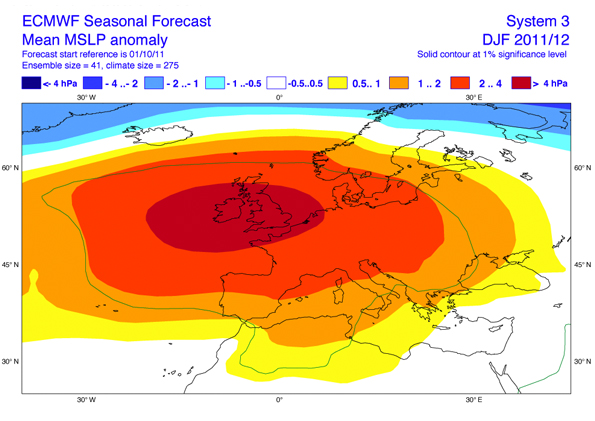
This would be bad news for drought affected eastern England, and could, if correct, lead to serious problems next year.
 Hello, I’m Paul Hudson, weather presenter and climate correspondent for BBC Look North in Yorkshire and Lincolnshire. I've been interested in the weather and climate for as long as I can remember, and worked as a forecaster with the Met Office for more than ten years locally and at the international unit before joining the BBC in October 2007. Here I divide my time between forecasting and reporting on stories about climate change and its implications for people's everyday lives.
Page 1 of 2
Comment number 1.
At 13:53 20th Oct 2011, QuaesoVeritas wrote:No small part of the "hype" over the winter forecast has been coming from the BBC.
I have seen news presenters making comments like "they say it's going to be a cold winter this year", without specifying who "they" are.
It seems that anyone and his dog can now set up a weather forecasting web site, forecast a cold winter, and get it reported in the press, by simply sending out a press release. Then the "fact" is repeated on t.v. simply because it has been in the newspapers, without any verification.
Complain about this comment (Comment number 1)
Comment number 2.
At 14:22 20th Oct 2011, MangoChutney wrote:@Paul Hudson
I think one of the reasons the weather sells newspapers is because there is so much overblown hype coming out of the met office / IPCC / BBC (certain "journalists" anyway)
Read Donna Laframboise's book "The Delinquent Teenager Who Was Mistaken for the World's Top Climate Expert".
Inside Donna explains how the IPCC's Climate Bible is being used to justify everything even the outlandish claims on the weather, but the Climate Bible is far from perfect and she traces the origins of the IPCC, the structure and the Climate Bible, although she doesn't comment on the science claimed to show GW is anthropogenic.
For example, the Climate Bible contains 30% of references to non-peer reviewed work or "grey literature" (5587 out of 18531 references), despite their assurances that the report was 100% peer reviewed and the fact that several "experts" were under 25 and weren't even PhD's (nor MSc's!) when they authored the IPCC's Climate Bible
Complain about this comment (Comment number 2)
Comment number 3.
At 15:06 20th Oct 2011, snowtime wrote:more backtracking again, I am really starting to think that James will be right again, it's like people have been waiting for him to update for the flood gates to open lol. Big problem with Paul Hudsons statement there about Exacta, as they stated October or November in certain parts in an UPDATE https://www.exactaweather.com/UK_Long_Range_Forecast.htmlhttps://www.express.co.uk/posts/view/272457/Britain-faces-an-early-big-freeze, the papers chose to hype this all up, plus there has been moderate snows in Scotland for October, plus October is not over yet, and neither is November!!! the newspaper titles are not what is said on Exacta. so why Paul Hudson chooses to say they was wrong is unbelievable, everything I have read in all Exacta updates and the papers clearly said October or November in certain parts, yet Paul chooses to emphasise on just October, deary me people are running scared of Exacta!
Shame he never posts anything about the MO like this LOL. this is from the actual Met Office site in 2009, it says "The coming summer is 'odds on for a barbecue summer"
https://www.metoffice.gov.uk/news/releases/archive/2009/summer2009
can some one remind me what James Madden forecast for this period and how it compared to this garbage from the MET. They are useless, can't even get the daily weather right, never mind months in advance. Get your PHD bums in order and put some hard work in like Exacta and maybe you might gain some ground with accuracy. Paul never even mentioned the fact that they got summer spot on too and before Piers Corbyn of weather action.
https://www.sundaysun.co.uk/news/north-east-news/2011/04/10/north-east-makes-the-most-of-the-lovely-weather-79310-28487833/
Complain about this comment (Comment number 3)
Comment number 4.
At 15:21 20th Oct 2011, snowtime wrote:Paul Husdon should read this, even though he is already aware!
Subzero Temperatures And Snow Herald Arrival Of Winter In Ireland And UK
Heavy snow showers will continue across the Scottish East and West Highlands during Wednesday. More widespread snow is expected to affect the region for a time on Thursday.
https://www.irishweatheronline.com/news/atmosphere/cold/subzero-temperatures-and-snow-herald-arrival-of-winter-in-ireland-and-uk/42296.html
Let me finally remind you what the Exacta update said
Winter 2011-12 Update
As we head towards winter, I expect to see the first signs of some moderate to heavy snowfalls as early as October or November in certain parts of the UK. In terms of the meteorological winter, I expect December, January, and February to experience below average temperatures, with the heaviest snowfalls occurring within the time frame of November to January across many parts of the UK.
Don't try and manipulate things Paul, it does not suit you fella, unless the authorisation is coming from elsewhere. Sour grapes that a free weather service is making you and your PhD peers look silly!!!
Complain about this comment (Comment number 4)
Comment number 5.
At 15:34 20th Oct 2011, snowtime wrote:This comment was removed because the moderators found it broke the house rules. Explain.
Complain about this comment (Comment number 5)
Comment number 6.
At 15:39 20th Oct 2011, Gadgetfiend wrote:Well said Paul and keep up your excellent, objective and balanced blogs. Looks like you've hit a raw nerve with snowtime!
Complain about this comment (Comment number 6)
Comment number 7.
At 18:01 20th Oct 2011, Paul Briscoe wrote:Mango @ #2
The criticism that IPCC AR4 Working Group II employed non-peer reviewed reports is nothing new. Indeed, it is almost certainly what led to the mistake regarding the Himalayan glaciers. It will be interesting to see how WG II, which is by its very nature more speculative, will be approached in AR5. However, it is important to note that WG I, "The Physical Science Basis" IS based on the peer-reviewed literature, just as it should be.
I can't pretend to have read Donna Framboise's book, but from my own experience I would caution against reading too much into her claims. I had cause to follow up on one of her claims in the past. I found that although the young woman in question had not finished her PhD at the point where she acted as an author for the IPCC (albeit not a main author), it was very clear that she was a high flyer who quickly went on to lead up a science group.
Having studied for a PhD myself, I am very conscious that it is really just a piece of paper - it is the process of working with other professional scientists that makes you good at what you do. You also need to bear in mind that not everyone who goes into scientific research gets the opportunity to register for a higher degree straight away. It is also the case that some people are just naturally better at writing and communicating science than others. Plus, a lot of scientists do some of their most important work and publish major papers BEFORE submitting their thesis.
So my message is that it is wrong to presume that the lack of a PhD means that someone isn't competent enough to contribute to the writing of a scientific report........ especially when they are working as part of a team.
Paul
Complain about this comment (Comment number 7)
Comment number 8.
At 19:13 20th Oct 2011, Martin In Yorkshire wrote:"snowtime" wrote:
"Paul Hudson seems to forget the number of mistakes him, along with the MET, have made in the past."
Paul is only too aware of this *every time* he appears on the TV alongside Christa.
Complain about this comment (Comment number 8)
Comment number 9.
At 20:30 20th Oct 2011, QuaesoVeritas wrote:#7. - Paul Briscoe wrote:
Mango @ #2
"So my message is that it is wrong to presume that the lack of a PhD means that someone isn't competent enough to contribute to the writing of a scientific report........ especially when they are working as part of a team."
And especially if they are pro AGW!
Of course if they were anti AGW, it there would be serious doubts about their competency.
In case anyone is in doubt, I am being ironic!
Complain about this comment (Comment number 9)
Comment number 10.
At 20:44 20th Oct 2011, jkiller56 wrote:Good post PaulH. To blame the MO for the media weather hype is utterly ludicrous.
If they say anything at all it is usually to calm down the wild speculation and attention seeking issued from elsewhere. Lets face it - this extreme "worst ever" weather stuff is a little game that plays out every year between an eager press and self publicising "charlatans" (for want of a better word), who because the MO supports the AGW concensus - are lauded by certain people in the hope that it undermines the credibility of the MO.
To more serious things.
Interesting about the anticyclonic forecast for winter. Anticyclones are fickle things as we all know and a slight shift in position could mean a wind "fetch" of either very mild or very cold direction. So an anticyclonic winter can be a tricky one - except for the probability of dryness. Anyway, no sign yet of this record cold plunge (I'm afraid a bit of snow in the highlands doesn't count).
Glad to see you back Paul - evidently not sacked by the BBC for saying what is supposedly unmentionable -and by the look of it, nor has your brain been replaced by a digital alarm snooze button!
Ah well - another conspiracy theory bites the dust!
Complain about this comment (Comment number 10)
Comment number 11.
At 21:08 20th Oct 2011, Paul Briscoe wrote:QV @ #7
I'm not sure what I did to deserve that response QV!! It was totally uncalled for. It's also a shame if you can't take my considered comments at face value.
Paul
Complain about this comment (Comment number 11)
Comment number 12.
At 21:45 20th Oct 2011, Gadgetfiend wrote:Snowtime:
Are you really expecting people to accept that a forecast which stated cold and snow across parts of the UK in October is a success because of a little bit of white stuff over the tops of the scottish highlands? Tell me when that hasn't happened in October!
To coin a famous phrase, you cannot be serious!
Complain about this comment (Comment number 12)
Comment number 13.
At 22:56 20th Oct 2011, snowtime wrote:At the end of the day James said moderate to heavy snow in certain parts of the UK as early as October or November in an UPDATE! Which is correct!
PLEASE EVERYONE READ THIS AS SOMETHING ODD IS GOING ON!
Now Paul Hudson says in his blog the Icy blast that Exacta Weather forecast?
It just seems a little strange that a MO representative would say this. Especially as the MET and PWS had this to say about this month in a recent Express article from only 5 days back. ARCTIC BLAST TO BRING SNOW
https://www.express.co.uk/posts/view/277583/Arctic-blast-to-bring-snow
Jonathan Powell, senior forecaster at Positive Weather Solutions, said: “Next week we are looking at the first real taste of winter. It is due to cold air being dragged in from the Arctic. We expect widespread frosts and snow in the North which may come down as far as the Midlands.”
He said freezing temperatures on Monday would “fall away sharply” towards the end of the week, plunging to minus 4C (25F) in parts.
“It will get worse and is certainly going to be the coldest spell of the season so far,” he added.
The Met Office said below-average temperatures could last until the end of the month with a second round of snow falling in the North next weekend.
his comments make no sense about Exacta, especially as the MET and PWS said this only 5 days back. The ICY BLAST article did mention James Madden but it said about snow NOV,DEC,JAN and below average temps NOV to FEB.
If you don't believe me check the article from the daily express https://www.express.co.uk/posts/view/277583/Arctic-blast-to-bring-snow
Complain about this comment (Comment number 13)
Comment number 14.
At 23:38 20th Oct 2011, newdwr54 wrote:Surely somebody, sometime, will publish a peer reviewed paper examining the forecast accuracy of all these so-called 'long range weather forecasters'?
I 'project' (though it's not peer reviewed) that they will find a correlation close to *random chance* for the lot of them - including Accuweather (which, suspiciously, usually escapes criticism on this site). The MET office is included in this by the way, for its past failed predictions/projections.
Weather is not climate. The former is chaotic; the latter is (within the bounds of probability) predictable. "Climate is what you expect; weather is what you get." [Attributed to Mark Twain (I think)].
Complain about this comment (Comment number 14)
Comment number 15.
At 02:36 21st Oct 2011, Lazarus wrote:Paul Briscoe wrote:
"I'm not sure what I did to deserve that response QV!!"
Neither am I. What you said about relevant qualifications seemed perfectly valid. Perhaps QV thinks some poorly qualified 'skeptics' should be taken more seriously but if so they failed to give any names so we can't actually determine if they worked with appropriately qualified peers.
I notice the Daily Maul is suggesting another warm spell over the half term holiday;
https://www.dailymail.co.uk/news/article-2051377/UK-traffic-trouble-expected-half-term-break-begins.html
And off topic, but Mango has already started that; I see that Richard Muller has released more information about the The Berkeley Earth project about which he says;
"My hope is that this will win over those people who are properly sceptical. Some people lump the properly sceptical in with the deniers and that makes it easy to dismiss them, because the deniers pay no attention to science. But there have been people out there who have raised legitimate issues."
https://www.guardian.co.uk/environment/2011/oct/20/global-warming-study-climate-sceptics
I suspect his deniers will say something like they now accept there is global warming but not what the scientists say is the cause.
Complain about this comment (Comment number 15)
Comment number 16.
At 08:16 21st Oct 2011, Harry Hardy wrote:Nicely done, Paul. Very well said. You should take a look at these on the same sort of subject; the first about this plethora of unverified winter forecasts, the second written following PWS's bust of a record-breaking summer forecast in 2010.
https://theophrastus.wordpress.com/2011/09/25/white-coats-and-white-winters/
https://theophrastus.wordpress.com/2010/08/17/stop-me-and-buy-one/
Complain about this comment (Comment number 16)
Comment number 17.
At 08:24 21st Oct 2011, Harry Hardy wrote:@snowtime
James, snow showers over high ground in Scotland and the far north of England and frost elsewhere for two or three days - that's typical weather for mid October, it's not the start of winter which is what your forecast was implying.
I'll forecast for October next year: October 2012 will see temperatures falling as autumn takes hold, with a chance of snow and frost in certain parts of the UK, the snow more likely to fall on high ground in the north.
You can apply that generic outlook to October 2013, October 2014, October 2015 etc if you like. It happens pretty much every year; it's climate, it's not a forecast with any skill whatsoever.
Apart from this chilly two to three days have you not noticed how warm October has been on average?
Complain about this comment (Comment number 17)
Comment number 18.
At 08:30 21st Oct 2011, MangoChutney wrote:@Paul Briscoe #7
Donna Lamframboise's "The Delinquent Teenager" does not examine the science behind the climate bible, just the process and the politics. We both know, however, that some of the work presented as "peer-reviewed" literature simply wasn't peer-reviewed by anybody and should have been corrected labeled as "grey" and some of the work was published after the IPCC's own cut off date - in some circumstances, after AR4 itself was published. We also know Susan Solomon co-chair of WG1 refused to let invited expert reviewers view the data behind the literature, so to say that "However, it is important to note that WG I, "The Physical Science Basis" IS based on the peer-reviewed literature, just as it should be.", doesn't tell the full story.
I'm pleased you have said you haven't read the book - please do, if only to see for yourself the machinations behind the headlines of the IPCC.
With regards to qualifications, I agree with you - they matter less than ability. I'm sure you are aware that lead authors write a significant amount of text, but do you really think that, for example, Richard Klein (in 1992 Klein was 23) completed a Masters degree, and worked as a Greenpeace campaigner and then 2 years later, at the age of 25, was an IPCC lead author? He didn't even receive his PhD until 2003. How on earth does that make him one of the IPCC's world experts at 25? Were there no other world experts in the field of geology (his MSc subject)
(I don't think QV was trying to obnoxious, Paul)
@Lazarus #15
First of all, I certainly didn't have you down as a Daily Mail ready!
Secondly, I wasn't off topic, I was talking about why the weather sells newspapers, which is helped by the media every time somebody mentions climate, the IPCC or the Met Office
Thirdly, "his deniers" lol, you're unintentionally funny, but getting to your point.
If you track back through my comments, I have always said the world is warming according to the record and I have also said the claim for CO2 induced catastrophic warming has not been made since there are too many unknowns and sensitivity in empirical studies is low. I've been saying the same thing, as I think you well know, ever since I contributed to Richard Blacks blog many moons ago.
With regards to Richard Muller, do you think his publicity stunt is a little premature, since the paper hasn't been peer reviewed yet? Do you think asking Anthony Watts to keep the paper under wraps and then sending copies to the media was a little off? Do you think Anthony Watts complying with Richard Mullers request, despite being asked for comments by the media, is admirable?
https://wattsupwiththat.com/2011/10/20/the-berkeley-earth-surface-temperature-project-puts-pr-before-peer-review/
There is no doubt, the world is warming, it's the reasons for the warming that are open for debate and there is no compelling evidence to show it's CO2 wot dunnit.
Even Al Gore had to cheat to "prove" it was CO2:
https://wattsupwiththat.com/2011/10/18/replicating-al-gores-climate-101-video-experiment-shows-that-his-high-school-physics-could-never-work-as-advertised/
/Mango
Complain about this comment (Comment number 18)
Comment number 19.
At 10:07 21st Oct 2011, QuaesoVeritas wrote:A few days ago, I posted that the NCDC/NOAA anomaly figure for September was 0.53c and the NH anomaly figure was 0.60c. Those figures were based on the September Global State of the Climate Report, but now that the data files have been updated, it appears that the actual global figure was 0.5242c and the NH figure was 0.5917c, both of which differ from the report figures, after rounding to two decimals. The final SH anomaly figure quoted in the files is 0.4602c, compared to the figure of 0.46c quoted in the report.
It is also worth noting that the global anomaly figure for August was revised downwards from 0.5512c to 0.5351c, although monthly figures for earlier in the year were generally revised upwards.
Complain about this comment (Comment number 19)
Comment number 20.
At 10:15 21st Oct 2011, QuaesoVeritas wrote:#11. - Paul Briscoe wrote:
"I'm not sure what I did to deserve that response QV!! It was totally uncalled for. It's also a shame if you can't take my considered comments at face value."
Sorry Paul, I didn't intend my comments to disparage you personally, simply pointing out that it is necessary to be consistent.
Complain about this comment (Comment number 20)
Comment number 21.
At 10:59 21st Oct 2011, RobWansbeck wrote:@14, newdwr54 wrote:
“ Surely somebody, sometime, will publish a peer reviewed paper examining the forecast accuracy of all these so-called 'long range weather forecasters'? “
It's a pdf so I can't link but google 'Can We Trust Long-Range Weather Forecasts? Pascal J. Mailer'
There are some interesting graphs of performance v time and long range NAO prediction statistics.
Complain about this comment (Comment number 21)
Comment number 22.
At 11:05 21st Oct 2011, RobWansbeck wrote:Personally, I have no fundamental objection to the use of grey literature by the IPCC if it provides useful information since all material is reviewed ( or at least should be ) by experts prior to its inclusion in an IPCC report.
The Himalayan Glacier claim was reviewed by experts and at least three of these expert reviewers pointed out the obvious flaws. Even Georg Kaser, a glacier expert and himself an IPCC lead author of a different chapter, pointed out the error.
This is where the problems start. It is not the use of grey literature but the total failure of some IPCC appointed authors to acknowledge the concerns of expert reviewers.
The glacier claim WAS reviewed by experts. The experts said it was not accurate. The IPCC published it anyway. This was not a mistake but a deliberate act.
Complain about this comment (Comment number 22)
Comment number 23.
At 11:33 21st Oct 2011, John Marshall wrote:La Nina is deepening which gives NW Europe cold winters. Nuuk, Greenland, average temperatures have been slowly falling for 80 years.
I leave you to resolve these facts with the forecasts Paul.
Complain about this comment (Comment number 23)
Comment number 24.
At 12:01 21st Oct 2011, Harry Hardy wrote:@John Marshall #23
"La Nina is deepening which gives NW Europe cold winters." No it doesn't. Other factors might but La Niña doesn't. Mr Hudson states that "on the balance of probabilities a colder than average winter is the most likely scenario."
"Nuuk, Greenland, average temperatures have been slowly falling for 80 years." a) How is that relevant to a winter forecast for the UK, and b) could you direct us to the data, please?
Complain about this comment (Comment number 24)
Comment number 25.
At 12:04 21st Oct 2011, ukpahonta wrote:I've seen this mentioned before about not being able to link to .pdf files
https://www.climate-development.org/atroccoli/nato_arw/arw_book/CH16_NATO_ARW_BOOK.pdf
Is there a problem that I haven't found?
Complain about this comment (Comment number 25)
Comment number 26.
At 12:27 21st Oct 2011, greensand wrote:QuaesoVeritas
On a previous thread you quoted the HadSST2 number for Sept 11. Did you get the data from Met Office/Hadley Centre or CRU?
The CRU data, my usual source has been removed:-
https://www.cru.uea.ac.uk/cru/data/temperature/
TIA
Complain about this comment (Comment number 26)
Comment number 27.
At 13:20 21st Oct 2011, Lazarus wrote:Mango @ #18
“First of all, I certainly didn't have you down as a Daily Mail ready!”
You obviously haven’t seen my own blog;
https://lazarus-on.blogspot.com/
“Secondly, I wasn't off topic,”
I’m not really bothered if you were or were not. But the IPCC don’t do weather forecasting.
“I have always said the world is warming according to the record and I have also said the claim for CO2 induced catastrophic warming has not been made since there are too many unknowns and sensitivity in empirical studies is low.”
Which really proves my point. Most ‘skeptics’ have already adopted this position ahead of this if it does becomes a game changer.
But your claims of too many variables is really just an argument from incredulity. Scientists admit the uncertainties but they are not likely to completely overturn the science.
“With regards to Richard Muller, do you think his publicity stunt is a little premature, since the paper hasn't been peer reviewed yet.”
The article I linked criticised the unorthodox method Muller’s group has taken to ‘get much more feedback from making these papers public before publication.’
But unless there are some very serious errors of method (and now there are so many more people, including genuine sceptics that can look for them), the conclusions will be relatively unchanged.
Complain about this comment (Comment number 27)
Comment number 28.
At 13:27 21st Oct 2011, ukpahonta wrote:I suspect that various factions of the media will now be game for a good old fashioned dust up.
https://www.bishop-hill.net/blog/2011/10/21/keenans-response-to-the-best-paper.html"
Complain about this comment (Comment number 28)
Comment number 29.
At 13:53 21st Oct 2011, Adrian Buckland wrote:Sorry to harp on but one of the considerations must be the current low state of
the Arctic which I alluded to was possibly/probably a factor in the early October heatwave. wow so we've had a frost on October 18th. So what? I can remember when we had frost in late September/early October in the 70s/earlyto mid 80s.
It would be interesting to see if there was a correlation between minimum Arctic ice cover and the date of the first autumn frost. I suspect it's quite strong. If we assume that the difference in 2007 and 2011 ice cover is negligible then the winter will be pretty mild. Of course I concede it's never that straightforward as for example early October 2007 didnt have a heatwave. But of course the point I make is if the Arctic ice trend continues ...
Complain about this comment (Comment number 29)
Comment number 30.
At 16:15 21st Oct 2011, LabMunkey wrote:@Paul #7.
I'd suggest you read the book Paul, it does seem to be very relevant.
On your point of qualifications, i agree wholeheartedly. I've eventually decided to do a PhD (ten+ years late lol) and i'm only doing it because its a subject that interests me, the qualification itself doesn't actually mean that much (helps on the old CV mind you!).
What's your thoughts, not on the BEST data or the report (though once the UHI ones out i'd be interested in hashing it our with you), but on how it's been presented- pre-pre review?
Complain about this comment (Comment number 30)
Comment number 31.
At 16:55 21st Oct 2011, jkiller56 wrote:To Harry Hardy #16
Excellent links about the weather charlatans - my own thoughts exactly (see above # 10). The tabloids really love it of course.
Notice, also, how they often use it to have a go at local authorities (that poor beast tethered by chains of responsibility and care they always enjoy letting their bating dogs have a go at) - making sure that they have definitely ordered enough salt to cover the worst concievable outcome of whatever fantastic forecast they have been fed by our stated one man weather "expert".
I am only waiting for the day when some story about "profligate waste" spent on unused salt following some future mild winter bursts forth.
Mark my words - it will happen!
Complain about this comment (Comment number 31)
Comment number 32.
At 17:12 21st Oct 2011, Paul Briscoe wrote:Mango @ #18
"Donna Lamframboise's "The Delinquent Teenager" does not examine the science behind the climate bible, just the process and the politics."
Yes, I'd gathered that.
"We both know, however, that some of the work presented as "peer-reviewed" literature simply wasn't peer-reviewed by anybody and should have been corrected labeled as "grey"...... "
Contrary to the impression given by Ms Framboise, the IPCC guidelines do specifically state that non-peer-reviewed reports can be used:
"Some important information appears not in scientific journals but rather in reports from governmental and non-governmental organizations. For the IPCC to fulfill its comprehensive assessment mandate, it needs to assess the information in these reports."
In other words, there's nothing wrong with using "gray" material as long as it is properly assessed (clearly, the checks were not adequate for parts of WG II!). So I don't think you're correct to suggest that gray literature was presented as peer-reviewed. The reference section made the individual literature sources perfectly clear.
"and some of the work was published after the IPCC's own cut off date - in some circumstances, after AR4 itself was published."
That's true, but even peer-reviewed papers often cite papers which are "in press". As a general rule, this is deemed acceptable as long as the paper has been accepted for publication (ie. passed the peer-review process) before publication of the document which cites it. Clearly, in the case of the IPCC reports, which only come along infrequently, there is extra pressure to get the most up-to-date papers included so that the reports don't become out of date as quickly.
"We also know Susan Solomon co-chair of WG1 refused to let invited expert reviewers view the data behind the literature...."
I'm presuming that you are referring to this:
https://climateaudit.org/2007/03/28/accessing-hegerl-data/
Having now read this in some detail, IMHO Susan Solomon's final response to Steve McIntyre was unambiguous and entirely reasonable. The IPCC does not "own" the data pertaining to any of the papers it cites - indeed, there is no reason to think that the IPCC would even have access to the raw data itself. All the IPCC does is pull the findings of all the literature together into a coherent report. So if an individual reviewer wants to check data from one of the papers cited, it is for him/her to approach the authors.
Paul
Complain about this comment (Comment number 32)
Comment number 33.
At 19:27 21st Oct 2011, LabMunkey wrote:@ paul #32
Sorry mate, i have to pick you up on this:
"indeed, there is no reason to think that the IPCC would even have access to the raw data itself."
Really?? Would you go so far as to say they never looked at it? Checked it? Verified it as well?
I despair.
Complain about this comment (Comment number 33)
Comment number 34.
At 19:44 21st Oct 2011, Paul Briscoe wrote:Sorry everyone. I don't have a lot of time as it's half-term and we're going away for a few days. Consequently, I'm not in a position to respond to every point in detail.
I will cover what I can!
Paul
Complain about this comment (Comment number 34)
Comment number 35.
At 20:19 21st Oct 2011, Paul Briscoe wrote:LabMunkey @ #33
For someone who is about to embark on a PhD (I wish you good luck with that, by the way) you show a poor grasp of the way scientific research actually works (well the branches of science I'm familiar with, anyway). I posted this on the last thread, but I'll post it again here just so that people understand:
https://www.youtube.com/watch?v=EV1SqGINnP8&feature=channel_video_title
"Really?? Would you go so far as to say they never looked at it? Checked it? Verified it as well?"
I would say it is VERY UNLIKELY that the IPCC authors, let alone the IPCC itself, would check the raw data from any particular paper unless they were to present it in a different way in conjunction with data from other studies. Apart from anything else, they simply wouldn't have the TIME to verify the data of every paper used. Furthermore, it is the responsibility of the scientific community, NOT the IPCC, to determine whether a particular paper is reliable or not. This happens through peer-review, further assessment over time by the community as a whole and comparison with the findings of other similar studies.
I appreciate that sceptics attach huge importance to checking raw data, but that has never been the priority of the scientific community. Why? First of all, checking data often won't reveal if it has been "fudged". Second, peer-review will reveal most serious problems. Ultimately, though, the only reliable way of checking the findings of a particular study is to reproduce the results for yourself. This is why having 3 separate surface temperature datasets AND two satellite series is so important - it is all about REPRODUCIBILITY.
I'm sorry if that's not good enough for you, but it IS the way science operates and it HAS delivered pretty well every major scientific advance.
Paul
Complain about this comment (Comment number 35)
Comment number 36.
At 20:32 21st Oct 2011, QuaesoVeritas wrote:#26. - greensand wrote:
"On a previous thread you quoted the HadSST2 number for Sept 11. Did you get the data from Met Office/Hadley Centre or CRU?
The CRU data, my usual source has been removed:-"
I obtained the data from the Met. Office web site. I normally do that because the figures are usually available sooner than on the CRU site.
I became aware that the link on CRU site was no longer there as a result of a newsletter from "Climate4you", in which the September figure hadn't been updated.
Finding the data on the M.O. website is somewhat complicated (you would almost think they didn't want anyone to see it), but here is a link to the relevant page:
https://www.metoffice.gov.uk/hadobs/index.html
Cllick on the HadSST2 link at the left, and on the "various diagnostics" link at the bottom. Then click on the "Mean of northern and southern hemisphere averages" link (or the individual NH and SH links), then on the next page, scroll down to the data file link under the monthly graph, and your there!
I have e-mailed the CRU to ask why their link to the monthly data isn't there, but I haven't yet had a reply. Maybe you could do that too.
Complain about this comment (Comment number 36)
Comment number 37.
At 20:58 21st Oct 2011, jazznick wrote:35.
Well replied Paul, I was about to defend you in your absence !
However, Susan Solomon's reply does say that "All the IPCC does is pull the findings of all the literature together into a coherent report" .
This is clearly NOT what they do.
They summarise all pro AGW literature and are not too fussy where it comes from.
Their creation by the UN was based on a search for 'proof of man made global warming' - NOT to get to the truth of the science of matter, so let's not get too defensive of their operation.
The hockeystick 'gatekeepers' ensure nothing remotely 'challenging' gets past pal-review so all we see is warmist output.
They have shown that they are blatantly incapable of quite simple 'due diligence' as other pressures seem to take priority
such as upcoming reports, conferences and MSM opportunities.
All this helps to feed the coffers and ensures that lobbyists from WWF and Greenpeace can keep up pressure on governments to maintain funding the Green mirage.
Complain about this comment (Comment number 37)
Comment number 38.
At 22:04 21st Oct 2011, greensand wrote:36. QuaesoVeritas
Many thanks QV, I had managed to access the MO data until about a year ago when they started to move things about and it truly was a maze and I lost the will. So the CRU site became my source.
Many thanks for the MO "route map" I am in again and booked marked. Will email CRU as per your suggestion and post if I get anything.
I am trying to get a handle on the make up of HadCRUT3 via CRUTEM NH & SH + HadSST2 NH + SH. It is especially of interest following the BEST claims that the AMO is more relevant to global temps than ENSO. But there is a long way to go with BEST, the jury will be out for a long time - UHI is negative??
Thanks again.
Complain about this comment (Comment number 38)
Comment number 39.
At 22:14 21st Oct 2011, Paul Briscoe wrote:jazznick @ #37
Just to clarify, "All the IPCC does is pull the findings of all the literature together into a coherent report" was my observation, not Susan Solomon's.
You are, of course, entitled to your views regarding the IPCC, although I think you'll find that papers putting forwards sceptical viewpoints are also cited together with the reasons why most scientists do not agree with their findings.
"The hockeystick 'gatekeepers' ensure nothing remotely 'challenging' gets past pal-review so all we see is warmist output."
Well that was one of the accusations following on from the Climategate emails......... the problem was that the papers in question DID get through peer-review and WERE discussed in IPCC AR4. I don't have time to go into any more detail on this just now, so I guess that we'll have to agree to differ.
Paul
Complain about this comment (Comment number 39)
Comment number 40.
At 22:18 21st Oct 2011, Paul Briscoe wrote:QV @ #20
"Sorry Paul, I didn't intend my comments to disparage you personally, simply pointing out that it is necessary to be consistent."
No problem....... although, for the record, I have no problem with even totally unqualified people writing about science as long as their output accurately reflects the scientific literature.
Paul
Complain about this comment (Comment number 40)
Comment number 41.
At 00:32 22nd Oct 2011, QuaesoVeritas wrote:#38. - greensand wrote:
"Many thanks QV, I had managed to access the MO data until about a year ago when they started to move things about and it truly was a maze and I lost the will. So the CRU site became my source."
Yes, after they "improved" the site, I found that most of the data are more difficult to locate.
"I am trying to get a handle on the make up of HadCRUT3 via CRUTEM NH & SH + HadSST2 NH + SH. It is especially of interest following the BEST claims that the AMO is more relevant to global temps than ENSO. But there is a long way to go with BEST, the jury will be out for a long time - UHI is negative??"
I haven't had a chance to look at the BEST papers myself but if one of the findings was that the effect of UHI is negative, that surely suggests that something is wrong. We all know from experience that cities are warmer than the countryside (at least the BBC weather forecasters keep telling us that. I suppose it may be that the trend is lower in urban areas than in the countryside, but that in itself may be an effect of overspill from the urban areas into the countryside.
I don't know how reliable it is, but according to David Whitehouse of the GWPF, (admittedly a "sceptic" source), one of the papers states that "the human component of global warming may be somewhat overstated":
https://thegwpf.org/the-observatory/4161-sceptical-berkeley-scientists-say-human-component-of-global-warming-may-be-somewhat-overstated.html
Complain about this comment (Comment number 41)
Comment number 42.
At 02:15 22nd Oct 2011, RobWansbeck wrote:@41, QuaesoVeritas wrote:
“ … I don't know how reliable it is, but according to David Whitehouse of the GWPF, (admittedly a "sceptic" source), one of the papers states that "the human component of global warming may be somewhat overstated". … “
That quote is accurate and, on the subject of media hype, something that Richard Black appears to have missed in his assessment.
It will be interesting to see if that statement survives 'peer review'.
Even though it has not yet been 'peer reviewed', according to the press release it 'will form part of the literature for the next IPCC report on climate change'.
Some discussion here:
https://wattsupwiththat.com/2011/10/21/best-what-i-agree-with-and-what-i-disagree-with-plus-a-call-for-additional-transparency-to-preven-pal-review/
Complain about this comment (Comment number 42)
Comment number 43.
At 02:26 22nd Oct 2011, RobWansbeck wrote:@25, ukpahonta wrote:
“ I've seen this mentioned before about not being able to link to .pdf files
… Is there a problem that I haven't found? “
It may be that this blog is reactively-moderated so no one sees the pdf link or there may have been a change in policy.
On moderated blogs pdf links have been removed as 'broken/unsuitable'. There seems to have been some objection to pdfs requiring third-party software so the BBC wouldn't use them.
Perhaps someone knows the full story?
Complain about this comment (Comment number 43)
Comment number 44.
At 02:44 22nd Oct 2011, RobWansbeck wrote:I see that Richard Black has put up a new post, on his blog this time, where he down-plays the suggestion that 'the human component of global warming may be somewhat overstated'.
Sadly he is still reporting that 'Climategate was about CRU temperature data.
It was not. Climategate was about paleoclimate reconstructions.
Complain about this comment (Comment number 44)
Comment number 45.
At 08:40 22nd Oct 2011, ukpahonta wrote:#43 RobWansbeck
I'm still confused, my #25 comment contains a link to a .pdf file, if I click on the link I go to the .pdf web page without any problem.
Are you saying that this doesn't work for you?
Complain about this comment (Comment number 45)
Comment number 46.
At 09:28 22nd Oct 2011, lateintheday wrote:pdf link worked for me.
Complain about this comment (Comment number 46)
Comment number 47.
At 09:39 22nd Oct 2011, ukpahonta wrote:#42 RobWansbeck
Which really makes you wonder why an environmental correspondence would downplay the result of a scientific paper before the paper has been peer reviewed. Surely an independent assesment would have been that this result is potentially huge and we await to see the outcome of review.
Do you have a link to his latest?
Complain about this comment (Comment number 47)
Comment number 48.
At 11:23 22nd Oct 2011, Adrian Buckland wrote:I think all of you should read this
https://www.bbc.co.uk/news/science-environment-15373071
Note that the study even received funds from parties lobbying against
global warming. The debate is well and truly over and the time for action
is now and urgent. Again I repeat look what's happening in the Arctic I think it's going to be a very significant driver for major change in the near future. There are also concerning signs that the oceans are now starting to depart from what we would regard as the norm.
Complain about this comment (Comment number 48)
Comment number 49.
At 14:00 22nd Oct 2011, ukpahonta wrote:#48
Already read, your statement about the debate is just so wrong:
"Science is best done when the problems with the analysis are candidly shared."
"They are asking for comments and feedback before preparing the manuscripts for formal scientific publication."
"That is the way I practised science for decades; it was the way everyone practised it until some magazines - particularly Science and Nature - forbade it," he said.
"That was not a good change, and still many fields such as string theory practice the traditional method wholeheartedly."
This open "wiki" method of review is regularly employed in physics, the home field for seven of the 10 Berkeley team.
Check out the blogs, you'll see.
Complain about this comment (Comment number 49)
Comment number 50.
At 14:07 22nd Oct 2011, RobWansbeck wrote:@45, ukpahonta re pdfs:
It is not that pdf links don't work but that they are, or were, removed by moderators before the post was published. All the reader would see was 'broken/unsuitable link removed by moderator' so there would be no link to click on.
Since this blog is not moderated prior to comments being published the pdf links get through but, if the policy still remains, a moderator may remove them in the future although I doubt if they will look at the comments unless they receive complaints so it seems posting links to pdfs should be OK.
Richard Black's latest post is here:
https://www.bbc.co.uk/news/science-environment-15400748
Complain about this comment (Comment number 50)
Comment number 51.
At 16:28 22nd Oct 2011, newdwr54 wrote:44. RobWansbeck wrote:
"Climategate was about paleoclimate reconstructions."
While that may be true, it is certainly not the perception that various 'sceptic' organisations have encouraged about 'climategate' in the popular media and therefore among the public.
If you ask a 'common or garden' sceptic what 'climategate' was about, they'll most likely tell you that it was about data manipulation designed to make current temperatures appear warmer than they actually are. In other words it was all about the public perception of the integrity of the surface station data as currently published. At least that is the impression I get from casual conversation and from viewing ill-informed comments on public blog discussions, etc.
The BEST study will hopefully restore some much-needed public confidence in the accuracy of the temperature record.
Complain about this comment (Comment number 51)
Comment number 52.
At 17:34 22nd Oct 2011, RobWansbeck wrote:@51, newdwr54 re the meaning of Climategate,
I agree that there has been much confusion about the subject of the CRU emails and it is sad to see from some of the comments on Richard Black's blog that this confusion still exists on both sides of the debate.
What is even sadder is the fact that a BBC journalist given the opportunity to clarify matters instead perpetuates the misunderstanding.
This was compounded by the fact that a BBC link to Richard Black's first article showed a paleoclimate reconstruction though I doubt if RB was involved with this.
Complain about this comment (Comment number 52)
Comment number 53.
At 18:01 22nd Oct 2011, lateintheday wrote:Adrian Buckland said . .
"The debate is well and truly over and the time for action is now and urgent."
Really, who won?
There has been a spate of 'now and urgent' postings around of late. There are two ways of looking at this. Taken at face value, AGW has truly reached the precipice and any delay in action will have devastating consequences. Or alternatively, one might think, rush the baseless green policies through now and make a run for it.
At the moment, I lean towards this alternative view - sorry about that.
Complain about this comment (Comment number 53)
Comment number 54.
At 20:40 22nd Oct 2011, john_cogger wrote:The GWPF 'quote' is not a quote from a scientist at all. Its a cherry pick of half a sentence from the documents, with no context.
“Given that the 2-15 year variations in world temperature are so closely linked to the AMO raises (or re-raises) an important ancillary issue: to what extent does the 65-70 year cycle in AMO contribute to the global average temperature change? (Enfield, 2006; Zhang et al., 2007; Kerr, 1984.)
Since 1975, the AMO has shown a gradual but steady rise from -0.35 C to +0.2 C (see Figure 2), a change of 0.55 C. During this same time, the land-average temperature has increased about 0.8 C. Such changes may be independent responses to a common forcing (e.g. greenhouse gases); however, it is also possible that some of the land warming is a direct response to changes in the AMO region. If the long-term AMO changes have been driven by greenhouse gases then the AMO region may serve as a positive feedback that amplifies the effect of greenhouse gas forcing over land. On the other hand, some of the long-term change in the AMO could be driven by natural variability, e.g. fluctuations in thermohaline flow. In that case the human component of global warming may be somewhat overestimated“
So only in the context of a certain scenario does the quote accurately work. However, feel free to use it out of context. The paper seems to of hit many a raw nerve. Another one joins the team and the conspiracy.
Complain about this comment (Comment number 54)
Comment number 55.
At 21:47 22nd Oct 2011, LabMunkey wrote:Paul @ #35
I can only summise that we have worked in two very different fields of science, as i can catagorically state that form my experience- you're wrong.
I had a long detailed post, pointing out the errors and assumptions you made- using my experience of the pharmaceutical industry to illustrate my points, but then relasied it'd be a waste of time.
Never mind, forget i said anything. I'm just glad i don't work in your lab.
Complain about this comment (Comment number 55)
Comment number 56.
At 20:59 23rd Oct 2011, NeilHamp wrote:John No.54
The GWPF article was written by David Whitehouse who used to be the BBC Science correspondent. He certainly is a scientist. He did not "cherry pick" the quote and gave a realonable summary of the resrvation. See below
The researchers find a strong correlation between North Atlantic temperature cycles lasting decades, and the global land surface temperature. They admit that the influence in recent decades of oceanic temperature cycles has been unappreciated and may explain most, if not all, of the global warming that has taken place, stating the possibility that the “human component of global warming may be somewhat overestimated.”
Complain about this comment (Comment number 56)
Comment number 57.
At 06:49 24th Oct 2011, ukpahonta wrote:#56 NeilHamp
What an excellent good news story that would make in these troubled times. It's a wonder that non of the science jounalists have scooped that. There couldn't be any reason for an outlet like the BBC not to grab that headline as Richard Black is already stating how wonderfull the work is, so it must be in the 'majority' view point on the topic.
It would be the perfect end piece for a news slot. All the bad news about Europe and the recession, ending with "And now for some good news, scientists have found that the human component of global warming may be somewhat overestimated. This evidence does not change the fact that the world has warmed over the modern era, just that the increase thought to be attributable to man has reduced thus making the warming more natural."
Wouldn't that make the country just feel better?
Complain about this comment (Comment number 57)
Comment number 58.
At 11:15 24th Oct 2011, newdwr54 wrote:56. NeilHamp wrote:
(Quoting David Whitehouse) "They admit that the influence in recent decades of oceanic temperature cycles has been unappreciated and may explain most, if not all, of the global warming that has taken place..."
The BEST team said nothing of the sort. The paragraph from which Whitehouse lifts his quotation reads as follows:
______________________
"Given that the 2‐15 year variations in world temperature are so closely linked to the AMO raises (or re-raises) an important ancillary issue: to what extent does the 65--‐70 year cycle in AMO contribute to the global average temperature change?... Since 1975, the AMO has shown a gradual but steady rise from --‐0.35C to +0.2C..., a change of 0.55C.
During this same time, the land‐average temperature has increased about 0.8C. Such changes may be independent responses to a common forcing (e.g. greenhouse gases); however, it is also possible that some of the land warming is a direct response to changes in the AMO region.
If the long‐term AMO changes have been driven by greenhouse gases then the AMO region may serve as a positive feedback that amplifies the effect of greenhouse gas forcing over land. On the other hand, some of the long‐term change in the AMO could be driven by natural variability, e.g. fluctuations in thermohaline flow.
In that case the human component of global warming may be somewhat overestimated."
______________________________
In other words they say AMO "may" have an effect on land temperature rise, but then again this may be because greenhouse gases have warmed the AMO. There might also be "some" natural variability in the long term AMO that causes temperature rise, and if so, then obviously greenhouse gases aren't to blame for all of it. And that's it. That's *all* they say.
From that, Whitehouse has decided that the BEST team claim ocean cycles are responsible for "most, if not all, of the global warming that has taken place" in recent decades.
That's just spin.
Complain about this comment (Comment number 58)
Comment number 59.
At 12:55 24th Oct 2011, Sheffield_city wrote:I hate to say this, but the Hype is coming from the Global warming by man club and all their hot air. We will have 30/40 winters like last year, it is a natural cycle controlled by nature.
Complain about this comment (Comment number 59)
Comment number 60.
At 17:01 24th Oct 2011, ukpahonta wrote:#58 newdwr54
Isn't the AMO already detrended to remove the linear GHG component, are they not refering to long term non-linear influence of GHG?
It does get confusing.
Complain about this comment (Comment number 60)
Comment number 61.
At 17:38 24th Oct 2011, newdwr54 wrote:60. ukpahonta:
I'm not sure about that, to be honest.
My interpretation is that the BEST team were simply discussing two possibilities that might explain the apparent impact of AMO on land temperatures:
i) AMO may be gaining heat from the atmosphere due to greenhouse gases and passing this heat on to the land surface. In this possibility, AMO is acting as a positive 'feedback' in man-made global warming, amplifying terrestrial temperatures
ii) AMO may be generating "some" extra heat naturally (they suggest via thermohaline circulation as a possible method for this, but give no details). In this possibility, since not all the observed warming since 1950 would be man-made, man's impact would have been 'overestimated'.
But it's all very speculative and they do not draw any conclusions or favour one idea over the other in their paper. What BEST certainly are *not* saying is, to paraphrase David Whitehouse, that 'most, if not all, of the global warming observed in recent decades may be due to ocean cycles'. That's just a preposterous interpretation, in my view.
Complain about this comment (Comment number 61)
Comment number 62.
At 21:29 24th Oct 2011, greensand wrote:What is the AMO?
The AMO is an ongoing series of long-duration changes in the sea surface temperature of the North Atlantic Ocean, with cool and warm phases that may last for 20-40 years at a time and a difference of about 1°F between extremes. These changes are natural and have been occurring for at least the last 1,000 years.
Is the AMO a natural phenomenon, or is it related to global warming?
Instruments have observed AMO cycles only for the last 150 years, not long enough to conclusively answer this question. However, studies of paleoclimate proxies, such as tree rings and ice cores, have shown that oscillations similar to those observed instrumentally have been occurring for at least the last millennium. This is clearly longer than modern man has been affecting climate, so the AMO is probably a natural climate oscillation. In the 20th century, the climate swings of the AMO have alternately camouflaged and exaggerated the effects of global warming, and made attribution of global warming more difficult to ascertain.
https://www.aoml.noaa.gov/phod/amo_faq.php
I think what we are trying to get at is does the AMO induced changes in Atlantic SST transfer into increased NH land temps.
An interesting aspect of NH temps - HadCRUT3 via CRUTEM3 & HadSST2 (not got to BEST yet) is that NH CRUTEM3 has been making an increasing contribution to NH HadCRUT3 over the length of the series 1850 to date. It “eyeballs” at about 0.2C.
The same is not the case in SH, where the contribution of land and sea appears to be level.
No answers only questions.
Complain about this comment (Comment number 62)
Comment number 63.
At 06:26 25th Oct 2011, ukpahonta wrote:If we now revisit the BEST statement:
'Given that the 2‐15 year variations in world temperature are so closely linked to the AMO raises'
So they know that there is short term relationship.
'an important ancillary issue: to what extent does the 65--‐70 year cycle in AMO contribute to the global average temperature change?'
But are unsure what the long term relationship is.
'If the long‐term AMO changes have been driven by greenhouse gases then the AMO region may serve as a positive feedback that amplifies the effect of greenhouse gas forcing over land.'
Beacause the AMO is basically SST with the linear GHG trend removed it is more representative of the natural cycle but may still contain some component of GHG energy that is non-linear, or more natural.
'On the other hand, some of the long‐term change in the AMO could be driven by natural variability, e.g. fluctuations in thermohaline flow.
In that case the human component of global warming may be somewhat overestimated.'
Conclusion, this needs to be investigated further to attach a value to it.
Complain about this comment (Comment number 63)
Comment number 64.
At 07:04 25th Oct 2011, newdwr54 wrote:63. ukpahonta:
That's what I take out of it too. The BEST study certainly does not say, as the GWPF have attempted to claim, that natural ocean cycles are responsible for "most if not all" of the global warming seen in recent decades.
Complain about this comment (Comment number 64)
Comment number 65.
At 08:51 25th Oct 2011, ukpahonta wrote:#64 newdwr54
I couldn't even say that.
Extrapulate that thinking a little bit further and I will explain what I mean.
0.55C temp rise attributable to AMO, which has the linear GHG characteristic removed.
Lets look at CO2 as the 'major' GHG.
The current thinking, graphically, is that the level of CO2 in the atmosphere was a constant level aprox 290 ppm and stable. Along came man and the level has increased in a linear fashion, minor variability, up to current levels.
BEST are saying that if that attribution of CO2 is correct over the last 150 years then the influence on the 0.55C is small, if that attribution is more non-linear then the influence is greater but then graphically there has to be a greater variability in the CO2 measurements and it undermines the stable 290 ppm.
Look at it as if we are currently measuring, the last 150 years, a part of a cycle at such a minute level that the graph is linear.
What the GWPF are stating is that either mans contribution to the CO2 level lowers if the graph is more non-linear, because mans contribution is mostly linear, or the 0.55C attributable to 'mostly' natural causes is more influential in the land surface temperature increase of 0.8C and is under accounted for.
So personally I can't say that the GWPF statement is wrong, I can't say that it is correct either, but I can say that it is possible from the BEST statement.
This is where uncertainty comes in and I will leave that to others of a more academic nature that I.
Complain about this comment (Comment number 65)
Comment number 66.
At 13:56 25th Oct 2011, newdwr54 wrote:65. ukpahonta wrote:
"0.55C temp rise attributable to AMO, which has the linear GHG characteristic removed."
I may be picking you up wrongly, but the BEST study doesn't say 0.55C warming is "attributable to AMO". What it says is that the AMO itself has risen in temperature by 0.55C - the average actual heat of the water in circulation, not its influence on land temperatures.
The questions they're asking really are i) to what extent does AMO influence land temperatures?, and ii) where did the extra 0.55C heat come from?
They believe they have answered the first question in this paper: 'warm' phases of the AMO are strongly linked to increased land surface temperatures (they believe). However there is currently no definitive answer to the second question.
They speculate that the extra heat in the AMO system may have come from greenhouse warming. I suspect that is the consensus scientific view, but it is not proven. BEST also speculate that "some" of the extra heat in the AMO system might come from heat already in the ocean from times past, re-surfacing due to thermohaline flow. Both options are left as possibilities.
BEST does not at any point state that natural ocean cycles are responsible for "most if not all" of the global warming seen in recent decades, as the GWPF is suggesting.
Here is a link to the BEST homepage from where you can download all the papers, if you haven't already. The one referenced above is ' Decadal Variations in the Global Atmospheric Land Temperatures': https://www.berkeleyearth.org/resources.php
Complain about this comment (Comment number 66)
Comment number 67.
At 17:05 25th Oct 2011, lateintheday wrote:hate to bring this up, but it appears that what Muller is suggesting as a possibility is almost a carbon copy of what Joe Bastardi has been saying for quite some time.
That is, the effects of the PDO and AMO etc, have not been so thoroughly investigated so as to rule them out as the major cause of late 20C warming. The only real difference is that JB has repeatedly nailed his colours to the flag, saying that he believes this will prove to be the case. Muller on the other hand is simply saying, he doesn't know, but it's worth looking at. Well excuse me, but a lot of people have been saying that for a long time and have been told in no uncertain terms, that it simply couldn't possibly be the cause. I believe SkS have a page or two explaining why it can't be the AMO/PDO/ENSO/SUN.
It seems to me that the highly complex statistical techniques used in climate science are probably not going to give us an answer. Too few people understand them and those that do, constantly argue about how they should be used. I realise that this will run counter to the alarmist view, but it does look like we're going to get a much reduced solar cycle with quite possibly another to follow. Add to this the cold PDO phase (which we're in) and the upcoming change in the AMO (in theory), and surely we'll all see the strength of the natural signal more clearly.
Muller has managed to do a 'Curry' and get on the wrong side of everyone. It's funny how a few days can change things. I don't hear much 'crowing' going on at the moment from those who initially greeted the BEST findings with such glee.
Complain about this comment (Comment number 67)
Comment number 68.
At 17:15 25th Oct 2011, ukpahonta wrote:#66 newdwr54
The GWPF have taken the BEST statement and applied some thought process to what they have said and extrapulated a meaning, which is scientifically unknown at the moment, but provides a possibility.
The reason why it is scientifically unknown as yet is because nobody has published any papers about this. If they had then BEST would have been able to cite them and fill their knowledge gap. Which, unfortunately, makes your 'concensus scientific view' point a little dodgy without reference.
If you reach a different meaning from the BEST statement then please let us know the steps of the thought process that achieved this, again you could present a possibility and end the debate with reasoning.
Just repeating that the GWPF have said something that BEST did not is not going to advance knowledge or persuade anyone to your argument.
Complain about this comment (Comment number 68)
Comment number 69.
At 17:41 25th Oct 2011, lateintheday wrote:whilst I'm at it, a plea for a paper or article dealing with radiative physics. I've looked around for a couple of weeks (incl Science of Doom and Wiki) and still can't find an answer so any help would be appreciated.
Question is this. Solar radiation strikes the earth at a variety of wavelengths. Some of the energy is reflected whereas some is partially absorbed and then re-radiated. So what chemical/biological process controls the spectrum that is radiated back up?
For example, does the re-radiated spectrum from sea water match the radiated from fresh water? Does re-radiated energy from arable crop match that of forest and woodland?
Complain about this comment (Comment number 69)
Comment number 70.
At 18:04 25th Oct 2011, greensand wrote:69 lateintheday
Can't help with a paper but have a look at https://www.climate4you.com/
Chose "Global Temperatures" from the menu on the left. Once there scroll down to the "Outgoing longwave radiation ...." headings. Don't think you will get your answer directly but there are some explanations and references that might.
Complain about this comment (Comment number 70)
Comment number 71.
At 19:08 25th Oct 2011, QuaesoVeritas wrote:#62. - greensand
This may, or may not be relevant.
Some time ago, I posted that when the rolling 50 year linear trend in HadCRUT3 was calculated, there appeared to be a cyclical pattern with a period of about 60 years from max. to max. (30 years from min. to max.), although there are insufficient data to be certain of the exact period.
This cycle has the appearance of a sine wave, and I was able to correlate the actual data to a sine wave to a very high level of correlation, i.e. over 0.99.
We currently appear to be reaching a peak at around the 0.15c/decade level, whereas the previous peak reached about 0.1c/decade around 1951.
A graph of this pattern in the 50 year linear trend can be seen on the Climage4you website here:
https://www.climate4you.com/images/HadCRUT3%2050yr%20AnnualTrendSinceDecember1899.gif
I am not sure, but it is possible that this cyclical pattern in the 50 year linear trend is related in some way to the AMO and indeed the recent peaks in the trend appear to coincide with those in the AMO.
This pattern in the 50 year trend would suggest that the underlying rate of increase in the trend is about 0.5c every 60 years, or about 0.83c/century,
and that any deviation from this trend, i.e. about +/- 0.7c may be due to cyclical influences.
In theory it should be possible to predict actual temperature anomalies using this cycle, but in practice this is difficult as it is not clear exactly where we are in the cycle. However, we do appear to be in a position in the cycle similar to that around 1947 and I therefore believe that we can expect
a period of at least 20 years of very little increase in global temperatures, until we reach the next low in the cycle around 2040. This may imply that temperature trends over shorter periods, e.g. 10 and 20 years may be negative, and indeed we are currently seeing a negative trend over 10 years. Of course the other
implication of this is that we can expect another high point in the linear trend around 2070, as a result of rising temperatures from 2040 onwards.
I have also looked at the rolling 50 year linear trends in NH and SH HadCRUT3 figures and while similar sine wave patterns exist in both hemispheres, the amplitude of the pattern in the NH appears greater than that of the SH, which I suppose is what you would expect if the pattern were being influenced by the AMO.
Complain about this comment (Comment number 71)
Comment number 72.
At 19:11 25th Oct 2011, QuaesoVeritas wrote:Continued:
I think that one crucial fact to take from the above is that recent global temperature extremes may be more due to the point we are in the cycle than to any long-term cause such as warming from greenhouse gasses. Also, any "cooling" that we are likely to experience over the next 20 years may have the same cause.
Complain about this comment (Comment number 72)
Comment number 73.
At 19:54 25th Oct 2011, ukpahonta wrote:newdwr54
My 68 above was posted as I rushed out to pick someone up. After reading it again it seems a little confrontational, it wasn't intended to be so, please don't read anything into it more than a thirst for knowledge.
Complain about this comment (Comment number 73)
Comment number 74.
At 23:41 25th Oct 2011, newdwr54 wrote:68. ukpahonta wrote:
"The GWPF have taken the BEST statement and applied some thought process to what they have said and extrapulated a meaning.."
Yes. A meaning that the BEST team at no point expressed.
Complain about this comment (Comment number 74)
Comment number 75.
At 23:51 25th Oct 2011, Paul Briscoe wrote:LabMunkey @ #55
I don't doubt that the pharmaceutical industry has its own way of doing things. However, it would be completely unrealistic to apply the rules from such a high-profit, industry-dominated science, to every other branch of science.
If PhD's are the same now as they were when I did mine twenty odd years ago, you will be required to do a literature review. The purpose of this is to show that you have a good grasp of all the peer-reviewed literature relevant to your chosen field of study. It might include upwards to 100 references and it will quickly become apparent that it is not feasible to check every paper in detail, let alone go right back to the raw data. However, this is not expected of you, as all the papers have already been through peer review and all but the most recent will have been further considered by the wider scientific community. All that is required of you in a literature review is that you are able to summarise the key findings of each paper and how they relate to the science as a whole - it is simply an extension of the "scientific method" described in the video I linked to above.
Now consider the IPCC. In fact, it has very few full-time staff and has neither the resources nor the broad-ranging technical expertise to review all literature cited in the reports. However, it doesn't need to, because the reports are written and reviewed by scientists and other specialists rather than the IPCC itself.
In the case of Working Group I, well over 90% of the literature used is peer-reviewed and the authors and reviewers between them will already be extremely familiar with every single paper cited. Indeed, some of them will have acted as peer-reviewers when the papers were originally published. Also, climate scientists have, out of necessity, to share data, so the authors and reviewers will have familiarity with most of the data too.
Given the above, reviewing the literature again would achieve nothing and would more than double the workload of the scientists involved. In other words, your expectation is unrealistic. This is why the IPCC guidelines state:
"These works are not themselves subject to the IPCC review process.......”
It is another extension of the scientific method and makes perfect sense.
Paul
Complain about this comment (Comment number 75)
Comment number 76.
At 23:53 25th Oct 2011, newdwr54 wrote:67. lateintheday wrote:
"....the effects of the PDO and AMO etc, have not been so thoroughly investigated so as to rule them out as the major cause of late 20C warming. The only real difference is that JB [Joe Bastardi] has repeatedly nailed his colours to the flag, saying that he believes this will prove to be the case..."
The problem with nailing your colours to the flag is that you can very easily nail your thumb there too. In other words, making definitive statements about things can seriously limit your capacity for manoeuvre.
When it works, it's very impressive; when it doesn't, you can make a real fool of yourself: https://www.youtube.com/watch?v=JRc_9nNTZg0&list=PL029130BFDC78FA33&index=1
Fortunately for Joe, his flock appear to suffer from selective amnesia.
Complain about this comment (Comment number 76)
Comment number 77.
At 01:02 26th Oct 2011, openside50 wrote:Best fun Ive had in ages has been watching Paul Briscoe squirm every time 'The Delinquent Teenager' has been mentioned
"I havnt read it but"..........................:-) priceless
Give it up its over
Complain about this comment (Comment number 77)
Comment number 78.
At 09:20 26th Oct 2011, newdwr54 wrote:Further to 68. ukpahonta:
Just on the point of Berkeley's mentioning of the +0.55C heat increase observed in the AMO and the GWPF's subsequent misrepresentation (in my view) of this.
BEST did 'not' specify a cause for this observed warming in the AMO. They said it 'may' be the enhanced greenhouse effect, in which case AMO is a positive feedback on AGW; or some of it 'may' be due to some natural effect as yet un-described, in which case the human impact would have been 'overestimated'.
What the GWPF has done is to take that one sentence, about the human impact being 'overestimated' and given it a completely different meaning. Instead of being one half of some speculative comments it becomes:
"[BEST] admit that the influence in recent decades of oceanic temperature cycles has been unappreciated and may explain most, if not all, of the global warming that has taken place..."
That's not applying 'thought processes' to it; that's misrepresenting it.
Complain about this comment (Comment number 78)
Comment number 79.
At 10:14 26th Oct 2011, QuaesoVeritas wrote:After falling rapidly during late September and early October, the AQUA CH5 temperature remained fairly flat between Oct. 4th and 12th., since when it has resumed it's downward path again. As a result the temperature is currently below average again and is actually lower than the temperature on November 12th last year. As a result, the cumulative anomaly was +0.027c on October 22nd, compared to a figure of +0.223c on September 30th.
This suggests that the UAH anomaly for October could be as low as +0.15c, compared to the figure of +0.298c for September. Obviously there are still 9 days to go until the end of the month but if temperatures continue to fall at the current rate, the UAH anomaly could be even lower.
Complain about this comment (Comment number 79)
Comment number 80.
At 12:51 26th Oct 2011, lateintheday wrote:Greensand - thanks for the link. Still haven't found what I'm looking for though but the link reminded me of the LOD/temps correlation which is interesting in itself. I've no idea what to make of that.
Newdwr54 - neat little side step. Avoid the point entirely and have your customary dig at JB. As for selective amnesia - give me a break. What about Hansen's calling of an el nino this year? The trouble is, whenever someone predicts something that can be verified or falsified within a short time period, they are putting their rep on the line. I give credit to those willing to do that whether they are right or wrong. Predicting the 'weather' in a hundred years time is a cop out if you can't or won't, stick your neck out on what will happen this year or next.
Complain about this comment (Comment number 80)
Comment number 81.
At 13:06 26th Oct 2011, ukpahonta wrote:#78. newdwr54
Definition from https://en.wikipedia.org/wiki/Atlantic_multidecadal_oscillation
The Atlantic multidecadal oscillation (AMO) was identified by Schlesinger and Ramankutty in 1994.[1]
The AMO signal is usually defined from the patterns of SST variability in the North Atlantic once any linear trend has been removed. This detrending is intended to remove the influence of greenhouse gas-induced global warming from the analysis. However, if the global warming signal is significantly non-linear in time (i.e. not just a smooth increase), variations in the forced signal will leak into the AMO definition. Consequently, correlations with the AMO index may alias effects of global warming.
https://en.wikipedia.org/wiki/File:Mauna_Loa_Carbon_Dioxide-en.svg
Would you describe this as linear, or significantly non-linear?
If linear then this influence has been removed from the AMO and is thus not referred to by BEST in their statement.
Complain about this comment (Comment number 81)
Comment number 82.
At 16:24 26th Oct 2011, greensand wrote:71 & 72 QuaesoVeritas
Many thanks for the info. Not much time at present so short reply.
The issue I am trying to resolve at present is why CRUTEM3-NH is warming more than HadSST2-NH over the whole length of the series (I may have to qualify this later as it maybe increasing). I get the 60 year cycle, it is imprinted throughout.
But if AMO is to be thought as the reason for increased land temperatures how can the land warm more than the SST's that are supposed to be creating the warming.
What is the mechanism whereby CRUTEM3-NH is warming more than HadSST2-NH?
There is ofcourse the possibilty that I have cocked up the numbers, been known before. Will keep checking, need more time.
Complain about this comment (Comment number 82)
Comment number 83.
At 17:24 26th Oct 2011, Paul Briscoe wrote:openside50 @ #77
"Best fun Ive had in ages has been watching Paul Briscoe squirm every time 'The Delinquent Teenager' has been mentioned"
I'm not sure where you got the impression that I was "squirming"!
If I wanted a reliable account of the IPCC's activities, I would read the InterAcademy Council Review rather than the opinions of a blogger who might have her own agenda:
https://reviewipcc.interacademycouncil.net/
Even without reading Ms Framboise's book, I have already identified two obvious problems with her claims, which is actually as many as there are in the entire 3 volume IPCC report, which has close to 3000 pages! So it seems that the "delinquent teenager" may actually have been more diligent than Ms Framboise!
In fact, you'll note that IPCC WGI reported the data for Himalayan glaciers correctly, indicating that the error in WGII was just a stupid mistake or poor communication rather than the deliberate falsehood which RobWansbeck suggests above:
https://www.realclimate.org/index.php/archives/2010/02/ipcc-errors-facts-and-spin/
I would never pretend that the IPCC is perfect and it is clear that AR4 WGII was a bit sloppy in places. Hopefully, this will be corrected for AR5. However, people need to get a big dose of realism - given the huge scale of the report, the massive number of people involved and the wide range of topics covered, it is actually remarkable that there were so few errors.
Paul
Complain about this comment (Comment number 83)
Comment number 84.
At 17:34 26th Oct 2011, Paul Briscoe wrote:Regarding AMO and PDO......... We have previously discussed these at some length on this blog. It is extremely unlikely that they could be responsible for the recent warming trend.
The problem is that for AMO or PDO to warm the atmosphere, the oceans would have to give up heat, meaning that the oceans themselves should show cooling. Instead, both the oceans and the atmosphere have warmed simultaneously. Also, if the atmosphere was being warmed from below by the oceans, there would be a negative energy imbalance at the top of the atmosphere, leading to more energy being lost to space. In fact, the opposite is the case.
Paul
Complain about this comment (Comment number 84)
Comment number 85.
At 18:49 26th Oct 2011, RobWansbeck wrote:@83, Paul Briscoe wrote:
“ In fact, you'll note that IPCC WGI reported the data for Himalayan glaciers correctly, indicating that the error in WGII was just a stupid mistake or poor communication rather than the deliberate falsehood which RobWansbeck suggests above:
https://www.realclimate.org/index.php/archives/2010/02/ipcc-errors-facts-and-spin/
“
The linked article is exactly what would be expected from a site that peddles propaganda.
It states:
“ There we find a 45-page, perfectly valid chapter on glaciers, snow and ice (Chapter 4), with the authors including leading glacier experts (such as our colleague Georg Kaser from Austria, who first discovered the Himalaya error in the WG2 report). “
It is not surprising that Georg Kaser was amongst the first to spot the error. What the RC article failed to point out (and which I noted earlier) was that Georg Kaser and others had pointed out the error months before the report was published.
Their concerns were simply ignored.
Complain about this comment (Comment number 85)
Comment number 86.
At 20:27 26th Oct 2011, greensand wrote:84. Paul Briscoe
"The problem is that for AMO or PDO to warm the atmosphere, the oceans would have to give up heat, meaning that the oceans themselves should show cooling. Instead, both the oceans and the atmosphere have warmed simultaneously."
What about the situation that exists (according to CRUTEM3 and HadSST2) in the NH whereby the land is warming faster than the ocean? Is this not the same as "the oceans giving up heat"?
Complain about this comment (Comment number 86)
Comment number 87.
At 20:55 26th Oct 2011, Paul Briscoe wrote:RobWansbeck @ #85
"The linked article is exactly what would be expected from a site that peddles propaganda."
That is opinion rather than fact, Rob...... and it is very different from the obvious errors I have pointed out at a certain other site we've discussed recently!
"It is not surprising that Georg Kaser was amongst the first to spot the error. What the RC article failed to point out (and which I noted earlier) was that Georg Kaser and others had pointed out the error months before the report was published."
You make it all sound so "certain"! Yes, I did indeed pick up on your earlier comment and I even went to check up on what Georg Kaser actually said. According to Spiegel online:
https://www.spiegel.de/international/world/0,1518,672975,00.html
Kaser said:
"It was after the official peer review process, shortly before the printing. It was probably too late to make any corrections." and: "for reasons I do not know," the people working on the Asia chapter, whose countries would be most affected by the melting Himalayan glaciers, "did not react."
So we can't be sure that the people responsible for the Asia chapter even picked up on Kaser's comments....... or whether they simply felt it was too late to change it.
Either way, your claim that the error was "deliberate" is unfounded, as is your criticism of the Realclimate article, which refrained from the pointless speculation of others!
Paul
Complain about this comment (Comment number 87)
Comment number 88.
At 21:08 26th Oct 2011, Paul Briscoe wrote:greensand @ #86
"What about the situation that exists (according to CRUTEM3 and HadSST2) in the NH whereby the land is warming faster than the ocean? Is this not the same as "the oceans giving up heat"?"
I don't think it is, as both have been warming. You need to bear in mind that warming of the oceans by AGW is entirely indirect. I haven't seen much online discussion of this, but Skeptical Science recently did this article, which considers many of the issues:
https://skepticalscience.com/How-Increasing-Carbon-Dioxide-Heats-The-Ocean.html
The other key issue is "thermal inertia" - it takes a lot longer for the oceans to respond to a greenhouse gas forcing.
Paul
Complain about this comment (Comment number 88)
Comment number 89.
At 21:56 26th Oct 2011, greensand wrote:88. Paul Briscoe
Thanks Paul,
Why do you think that "as both have been warming." is different from one warming and one cooling? Is not one body increasing at a slower rate than another the same as one cooling and one heating, don't they both exhibit an increasing differential?
The intriguing issue is why does the ratio in the make up of NH surface temps, land to ocean have the same time cycle as the AMO?
A simple chart of CRUTEM3-NH minus HadSST2-NH follows the AMO cycle very well with a distinct increase in amplitude since the late 1970's.
I have not looked at thermal inertia/lag yet, but a 50/60 year cycle does appear to be there.
Thanks for the SKS link, had a quick look, get and understand the mechanics. Not gone too far into the models as at present I am only interrogating the empirical data.
Also this appears to only affect the NH and not the SH.
Complain about this comment (Comment number 89)
Comment number 90.
At 02:27 27th Oct 2011, RobWansbeck wrote:@87, Paul Briscoe wrote:
“ ...
Kaser said:
"It was after the official peer review process, shortly before the printing. It was probably too late to make any corrections." and: "for reasons I do not know," the people working on the Asia chapter, whose countries would be most affected by the melting Himalayan glaciers, "did not react."
So we can't be sure that the people responsible for the Asia chapter even picked up on Kaser's comments....... or whether they simply felt it was too late to change it.
… “
'Simply felt it was too late to change' an error of this magnitude? Simply nonsense with today's electronic publishing. Or maybe issue an erratum? Or how about a press release pointing out the error?
No, complete silence.
Of course you omit the fact that others had pointed out errors during the official peer review process but were ignored.
AR4 was published in Feb 2007 and as late as Nov 2009 when the Indian government went public with the errors they were accused of 'Voodoo Science' by the head of the IPCC, Rajendra Pachauri.
Seems like everyone had kept quiet about the errors for over two years. A simple mistake, easily done. They just forgot to open their mouths; it could happen to anyone.
Complain about this comment (Comment number 90)
Comment number 91.
At 10:31 27th Oct 2011, QuaesoVeritas wrote:#82. - greensand
I must admit that I have concentrated my attention mainly to HadCRUT3 and other global temperature anomalies and only recently to HadSST2 as a method of estimating HadCRUT3 and I haven't really done any work on CRUTEM3.
I will give some more attention to these separate data series and have a think about it.
Complain about this comment (Comment number 91)
Comment number 92.
At 10:56 27th Oct 2011, Paul Briscoe wrote:RobWansbeck @ #90
What I find so deeply troubling about your posts is that whenever there is any uncertainty at all over the facts surrounding people with any connection to climate science, you always appear to presume the very worst........ to the point that you make libelous allegations which are not supported by the facts. Yet again, I see no acknowledgement from you that you went too far.
Georg Kaser also expressed the view that WGII needed to be reorganised in the light of the glacier mistake. He may indeed be correct and there is no doubt that those responsible for the Asia chapter of WGII were less careful than they should have been, but the facts do NOT support the view that the mistake was left in deliberately. Also, as Realclimate pointed out, the completion dates for the three sections made it impossible for the WGII section to draw on the discussions in WGI.
Realclimate, like Dr Kaser, identified the need for better organisation and coordination. Thet also noted that:
"Also, these errors revealed that the IPCC had no mechanism to publish errata. Since a few errors will inevitably turn up in a 2800-page report, obviously an avenue is needed to publish errata as soon as errors are identified."
"Seems like everyone had kept quiet about the errors for over two years. A simple mistake, easily done. They just forgot to open their mouths; it could happen to anyone."
What the facts actually suggest to me is poor communication. After all, why would Dr Pachauri have made the uninformed statement he did if he had actually known about the error?! Once again, you are simply jumping to the conclusion that everyone knew there was a problem. There is no evidence to support this assertion.
"Of course you omit the fact that others had pointed out errors during the official peer review process but were ignored."
Do you have specific examples of this? It is often the case that reviewers have differences of opinion regarding the interpretation of a particular section, so the fact that some reviewers' recommendations were not implemented does not mean that they were ignored. To my knowledge, there are only the two obvious mistakes in the report. These were discussed in some detail in the Realclimate article linked to above.
Paul
Complain about this comment (Comment number 92)
Comment number 93.
At 10:59 27th Oct 2011, greensand wrote:91 - QuaesoVeritas
I will be very interested to hear what you find. I think I am about there, but that is just the time when you need somebody else to have a look. I am fairly sure that as I said to Paul in 89 above:-
"A simple chart of CRUTEM3-NH minus HadSST2-NH follows the AMO cycle very well with a distinct increase in amplitude since the late 1970's."
My statistical knowledge is near zero. At present I am reading up about sine waves.
Regards
Complain about this comment (Comment number 93)
Comment number 94.
At 11:35 27th Oct 2011, Paul Briscoe wrote:greensand @ #89
"Is not one body increasing at a slower rate than another the same as one cooling and one heating.......?"
No, I don't think so. Strictly speaking, the oceans are always giving up heat to the atmosphere. However, when the atmosphere is warmed by an external forcing such as greenhouse gases, the temperature differential falls and the heat loss from the oceans is therefore reduced - leading to a small rise in ocean temperature.
Of course the oceans can lead to short term changes in atmospheric temperature due to AMO, PDO and ENSO. However, if they were responsible for a long term warming trend of the type we've seen over the past 30 years, we would be seeing ocean temperatures falling not rising.
Paul
Complain about this comment (Comment number 94)
Comment number 95.
At 11:57 27th Oct 2011, lateintheday wrote:Well, I've read and re-read the SkS link and I'm still not getting it. The warming of the top of the skin layer reduces the the skin layer gradient and thereby inhibits heat loss to atmosphere - okay so far. But since the ocean surface layers are typically warmer than the atmosphere, surely this would increase the temp gradient between top of skin layer and atmospheric layer which should lead to greater heat loss to atmosphere.
What am I missing?
Complain about this comment (Comment number 95)
Comment number 96.
At 13:37 27th Oct 2011, Paul Briscoe wrote:lateintheday @ #95
"What am I missing?"
I think you've grasped the main point. You also need to remember that the system will always work towards establishing an equilibrium.
First let us assume equilibrium in terms of solar output and other forcings........
The oceans are heated primarily by direct insolation and the rate of loss of heat to the atmosphere is dependent on the temperature gradient at the ocean/atmosphere interface. Obviously, if ocean currents bring unusually warm water to the surface, the temperature gradient increases and heat loss to the atmosphere also increases. However, this cannot happen without a net (net is the key word here) loss of heat from the oceans. If such a situation were to continue for a period of years, as it would need to to explain the recent warming trend, the net loss of heat from the oceans would eventually become measurable in the form of a fall in ocean temperature.
Conversely, if an external forcing such as CO2 warms the atmosphere, the temperature gradient between ocean and atmosphere falls and so the net loss of heat from the ocean falls, leading to a gradual build-up of ocean heat content - this manifests itself as an increase in ocean temperature.
Paul
Complain about this comment (Comment number 96)
Comment number 97.
At 15:43 27th Oct 2011, ukpahonta wrote:Conversely if instead of the CO2 heating the atmosphere you view it as delaying the release of heat from the oceans, then from the major heat source, the Sun falling quiet, the greater the GHG effect the longer it takes for the oceans to release the heat.
During a normal solar minimum the lag in heat dissipation maintains a healthy temperaure until the Sun, 'turns back on again'.
During an extended minimum it becomes noticeable.
Anyone noticed the rise in temps levelling off yet:
https://www.nodc.noaa.gov/OC5/3M_HEAT_CONTENT/heat_content55-07.png
https://sealevel.colorado.edu/files/current/sl_global.jpg
https://www.ncdc.noaa.gov/sotc/service/global/global-land-ocean-mntp-anom/201001-201012.gif
During a Grand Minimum it will become obvious, perhaps too late though.
Anyone taking bets yet on which way the graphs will head next?
Follow the money, heathrow airport, council grit stocks, Scotland winter preparedness.
Perhaps if we pumped some more CO2 into the atmosphere we could maintain these hospitable temperatures for a while longer, ah, but no, but.
Complain about this comment (Comment number 97)
Comment number 98.
At 15:44 27th Oct 2011, lateintheday wrote:"I think you've grasped the main point. You also need to remember that the system will always work towards establishing an equilibrium."
Because it's a boundary layer with inverted temp profiles?
Complain about this comment (Comment number 98)
Comment number 99.
At 15:58 27th Oct 2011, RobWansbeck wrote:@92, Paul Briscoe wrote:
“ ...
RobWansbeck @ #90
What I find so deeply troubling about your posts is that whenever there is any uncertainty at all over the facts surrounding people with any connection to climate science, you always appear to presume the very worst........
… “
No, not me.
It was not me who accused critics of practising 'voodoo science' without checking the facts or that such criticism was reminiscent of 'climate change deniers and school boy science'.
Or how about avoiding debate by accusing people of being 'fossil fuel shills' while overlooking the fact that claims of catastrophic Himalayan glacier melt had allowed Pachauri's TERI organization to pocket more than three million euros in grants?
You state 'Realclimate, like Dr Kaser, identified the need for better organisation and coordination.'
You acknowledge that the errors were known about prior to the publication of AR4 yet it was left to a third party to make these errors public; a third-party that had abuse hurled at it by IPCC officials.
It was only after the error was pointed out by a third-party that RC and Georg Kaser made their public statements – some three years after publication.
It seems that the official line was to keep quiet and correct the error in the next report.
Complain about this comment (Comment number 99)
Comment number 100.
At 17:44 27th Oct 2011, Paul Briscoe wrote:RobWansbeck @ #99
"No, not me."
Yes, you........ repeatedly! Pointing to the failings of others doesn't alter this.
I don't condone Dr Pachauri's comment - IMHO it was unprofessional, but it does at least indicate that he was unaware of the error. Incidentally, do you have EVIDENCE that the mistake led to the award of research grants?
"You acknowledge that the errors were known about prior to the publication of AR4..."
We simply don't know who was aware of the error. Dr Kaser pointed out the problem, but it clearly came after the review process, so it would not have been logged through the official channels - this may well be why it was not picked up by the people who would have been responsible for any correction (assuming that correction was still possible).
"It seems that the official line was to keep quiet and correct the error in the next report."
Again, this is purely supposition based on your own preconceptions.
Finally, whilst the mistake was stupid and shouldn't have happened, I firmly believe that it is being blown up out of all proportion and used by some elements as yet another stick to beat the scientific community with. This is especially true given that the correct information was given elsewhere in the report.
I would remind you that if a sceptic blog such as Bishop Hill or Climateaudit were to make such a mistake you wouldn't bat an eyelid. Perhaps you don't think it matters if a blog makes a mistake, but I beg to disagree. FAR more people read Climateaudit, WUWT and Bishop Hill than will ever read an obscure section of the IPCC report, so these blogs' potential to mislead is far greater.
Bearing the above in mind, perhaps you can now understand why I take your vociferous criticism of the IPCC with a rather large pinch of salt!
Paul
Complain about this comment (Comment number 100)
Page 1 of 2