BBC BLOGS - Paul Hudson's Weather & Climate Blog

Archives for March 2011

Long range forecasts: The day of judgement nears.

Paul Hudson |17:42 UK time, Tuesday, 29 March 2011

Blog comments are currently unavailable. Find out more.

In the last two days the press have been full of stories about how we are in for a scorching August.

Of course, we have been here before. The Met Office may for ever be associated with the phrase 'barbecue summer' following its disastrous forecast for Summer 2009, which amongst other things led them to stop publishing long range or 'seasonal' forecasts.

But the Met Office is often between a rock and a hard place. Greeted with shrugs when they get it right, and outright derision when they don't, they are under far more scrutiny than any other forecasting organisation.

Take for example Positive Weather Solutions (PWS). Last summer we were told that average temperatures would be hotter than those during the summer of 1976. And although summer started well, in the end, in large part because of a poor August, summer was statistically nothing more than average.

And then yesterday, PWS is widely reported in the tabloids saying that although this summer will be mixed, August will be a 'scorcher'.

Curiously, in all the newspapers I have read, it says that 'PWS forecasts have proved to be more accurate than the Met Office' without for some reason pointing out that last year PWS got it completely wrong.

But back to the line that PWS are 'more accurate' than the Met Office. Have we got independent statistics to back this claim up? Sadly not.

It is a curious part of the 'weather industry' that all forecasting organisations that I know of, including my former employer, The Met Office, verify their own forecasts and work out how accurate they are.

Far from me to say that this could be open to abuse - but it's clearly unsatisfactory that we have no independent way of verifying the claims of all these forecasting organisations.

And so perhaps a more accurate way would have been to say that 'in Positive Weather Solutions opinion, their forecasts have proved more accurate than the Met Office.'

But help is at hand to rectify the situation. After over a year in the planning, my colleague Roger Harrabin is about to begin the 'weather test' which you can read more about by clicking here

The process aims to independently evaluate the level of accuracy of all medium range forecasters (who chose to take part that is), and will be in association with, amongst others, our very own Leeds University.

It will be fascinating to see the outcome.

Follow me on twitter @Hudsonweather

Biofuels: Some have a higher carbon footprint than oil.

Paul Hudson |15:09 UK time, Friday, 25 March 2011

Blog comments are currently unavailable. Find out more.

Over the last few years there has been a huge drive towards producing more biofuels to replace some of the fossils fuels we consume, which, we've been told, produce lower carbon emissions.

Slowly though there is a realisation that in some instances, the carbon footprint of certain biofuels can actually be higher than conventional fossil fuels.

The UK and the EU has set a goal of obtaining 10 per cent of its road fuels from renewable sources by 2020.

But a report last April commissioned by the EU itself found some biofuels can lead to four times more carbon dioxide polluting the atmosphere than equivalent fossil fuels.

It specifically looked into the indirect emissions from biofuels caused by land use change.

The worst example they found was for soy beans in America.

Because the land that used to grow soy beans for animal feed is now being used for biofuels, more soy beans must be grown in the rainforests of Brazil to make up for the loss in the domestic market.

Soybeans grown in America therefore have an indirect carbon footprint much higher than that of diesel or petrol.

Another example is biodiesel from European rapeseed and bioethanol from sugar beet; it's been suggested that both have been found to have a much higher carbon footprint than conventional diesel because of the indirect use of land in other countries to replace the food crops that are no longer grown in Europe.

And many of these crops have to have a high yield in order to make enough biofuel, and make them a commercially viable entity. In order to reach these high yields in some cases there's heavy use of nitrogen based fertilisers - and one of the by-products of nitrogen based fertilisers is nitrous oxides - itself a greenhouse gas.

This week, a report commissioned by Action Aid and the RSPB and based on research conducted in Kenya, highlighted a crop known as Jatropha, which has been widely planted in order to produce biofuels.

It found that greenhouse gas emissions in producing the biofuel would be between 2.5 and 6 times higher than the fossil fuel equivalents.

The report examined the life cycle of the crop, including amongst other things the clearance of woodland, harvesting and refining.

Follow me at Twitter@Hudsonweather

Nuclear power: Why the UK government may have little choice

Paul Hudson |16:54 UK time, Friday, 18 March 2011

Blog comments are currently unavailable. Find out more.

The news and pictures from the nuclear power station in Japan that has been badly damaged from last week's earthquake and tsunami have alarmed us all.

Nuclear power is seen almost universally around the world as being crucial in producing carbon free electricity, as countries start to decarbonise their economies.

But politicians are already sensing the potential for huge opposition from the general public who may conclude from events in Japan that nuclear power is just too risky.

Japan's nuclear crisis means Italy's plans to reintroduce nuclear power look dead in the water ahead of a June referendum on the issue, with opinion polls indicating a majority do not want nuclear power on their soil, amid much public opposition.

Many other governments around the world are now reviewing their policy on nuclear power development.

It comes at an enormously awkward time for the UK government. Faced with the world's only legally binding targets to reduce carbon dioxide emissions, it was relying on a new generation of nuclear power stations to help it reach its goal.

In autumn last year it gave the go-ahead for eight new nuclear power stations, at the same time turning its back on a proposal to build a tidal barrage across the Severn estuary.

It must have been a painful decision for the Secretary of State for Energy and Climate Change, Chris Huhne, who in opposition was strongly critical of nuclear power.

But what are the alternatives, other than drastically reducing consumption? Most scientists agree that reducing carbon dioxide levels in the decades to come is crucial in order to prevent climate change.

The government are already committed to producing 30% of all our electricity from renewable sources by 2020, the majority of which will be generated by wind turbines - but, as we experienced in the cold in December, it cannot be relied on.

To a much lesser extent, solar power is being encouraged, but confidence in these plans have recently taken a big hit with the government ordering a review of the level of subsidies available, in particular to large scale 'solar farms'.

The large scale use of biomass is still not seen as a commercially viable option, as burning coal is currently much cheaper. The government is still working on the level and time frame of subsidies to encourage companies like Drax to invest.

Plans for carbon capture power stations continue to proceed at a painfully slow pace - it was way back in 2003 that the then Labour government announced there would be a white paper on the issue. Since then one demonstrator plant last year was given the go ahead in Scotland, but the decision as to where the three others are to be sited is not expected until the earliest late 2011. If the demonstrator plants show that carbon capture technology works, we are years away from carbon capture power generation.

Putting further pressure on the situation is the fact that two oil-fired power stations in the South of England will have to be shut by 2015 if the UK is to abide by EU emission regulations.

Of course many countries around the world have produced electricity from nuclear power stations safely for years, including France where over 70% comes from nuclear reactors. It could very easily be argued that the Japanese authorities were unwise to build such facilities in a country that is so prone to powerful earthquakes.

Because of where the UK sits geologically, nowhere near tectonic plate boundaries, it is impossible for us to suffer earthquakes anywhere near the magnitude that would cause problems at nuclear sites here.

So it is almost certain that despite any reservations that decision makers in the UK may have about the safety of nuclear facilities, the potential for a looming energy gap caused by ageing power stations being closed, coupled with their desire to cut carbon emissions, means they are likely to conclude fairly quickly that the we simply have no choice but to rely on nuclear power in the future.

Is Solar activity to blame for Japan's massive earthquake?

Paul Hudson |11:27 UK time, Friday, 11 March 2011

Blog comments are currently unavailable. Find out more.

The massive earthquake that affected Japan this morning is one of the strongest in recorded history at 8.9 on the Richter scale.

With a number of powerful earthquakes recently it once again begs the question, is there a link between seismic activity and solar activity?

Recently we have witnessed a very unusual, prolonged period of low solar activity. Solar activity though has increased sharply in recent weeks.

Only yesterday I noticed that the number of recorded sunspots (a crude measure of solar activity) was in excess of 100 - compared with 6 months ago when the number of sunspots was zero.

In March last year a preliminary study was published from the Space and Science research centre in Florida.

A review of historical records was performed for 350 years of global volcanic activity (1650-2009) and seismic (earthquake) activity for the past 300 years (1700 to 2009) within the continental United States and then compared to the Sun's record of sunspots as a measure of solar activity.

According to this study, there exists a strong correlation between solar activity and the Earth's largest seismic and volcanic events.

They found an impressive degree of correlation for global volcanic activity (>80.6%) and for the largest USA earthquakes (100% of the top 7 most powerful) versus solar activity lows.

According to another study, published in Earth and Planetary Science letters, solar activity, as indicated by sunspots, radio noise and geomagnetic indices, plays a significant but by no means exclusive role in the triggering of earthquakes, with maximum quake frequency occurring at times of moderately high and fluctuating solar activity - which is what we have seen in the last few weeks.

Piers Corbyn, at Weather action, added last month following the New Zealand earthquake that within such long quieter solar periods like we have been through, the biggest earthquake & volcano events are triggered by extra solar activity, particularly during the the rising phase of even solar cycles.

This is precisely where we are now as Solar cycle 24 gains in strength. He also claims that solar activity strongly influences climate patterns too.

According to Mr Corbyn, 'The (New Zealand) event follows the world wide increase in volcanism and earthquakes in the last year or two and confirms the general statistical fact that more - and more serious - earthquakes, and volcanic activity, tend to occur around solar cycle minima'.

He reckons there will be more strong earthquakes like the ones we have recently witnessed in the next 2 years.

This is another one of those frustrating areas of science. There does seem to be empirical evidence to show a link between periods of low solar activity, and increased occurrences of earthquakes, but quite why this is so is not fully understood.

Severe gales affect parts of Yorkshire

Paul Hudson |14:55 UK time, Thursday, 10 March 2011

Blog comments are currently unavailable. Find out more.

It's been a wild day across Yorkshire, with a fierce westerly wind causing disruption at Leeds Bradford airport where gusts have been exceeding 60mph.

The highest recorded wind speed so far has been 67 mph at Fylingdales on the North York moors.

The highest wind speeds could though be affecting areas where the Met Office have no observations. The Aire valley from Skipton through to Leeds is prone to funnelling in westerly gales, and gusts here are likely to have been reaching up to 70 mph in the last few hours.

In Rodley a roof has been blown off a factory, and in Leeds an overturned lorry has caused disruption in the city centre.

The picture below shows a tree that has been brought down by the strong winds in the Aire valley on the Leeds Liverpool canal at Saltaire this lunchtime.

Elsewhere a tree has fallen onto a train in Knaresborough, although there are no reports of injuries.

Wind speeds will remain high for the rest of the afternoon and this evening, but slowly moderate overnight.

Goodbye to the Space Shuttle Discovery

Paul Hudson |15:19 UK time, Wednesday, 9 March 2011

Blog comments are currently unavailable. Find out more.

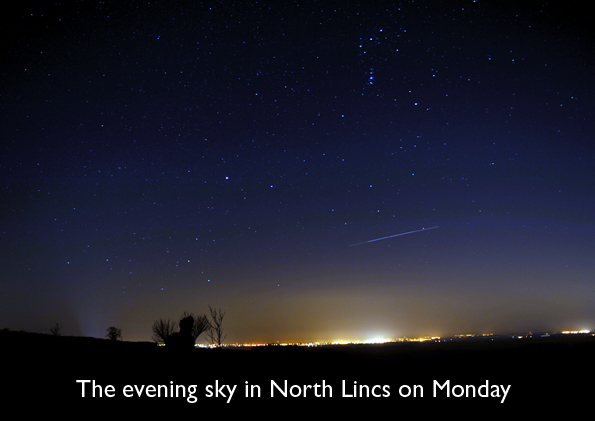
On Monday evening with clear skies across the North of England star gazers were treated to a wonderful, and it turns out historical spectacle in the southern sky.

The International Space Station was clearly visible, closely followed in the same orbit by the Space Shuttle Discovery, which had been docked with the space station up until then.

This time lapse picture was taken on Monday evening in North Lincolnshire, showing the ISS and Space shuttle as a streak of light.


What I didn't realise when I broadcast the information on Look North was that this would be the last time we could see the Space Shuttle Discovery, as it is due to land at the Kennedy Space Centre at 5pm GMT this evening, having completed its 39th and final voyage - ending the 27-year flying career of the world's most-travelled spaceship.

Discovery's sister ships Endeavour and Atlantis are scheduled to make their final flights to the International Space Station in April and June.

The two other space shuttles were destroyed in accidents. Challenger broke apart over the Atlantic Ocean shortly after takeoff on January 28, 1986. And Columbia disintegrated as it re-entered Earth's atmosphere over Texas on February 1, 2003 killing all astronauts on board.

The ISS can be seen once more this evening, at approximately 6.40pm, quite low in the southwest sky. Skies will be partly cloudy, so this evening's viewing will be quite hit and miss.

What now for Global temperatures?

Paul Hudson |17:06 UK time, Thursday, 3 March 2011

Blog comments are currently unavailable. Find out more.

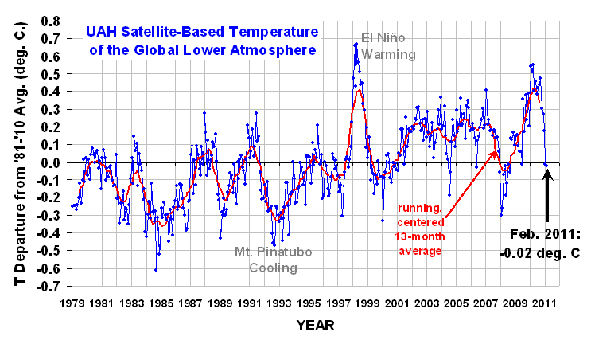
Latest satellite data from the University of Alabama (UAH) shows virtually no change in global temperatures from January's levels. The -0.02C anomaly relative to the 1981-2010 average equates to approximately +0.24C above the more standard 1961-1990 average used by the Met Office and World Meteorological Organisation.


Most climate models indicate that Pacific sea temperatures will very slowly warm in the next few months, with La Nina conditions becoming neutral by mid summer.

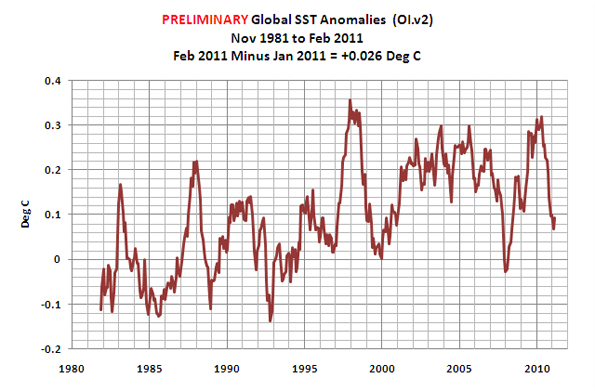
The graph below shows that monthly global sea surface temperatures have stopped falling, although as ever it's very difficult to say whether this marks the end of the cooling associated with La Nina.


But if the minimum for sea surface temperatures has been reached in this latest cycle, then it's interesting that it will be at a somewhat higher level than the minimum associated with La Nina of 2007 - with the knock on effect that Global temperatures may not fall quite as far as some climate sceptics have been predicting.

Winter 2010/2011: Cold and dry - as forecast!

Paul Hudson |14:20 UK time, Wednesday, 2 March 2011

Blog comments are currently unavailable. Find out more.

After a record breaking December, a mild February has meant that winter 2010/2011 across the UK as a whole has ended up only 15th coldest since UK figures started in 1910.

Provisional UK data for winter 2010/2011 shows a mean of 2.39C, compared to the 1971-2000 average of 3.7C.

How does that compare with recent winters?

Last winter was much colder, with a mean temperature of 1.64C, the coldest since 1978/79.

2010/2011 was though colder than 1995/1996, which had a mean of 2.53C, but was not as cold as the winter of 1985/86 which had a mean temperature of 2.29C.

Based on the Central England Temperature data set (CET), the winter mean temperature was 3.13C, compared to the 1961-1990 average of 4.06C.

This has made it only the 112th coldest winter since CET records began in 1659.

It was also a dry winter.

Across the UK, 259mm of rainfall was recorded, 78% of the average. For the North of England, 233mm was recorded, 89% of average.

This all ties in very well with winter projections made back in early October, which you can see from my article: Winter 2010/2011 - cold and dry?

Later today the first estimate for global temperatures for February will be released which I will write about tomorrow.