
Goodbye to the Space Shuttle Discovery
On Monday evening with clear skies across the North of England star gazers were treated to a wonderful, and it turns out historical spectacle in the southern sky.
The International Space Station was clearly visible, closely followed in the same orbit by the Space Shuttle Discovery, which had been docked with the space station up until then.
This time lapse picture was taken on Monday evening in North Lincolnshire, showing the ISS and Space shuttle as a streak of light.
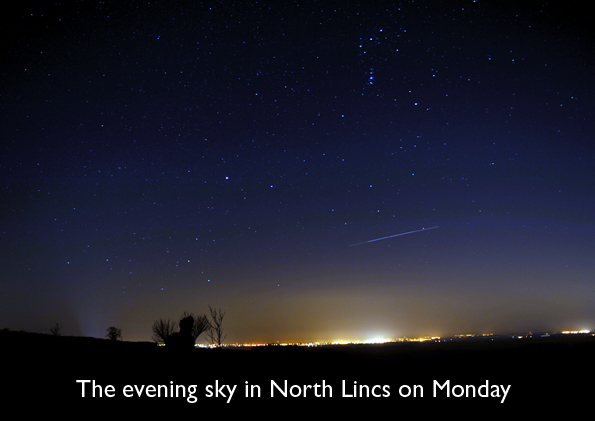
What I didn't realise when I broadcast the information on Look North was that this would be the last time we could see the Space Shuttle Discovery, as it is due to land at the Kennedy Space Centre at 5pm GMT this evening, having completed its 39th and final voyage - ending the 27-year flying career of the world's most-travelled spaceship.
Discovery's sister ships Endeavour and Atlantis are scheduled to make their final flights to the International Space Station in April and June.
The two other space shuttles were destroyed in accidents. Challenger broke apart over the Atlantic Ocean shortly after takeoff on January 28, 1986. And Columbia disintegrated as it re-entered Earth's atmosphere over Texas on February 1, 2003 killing all astronauts on board.
The ISS can be seen once more this evening, at approximately 6.40pm, quite low in the southwest sky. Skies will be partly cloudy, so this evening's viewing will be quite hit and miss.
 Hello, I’m Paul Hudson, weather presenter and climate correspondent for BBC Look North in Yorkshire and Lincolnshire. I've been interested in the weather and climate for as long as I can remember, and worked as a forecaster with the Met Office for more than ten years locally and at the international unit before joining the BBC in October 2007. Here I divide my time between forecasting and reporting on stories about climate change and its implications for people's everyday lives.
Comments
Sign in or register to comment.