
_178_100.jpg)
Depeche Drums & A Furry Flop
Post categories: Tom Talk
 |16:16 UK time, Friday, 17 June 2011
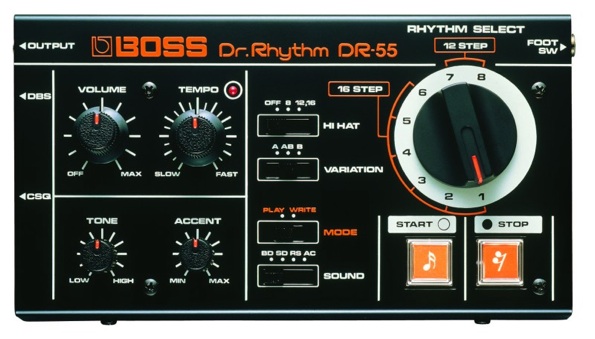
A band like Depeche Mode would not have been possible before cheap programmable drum machines. Prior to their arrival, any aspiring pop songwriter hoping to make a demo needed a full recording studio and the services of an amenable drummer before the groove in their head could become a reality.
During the seventies drum machines were a joke - the affordable ones only played preset bossa nova patterns, while the few programmable models on the market were eyewateringly expensive. Phil Collins embraced the Roland CR78 while Peter Gabriel brought one of the first Linn machines into the country. They were far beyond the reach of bright teenagers with fresh ideas and next to no cash.
But then in 1980 along came the Boss Dr Rhythm DR-55 - a small battery operated box with four naff analogue drum voices and, crucially, eight memory slots where you could create and save your own drum patterns. The main downside in those pre-MIDI days was that tempos were a bit hit and miss - there was no readout, just a sweepable knob you could turn to make your beats faster and slower. In the unfashionable dormitory town of Basildon, a young songwriter called Vince Clarke worked odd jobs to raise enough cash to buy one as soon as they arrived in the local music shop. Suddenly, with the help of a four-track cassette recorder and an early Roland synth, the world was his musical oyster.
Back then I used to read the NME religiously from cover to cover, and early in 1981 their single of the week was an indie release by a new young all-synth band called Depeche Mode. The gig guide showed they were opening for The Psychedelic Furs at Hammersmith Palais that week and I bought myself a ticket. The Furs were a big noise back then, with a debut album on CBS Records, posters everywhere and gigging on a grand scale thanks to lavish tour support from their label.
The Palais was rammed with their fans, and the support band had been crammed into a small apron of stage, hemmed in my giant amplifiers, guitar stands, PA stacks, monitors, keyboards, drum risers and - at the back of the stage - a SuperTrooper followspot mounted on a stand like a machinegun.
Depeche Mode turned out to be four small shy skinny youths with three cheap bottom-of-the-range synths on makeshift stands and no backline at all. There was no sign of Vince's drum machine - instead at the front of the stage Dave Gahan had a radio cassette recorder that was wired into the PA system. As he announced each song, he would pull a cassette out of his shirt pocket, put it in the machine and out would come a plinky DR-55 drum pattern at exactly the right speed. A foolproof lo-tech solution to the tempo problem.
Their sound was young, fresh, sexy and quite unlike anything I'd seen or heard before. The Furs were as heavy dull and predictable as a Sherman tank and after two numbers I slipped away. As to what happened next... New Life went to number 11 that month on the unknown indie label Mute - while later in the year, for all the Furs' touring and promotional push, Pretty in Pink failed to even dent the UK Top 40.

Comments Post your comment