
Special guest post by Mike Toms, BTO Associate Director of Communications (Science).
How we can communicate through the power of art and nature.
Concerns about the levels of environmental change now being witnessed across the globe have prompted a growing number of academics, conservation practitioners and science-based charities to seek to improve the ways in which they communicate with policy makers and the wider public. Such communications are not limited to those of direct conservation relevance, with the communication of science in more general terms also benefiting from these new ways of seeking engagement.
Central to this new approach for communicating impact has been engagement through the creative arts, with film-making, photography, the written or spoken word, and art and sculpture being much in evidence. A growing body of work indicates that the creative arts can make a significant contribution to the communication of science because they stimulate intuitive thinking and take audiences on a journey of discovery. Those audiences exposed to scientific ideas through such pathways are more likely to show meaningful change in their understanding and – where the topic has an environmental basis – their behaviour.
Over the past seven years the BTO has been developing creative collaborations, seeking to expand and improve on how it presents its research and showcasing the impact that the organisation is able to deliver through its staff and volunteers. Involvement with New Networks for Nature, with the Society of Wildlife Artists (SWLA) and with individual creatives, for example, has enabled BTO to reach new audiences and present its work in more engaging ways.
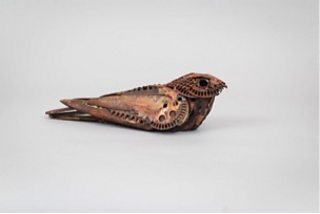
A Nightjar made of saw blades by Harriet Mead.
Of course embracing these new approaches isn’t always straightforward; for example, scientists may need reassurance about how the nuances of their work might be translated when communicated through a different medium. Key to the successful communication of science, whether through a film, a piece of prose or a scientific paper is that the messages you wish to put across are structured in a logical way and presented so as to engage the watcher, listener or reader with what is being said.
Perhaps the most ambitious of BTO’s storytelling efforts has been the BTO/SWLA Flight Lines project. The project, which was launched in the autumn of 2013, has seen BTO work with SWLA member artists, storytellers, writers and photojournalists to tell the stories of the birds that migrate between the UK and Africa each year. In addition to performance pieces at various events – from the Cambridge Festival of Ideas to Nature Matters 2016 – the project has delivered art exhibitions in London and storytelling in Lincolnshire.
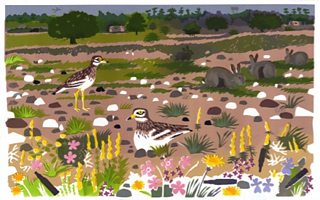
An example of artwork from the Flight Lines project; Secured Ground by Carry Akroyd.
Such projects reach a far wider audience than is reached by academic publishing - the usual route by which scientific results are delivered. They also have far more energy about them, offering the opportunity to deliver greater understanding, stronger advocacy and more significant engagement. Over the coming years we are likely to see increasing numbers of similar projects, and not before time.
