
Special guest post by Mike Toms, BTO Associate Director of Communications (Science).
The Poet and the Nightjar
There has been something of a resurgence of interest in poetry over the last few years, with ‘nature’ poetry no longer the poor relation to nature writing. It is the new kid on the block, sometimes cocky and self-assured but more often the quiet voice that speaks of connection, of people to seeking to reaffirm their place in the natural world.
That this interest is growing can be seen from the success of the Nature and Place poetry competition coordinated by The Rialto magazine, working with RSPB, BirdLife International and the Cambridge Conservation Initiative. This is attracting large numbers of entries from across the poetry community, and wider interest from those who might previously have been hesitant in approaching the poetic form. Much of this success stems from growing recognition of key nature poets, or poets who include nature within elements of their work. The legacy of Ted Hughes, and rekindled interest in Edward Thomas, has become intertwined with the work of modern poets like Kathleen Jamie, Alison Brackenbury, Ruth Padel and Paul Evans, amongst others.
The approachability of the poetry community, and the communal way through which poets are able to voice their works and learn from one another, makes this an arena open to all. Importantly, poetry gives voice to the little things, to brief moments and half-glimpsed opportunities. It provides an outlet for the words that form inside when you experience the natural world and then, later, distill those experiences down. It is a craft that teaches you to look, to listen, touch, smell and taste, and to then find a way to share all of these with your readers and listeners.
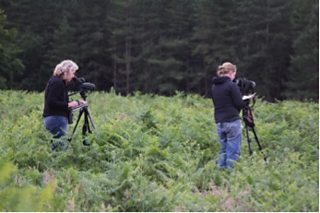
Looking out for Nightjars by Mike Toms
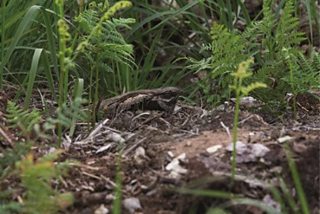
One evening, the summer before last, I took artists Harriet Mead and Esther Tyson out into Thetford Forest to join BTO researchers Ian Henderson and Greg Conway who were working on the forest’s Nightjars. Ian and Greg’s work with tiny tracking devices has documented how the birds use the forest and surrounding landscape, additionally revealing their journeys to and from Africa. Esther and Harriet came to document the bird through painting and sculpture for the BTO/SWLA Flight Lines Project, while I did the same through the written word. We spent two evenings watching a single sitting female, soaking up the atmosphere and shaping our individual creative outputs. These are the words that capture that sitting Nightjar and the forest she inhabited.
An incline of Nightjar
An incline of nightjar, the earth-sitter,
with slit of watchful eye upon us.
Amid the bleached bones of broken pines
and crisp green fronds of bracken,
she sits.
Cryptic nonchalance;
the broken ground in feathered form.
Evening warmth nudges her back,
the copper of peeled birch, briefly held in light.
The moment passes, the palette changes.
The buzz of a late fly and the crack of a rifle on the range.
Credit: Mike Toms
