

Student protests, politics and Parliament
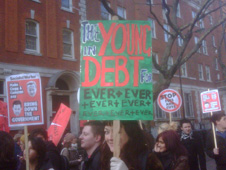
Malet Street at 12.43pm on Thursday
I used to spend a lot of time in Malet Street, the heart of University life in Central London.
The quasi-Stalinist structure of Senate House dominates the imposing architecture and appears to scrape the sky; a reminder of what idea previous generations had of a University education. It was part of an elitist enterprise, for those that benefitted, the sky was the limit.
Academe is no longer so revered. In an age where celebrity can appear to grease the path to fame and fortune less arduously, the whole idea of a university education for many has become much more utilitarian. A means to an end, financial and job wise, not an end in itself.
I write as no stranger to academe. The proud owner of three degrees and fond-ish memories of an early career as an academic means I was a beneficiary of state and university largesse as a young man.
Now my own children are at the age of post-compulsory education the fees issue is a hot topic at the dinner table. There is a lot of finger-pointing.
It comes at no surprise to me to see the tuition fees debate inflaming passions. What is perhaps surprising is that so many people seem surprised. A lot is at stake for a lot of people.
In my generation around 15% of the age group went to University and therefore arguably had a direct stake in this debate; that number has now more than trebled. Many students, although not all, believe they have a lot to lose.
My parents were pretty agnostic about a university education. At 18 my father tried to persuade me to enter a career in banking directly from school.
In 30 years expectations have dramatically changed. The idea of a fulfilling life without a university education has become almost unthinkable, for some even scary. Many will now need to think again.
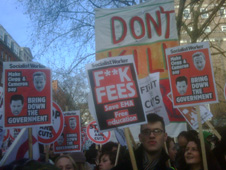
Protesters in Malet Street at 13.06pm on Thursday
Amongst the marchers were many who will begin their university careers in a few years time. Presumably they were there because they were all there because they'd not yet been convinced that the changes are in their best interests or the country's.
Politicians take note; the best way of politicising young people is demonstrating they have a stake in politics. The best way of riling them is to then ignore them when they try to become engaged.
The assembled throng was too angry to be described as overwhelmingly good-humoured, but it was good-natured, there was a real sense of purpose and a common thread to what most marchers were protesting against. Many fear the worst, even the commercialisation of non-compulsory education.
So when I arrived at Parliament Square at about 2.35pm I think I was expecting a more sombre and menacing mood.
Instead it was part music festival and part gentle protest. Perhaps the walk from Malet Street to Parliament Square had worn people out, but the majority of marchers had already begun to drift off through St James' Park.
For more than an hour different groups seemed to mill aimlessly around in Parliament Square.
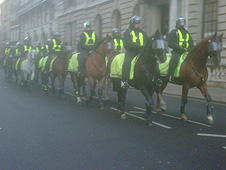
Police on horseback at Whitehall at 14.33pm
Inexplicably to the demonstrators police horses were then without warning used against the crowd gently pushing up against the police line running between the Supreme Court and Westminster Abbey.
A number of those bundled out of the way were sixth-form girls much to their bemusement and the anger of others around them. It was only by sheer luck that none was seriously injured.
The sixth-formers were from a North London Grammar school, one of the best, they were seriously unnerved by that experience. Their mood had been calm, although excitable, and they didn't anticipate a horse charge.
It's a bit of a mystery to me why horses were deployed at all at this point. It was certainly one of the police actions that helped switch the mood.
The fact that police were already in riot gear and there hadn't yet been any serious trouble caused some consternation too.
On the opposite side of the square facing Parliament there was still a polite standoff; only the occasional expletive being exchanged back and forth between police and protestors.
Curiously as you walked around the square it still felt like several different events were going on, including a protest.
One group followed a sound-system pulled on a bicycle trolley with blaring hip hop; dancing and swinging from the traffic lights.
Underneath Churchill's statue a raging bonfire created a Guy Fawkes Night atmosphere. Meanwhile a lone protester placed a note over the head of Abraham Lincoln in front of the Supreme Court.
Around 3.45pm the police were still letting people come into Parliament Square from Whitehall and in and out through a tight cordon on Whitehall Place.
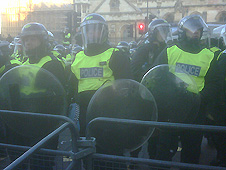
Scenes opposite Parliament at 15.08pm on Thursday
Within five minutes the Whitehall Place cordon had been closed. I found this out when I was told that my exit point was now Whitehall itself. I walked to Whitehall and was told that where I had come from, Whitehall Place, was my exit point.
Twice more I went back and forth to each exit and was told my exit point from the Square was in the opposite direction.
There scores of other people doing the same and getting increasingly frustrated that they were being given confused information.
In fact after 20 minutes of asking a simple question of where my exit was the Sergeant at Whitehall place told me in fact no-one was being allowed out for the moment. At 4.01pm I tweeted that I thought "kettling" had begun.
A couple of the North London school girls who recognised me came over and were clearly panic stricken about not being allowed out. I doubt they could have caused any harm to a blancmange let alone a fully equipped riot officer.
Now anxiety levels rose across the Square and those groups of individual's intent on causing trouble begun to do just that.
Charging police lines outside Westminster Abbey with metal barriers, Westminster Council seemed to have helpfully left lying around, setting fire to memorial benches and a whole host of other downright daft ideas.
From what I could observe there were still a majority of people in the Square who were openly irritated at both the police hemming them in and by the people intent on causing trouble.
Those still in the square at this point were nevertheless a minority of those who had marched down Whitehall and entered Parliament Square earlier in the afternoon.
As the temperature dropped and the night lights came on the tension rose. The police opened a very narrow exit at one end of the Whitehall cordon. Judging by the jostling in that corner there were many people eager to leave. Police were letting half a dozen people through at a time, effectively a trickle.
The weight of people trying to get out irritated some officers in the cordon because they were getting pushed. The response from those colliding with them let more people out, more quickly and you won't get pushed.
Tempers were fraying but still no general violence. It was not possible after that for me to judge how many people were left from the original march.
But it was possible to see that the circumstances had become extremely intimidating for many of those trying to leave, it was obvious to most trouble was brewing.
The mood had changed. I tweeted that I passed through the cordon at 4.28pm. I think by this time most people trying to get out had at least for the moment stopped thinking about tuition fees.
I'm clearly not an expert in police tactics but there must surely be questions for the Met about more effective ways of encouraging people to move on and disperse from a largely peaceful march once it has reached its destination.
Ironically most marchers were not expecting to go all the way to Parliament Square and were confused that this had been allowed by Police.
Keeping a large number of vocal and volatile people in one place, stopping them from leaving, police officers giving them confused information but being prepared for the worst in full riot gear feels like a recipe for intimidation if not downright confrontation.
When young people march to have their voice heard and then see that the overwhelming depiction of their freedom of expression is a focus on a minority of morons who want to smash up the joint, it is hardly a good advert for robust political debate.
What's the point of attempting to talk politics with the majority, my children ask me, if everyone in the media appears more interested in focussing on the minority who relish street fighting?
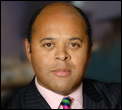 I’m Kurt Barling, BBC London’s Special Correspondent. This is where I discuss some of the big topical issues which have an impact on Londoners' lives and share stories which remind us of our rich cultural heritage.

Comment number 1.
At 12:05 13th Dec 2010, veop wrote:"When young people march to have their voice heard and then see that the overwhelming depiction of their freedom of expression is a focus on a minority of morons who want to smash up the joint, it is hardly a good advert for robust political debate."
Easily fixed. Identify the morons who want to smash up the joint, hand them over to the police and give evidence against them in court. It's an open question that had the 'responsible' protesters at Millbank done that in a timely manner, perhaps the Met would not have adopted riot gear as the starting point for their dress code last week. Instead we get media coverage of what happened, focusing on the unacceptable violence and criminality that hardly anyone acted to prevent. Well done to the few that did, you should have had more recognition and coverage.
Complain about this comment (Comment number 1)
Comment number 2.
At 15:26 13th Dec 2010, Jessica_Fletcher wrote:It is interesting reading this, as I was not present at the protest, but was watching it live on the news, perhaps giving a better vantage point of the whole protest. It seems that the sheer size of the protest meant that many who attended were not aware of events happening elsewhere. The police were already having missiles thrown at them when they made the decision to change into riot gear. The police horses had also had missiles thrown at them, and a decision seemed to be made for them to retreat. However, as soon as they retreated, protesters charged the police lines, and the horses quickly returned. I believe that this is the point at which they charged the crowd. I was also under the impression that the protesters were not supposed to enter Parliament Square - there were high barriers cordoning it off which some of the first protesters climbed over and tore down, later using them as weapons to throw at the police lines. This was all long before kettling began. Yet it seems that many people were unaware of this - perhaps if they had known, they would have made the decision to leave much earlier.
Complain about this comment (Comment number 2)
Comment number 3.
At 23:38 13th Dec 2010, gerang wrote:There you go then jessica - you saw it on which, sky, bbc, ??? all well known pillars of journalistic virtue and truth. This provided you with a better overall picture than if you had actually been there - complete with a lovely narrator to explain any anomalous visions like maybe horses charging peaceful protesters or clearly charged up and vicious policemen (versus kids?). A lot of believing and perhapsing in your vision of what must have happened in order to fit with the narrative you wish to keep. i would suggest the possibility that at least some of the violence was deliberately orchestrated by the police, plenty of motive if you can think about it. also i would suggest broadening your sources of information - and maybe go out and have a look around now and again - it looks better than hd.
Complain about this comment (Comment number 3)
Comment number 4.
At 23:45 13th Dec 2010, gerang wrote:oh and veop - maybe people are so angry that they had their votes stolen and effectively their government stolen that they feel this is the only way to make a point. remember over 1 million people marched against the war - and were later proven to be 100% correct - where was the point in their protest - who listened - you? when this number of people march and your government has more colours than josephs coat - does not have the peoples authority to act in this way.
Complain about this comment (Comment number 4)
Comment number 5.
At 10:00 14th Dec 2010, Jessica_Fletcher wrote:Gerang, I would not have gone to the protest if I had had to - common sense predicted that some protesters (not students) were going to use it as an excuse for violence. My point if you had read my post carefully was that due to the sheer size of the protest it would have been entirely possibly for many protesters to be unaware of pockets of trouble - why else would peaceful protesters have stayed once it was clear the protest had been sabotaged by trouble-makers? This was clearly not a demonstration to bring kids to.
I would like to hear the motive you say police had for wanting to encourage protesters to hit them with metal barriers, poles, or snooker balls, flares and whatever else some of the protesters thought was necessary to bring to a peaceful protest?
Complain about this comment (Comment number 5)
Comment number 6.
At 17:32 14th Dec 2010, gerang wrote:maybe they need to demonstrate their worth to avoid being cut so deep. theres one possible motive. now same question to you. why would students deliberately provoke heavily protected and well armed and organised police when they could not possibly defend themselves against the brutality witnessed (its there if you look, i promise) against them. and remember most of them were kids.
people have a right to protest. kids have a right to protest. they should not be prevented from doing so by the threat of someone elses violence and indeed the police have a duty to ensure that this is so. now where was the polices preventative operation, which ringleaqders did they identify and take out before the protest a la g20/irag war protests. hmmm, they didnt and violence was allowed to happen and hey presto bad publicity for the students, great for the police and government and all because of a handful of peoples actions. is it fair that the students cause is damaged in this way and how would you suggest they prevent this, it is the polices job. please think about it.
Complain about this comment (Comment number 6)
Comment number 7.
At 17:35 14th Dec 2010, gerang wrote:they couldnt leave because they were being given false directions by the police (there are hundreds of reputable people reporting this and loads of videos showing it actually happening - really) and they were also being kettled, a barbarian tactic not even fit for belfast - what would you expect of a large number of young people held for hours against their will to do, sing.
Complain about this comment (Comment number 7)
Comment number 8.
At 11:36 16th Dec 2010, BrianBebonde wrote:Gerang, what do you expect the police to do when they have large numbers of people attacking them. Just stand there and take it?
At last month's protest some idiot threw a fire extinguisher from a roof which would have killed someone (police or protester) if it had hit them. You are aware of the provocation the police face aren't you?
So many protests seem to attract people who are just up for a fight with the police and its sad but it makes it tough for the people who wish to protest peacefully because I believe, in this country, we all have a right to protest.
Complain about this comment (Comment number 8)
Comment number 9.
At 19:53 16th Dec 2010, gerang wrote:so, its now large numbers of people attacking the police - in other words a riot. now i didnt see any riot and i saw nothing to justify the level of aggression or the tactics used. i'm not alone in this interpretation. nor are you in yours. but evidence speaks for itself and as i said before, its all there.
your point about the fire extinguisher idiot is what? there are idiots around so a whole protest be damned? the idiot has been arrested and will be dealt with accordingly, thats how it works. its also the polices job to deal with provocation, not to incite it and take advantage of it or to manage it poorly and allow it to spiral out of control. how much responsibility should they bear?
we all do have a right to protest and to our own opinions, however naive or misguided we may be. all of our rights should be protected equally and it is here where the demise of britain will finally come because that was what was great about it...
Complain about this comment (Comment number 9)
Comment number 10.
At 01:29 15th Mar 2011, fraulemon wrote:I was a student not so long ago and was shocked at how many people take their university education for granted. There is a general lack of seriousness regarding undergraduate study both students and academics which turns the whole operation, I'm afraid to say, into a waste of time for a large proportion of students there.
On a slightly different note, I think that new opportunities are emerging for universities to secure funding from business and it is time for higher education institutions to start thinking outside of the box for new sources of funding.
For example, Google is in the process of redefining the incentive structure between the corporate world and public institutions such as universities. A business who can secure a website link from a university website will be strongly prioritized in the search results - a great leg-up for them in business terms. A good explanation can be found here .If this authority were leveraged properly, perhaps educational instutions could use their clout to secure funding/apprenticeships/sponsorship and other kinds of favours from businesses.
Although I am not suggesting that this will avert public funding cuts, I think that there is potential for more creative, entrepreneurial leadership when it comes to fundraising for universities.
Complain about this comment (Comment number 10)