

Street protests and the technological age
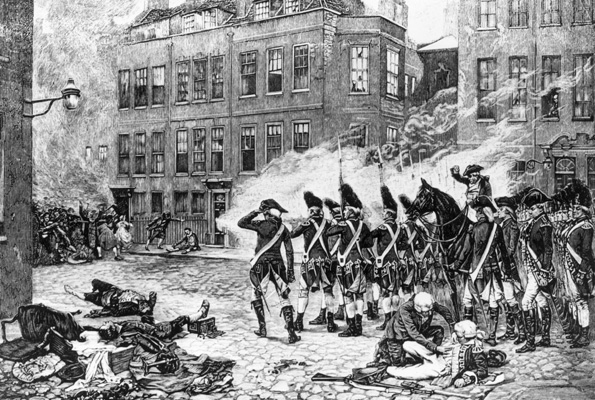
The Gordon Riots of 1780 were an anti-Catholic uprising against the Papists Act of 1778. Getty Images.
The French have a saying "the more things change, the more things stay the same". In reality protesting is to London, what fish is to chips.
You'd be hard pressed to find a decade in the past few hundred years where there haven't been protests of one kind or another in the capital.
How about the 1780s when protestants got the hump with an act which removed some elements of discrimination against Catholics. After several days of argy-bargy word of mouth spread bringing out a crowd estimated at 50,000.
The Gordon Riots ensued; days of rioting caused extensive damage in central London. The use of live ammunition turned this into a rather notorious event with several hundred Londoners left dead.
Since then any number of causes has brought protesters to the heart of where political power lies to make their voices.
Think suffragettes, the Jarrow marchers, those who fought street battles with the Mosleyites, CND marchers, anti-Vietnam protesters, National Front supporters, Civil Rights marches in the 1980s, poll tax haters, anti-war protesters, G20 demos and the list goes on.
Rarely do these events pass off without some disturbance or police intervention. When passions are running high some people can't help themselves when it boils over.
The latest student organised marches to protest against what they argue are decisions which directly contradict the mandate of one of the coalition partners joins a long line of justifiable protest. The law allows the protest therefore it is justified.
There are those who argue that the use of new mobile technologies is helping to change the character of the current crop of marches. Some argue that these protest are more organic, driven from the bottom up.
Social networking sites enable quick communication and in assist the spontaneous organisation of events. It is the speed at which events can be organised which has added to the speculation that London could be in for a season of difficult demonstrations.
But when you talk to veterans of street protests there is a much more sanguine view. They remain less convinced the character of demonstrations is changing.
They emphasise that to be effective, protests still need a strong sense of purpose.
Of course, demonstrations also respond to the way they are policed. We have heard from demonstrators this week that in order to counter the police tactic of "kettling" they broke into many different groups to avoid being "kettled".
This has accounted for some of the assertions that the character of the demonstrations is changing.
It would seem that there is a danger of mistaking spontaneity here for an unwillingness to be kept in one place for hours on end because the police chose to use the particular "kettling" tactic.
The Metropolitan police have faced heavy criticism for the use of this tactic. Clearly if it forces demonstrations to fragment along the way of a marching route it may soon become as much a problem as a solution.
There is another problem with new technology. Speed of organisation may be helpful for many things but can lead to fragmentation on the street because people come with different agandas.
Talking to protesters at this week's fragmented demonstration, it was clear that many people were being given different information.
I kept bumping into people asking where the demonstrators had gone to. It's not difficult to see why it might be difficult to keep control of an event in these circumstances.
Fragmentation may be good for making a nuisance of yourself but it is arguable that to march in London is to get your issue at the heart the news agenda, conveying your message of protest to the widest possible audience.
Without a strong sense of purpose this may be more difficult to achieve because it can comes across as simply anarchic. Of course anarchists on the marches will argue that's a good thing.
Some people feel there's something French in our emerging culture of street protest. It's more likely that mobilisation using technology is speeding things up.
But this doesn't mean the reasons for demonstrating in the first place OR being effective is destined to change. Or for that matter need less thought and planning.
 I’m Kurt Barling, BBC London’s Special Correspondent. This is where I discuss some of the big topical issues which have an impact on Londoners' lives and share stories which remind us of our rich cultural heritage.

Comment number 1.
At 13:33 2nd Dec 2010, JoC wrote:Interesting view but surely the Police have equal access to any of this kind of information floating around in cyber-space and what's to say they can't or don't throw out some disinformation to disrupt protests or send them where they want them to go?
Complain about this comment (Comment number 1)
Comment number 2.
At 15:09 2nd Dec 2010, BluesBerry wrote:The French have a saying "the more things change, the more things stay the same". The rich get rich; the poor get poorer. Those who know how to gamble cheat those that do not know.
Since the Frech Revolution, any number of causes has brought protesters to the heart of cities and towns (where the political power lies) to make their voices heard.
But there's a difference now: The common folk are mad as Hell, and they don't want to take it any more; yet, against whom are they protesting, or against whom should they be protesting, the Governments with their austerity programs, or the investment banks "too big to fail" that failed and got paid to fail with something called "the bailouts"?
The answer: BOTH!
I wish these protesting students and other justifiable protesters would take their marches, their shouts, their anger to the front of the investment banks "too big to fail" and Government offices.
I wish they would shout and carry placards that said:
- split banks between commercial and investment; we do not need gambling casinos; we need local banking.
- implement a transaction tax against all foreign transactions. Our localized, commercial banks will not be hurt; but you big, greedy, investment banks "too big to fail" will pay a tax on your nefarious gambling transactions, your front-end loading, your computerized transactions, your cheating and your exploitation;
- we the taxpayers do not deserve to bare the weight of your potentially white collar crime. If you don't like the transaction tax, go somewhere that doesn't have one.
Yes, proterstors ought to get on their twitter, their Facebook and organize marches. Put them where they should be held - in front and around these investment banks "too big to fail", and the Governments too scared to take them on by
- splitting commercial and investment banking or
- imposing a transaction tax.
Social networking sites enable quick communication, spontaneous organisation. Get to work...The foregoing represents your strong sense of purpose. Just keep asking yourself: Why am I paying for the gambling of investment banks "too big to fail"?
There are enough Government places and enough investment banks "too big to fail" that there should be no danger of mistaking the quiet, but persistent anger of the public.
Remember: The investments banks "too big to fail" and the Government has played upon your ignorance. Who understands derivative bundles, and negative credit default swaps, and all the nefarious instruments that these investment banks "too big to fail" have unleashed on an ignorant public and STUPID PIIGS?
You don't have to understand it. You just have to know how to solve it, and I have told you what I would do.
Complain about this comment (Comment number 2)
Comment number 3.
At 16:58 2nd Dec 2010, JoC wrote:I'm suprised the government hasn't erected some kind of holding pen for protesters and Police don't just kettle them up in the same place every time - with a media centre built on to the side...stick in an old Police van for the 'violent' elements to smash up and grafitti to their hearts content, then let them out one by one at days end. Surely there are better ways to get heard - the students have seen voting for a particular party ie. Lib Dems doesn't mean they will stick by their promises?
Complain about this comment (Comment number 3)