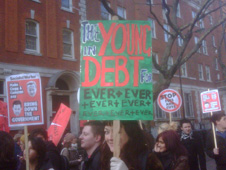
Malet Street at 12.43pm on Thursday
I used to spend a lot of time in Malet Street, the heart of University life in Central London.
The quasi-Stalinist structure of Senate House dominates the imposing architecture and appears to scrape the sky; a reminder of what idea previous generations had of a University education. It was part of an elitist enterprise, for those that benefitted, the sky was the limit.
Academe is no longer so revered. In an age where celebrity can appear to grease the path to fame and fortune less arduously, the whole idea of a university education for many has become much more utilitarian. A means to an end, financial and job wise, not an end in itself.
I write as no stranger to academe. The proud owner of three degrees and fond-ish memories of an early career as an academic means I was a beneficiary of state and university largesse as a young man.
Now my own children are at the age of post-compulsory education the fees issue is a hot topic at the dinner table. There is a lot of finger-pointing.
It comes at no surprise to me to see the tuition fees debate inflaming passions. What is perhaps surprising is that so many people seem surprised. A lot is at stake for a lot of people.
In my generation around 15% of the age group went to University and therefore arguably had a direct stake in this debate; that number has now more than trebled. Many students, although not all, believe they have a lot to lose.
My parents were pretty agnostic about a university education. At 18 my father tried to persuade me to enter a career in banking directly from school.
In 30 years expectations have dramatically changed. The idea of a fulfilling life without a university education has become almost unthinkable, for some even scary. Many will now need to think again.
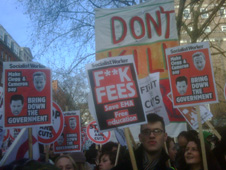
Protesters in Malet Street at 13.06pm on Thursday
The throng that assembled at Malet Street at midday on Thursday had clearly been thinking. Students, supported by others, were organised, passionate and legal.
Amongst the marchers were many who will begin their university careers in a few years time. Presumably they were there because they were all there because they'd not yet been convinced that the changes are in their best interests or the country's.
Politicians take note; the best way of politicising young people is demonstrating they have a stake in politics. The best way of riling them is to then ignore them when they try to become engaged.
The assembled throng was too angry to be described as overwhelmingly good-humoured, but it was good-natured, there was a real sense of purpose and a common thread to what most marchers were protesting against. Many fear the worst, even the commercialisation of non-compulsory education.
So when I arrived at Parliament Square at about 2.35pm I think I was expecting a more sombre and menacing mood.
Instead it was part music festival and part gentle protest. Perhaps the walk from Malet Street to Parliament Square had worn people out, but the majority of marchers had already begun to drift off through St James' Park.
For more than an hour different groups seemed to mill aimlessly around in Parliament Square.
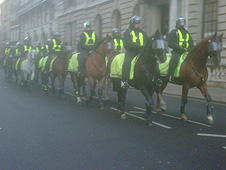
Police on horseback at Whitehall at 14.33pm
Police cordons to the road exits were already in place with a very sizeable police presence, all in full riot gear. It was difficult to judge but it certainly appeared there were more police than demonstrators at that point. Parliament debated whilst the protesters waited.
Inexplicably to the demonstrators police horses were then without warning used against the crowd gently pushing up against the police line running between the Supreme Court and Westminster Abbey.
A number of those bundled out of the way were sixth-form girls much to their bemusement and the anger of others around them. It was only by sheer luck that none was seriously injured.
The sixth-formers were from a North London Grammar school, one of the best, they were seriously unnerved by that experience. Their mood had been calm, although excitable, and they didn't anticipate a horse charge.
It's a bit of a mystery to me why horses were deployed at all at this point. It was certainly one of the police actions that helped switch the mood.
The fact that police were already in riot gear and there hadn't yet been any serious trouble caused some consternation too.
On the opposite side of the square facing Parliament there was still a polite standoff; only the occasional expletive being exchanged back and forth between police and protestors.
Curiously as you walked around the square it still felt like several different events were going on, including a protest.
One group followed a sound-system pulled on a bicycle trolley with blaring hip hop; dancing and swinging from the traffic lights.
Underneath Churchill's statue a raging bonfire created a Guy Fawkes Night atmosphere. Meanwhile a lone protester placed a note over the head of Abraham Lincoln in front of the Supreme Court.
Around 3.45pm the police were still letting people come into Parliament Square from Whitehall and in and out through a tight cordon on Whitehall Place.
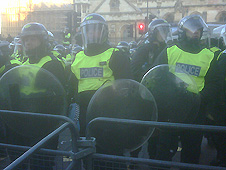
Scenes opposite Parliament at 15.08pm on Thursday
The anxious sixth formers had decided they didn't like the changing mood and decided to leave. In the process they got split up from half a dozen of their colleagues.
Within five minutes the Whitehall Place cordon had been closed. I found this out when I was told that my exit point was now Whitehall itself. I walked to Whitehall and was told that where I had come from, Whitehall Place, was my exit point.
Twice more I went back and forth to each exit and was told my exit point from the Square was in the opposite direction.
There scores of other people doing the same and getting increasingly frustrated that they were being given confused information.
In fact after 20 minutes of asking a simple question of where my exit was the Sergeant at Whitehall place told me in fact no-one was being allowed out for the moment. At 4.01pm I tweeted that I thought "kettling" had begun.
A couple of the North London school girls who recognised me came over and were clearly panic stricken about not being allowed out. I doubt they could have caused any harm to a blancmange let alone a fully equipped riot officer.
Now anxiety levels rose across the Square and those groups of individual's intent on causing trouble begun to do just that.
Charging police lines outside Westminster Abbey with metal barriers, Westminster Council seemed to have helpfully left lying around, setting fire to memorial benches and a whole host of other downright daft ideas.
From what I could observe there were still a majority of people in the Square who were openly irritated at both the police hemming them in and by the people intent on causing trouble.
Those still in the square at this point were nevertheless a minority of those who had marched down Whitehall and entered Parliament Square earlier in the afternoon.
As the temperature dropped and the night lights came on the tension rose. The police opened a very narrow exit at one end of the Whitehall cordon. Judging by the jostling in that corner there were many people eager to leave. Police were letting half a dozen people through at a time, effectively a trickle.
The weight of people trying to get out irritated some officers in the cordon because they were getting pushed. The response from those colliding with them let more people out, more quickly and you won't get pushed.
Tempers were fraying but still no general violence. It was not possible after that for me to judge how many people were left from the original march.
But it was possible to see that the circumstances had become extremely intimidating for many of those trying to leave, it was obvious to most trouble was brewing.
The mood had changed. I tweeted that I passed through the cordon at 4.28pm. I think by this time most people trying to get out had at least for the moment stopped thinking about tuition fees.
I'm clearly not an expert in police tactics but there must surely be questions for the Met about more effective ways of encouraging people to move on and disperse from a largely peaceful march once it has reached its destination.
Ironically most marchers were not expecting to go all the way to Parliament Square and were confused that this had been allowed by Police.
Keeping a large number of vocal and volatile people in one place, stopping them from leaving, police officers giving them confused information but being prepared for the worst in full riot gear feels like a recipe for intimidation if not downright confrontation.
When young people march to have their voice heard and then see that the overwhelming depiction of their freedom of expression is a focus on a minority of morons who want to smash up the joint, it is hardly a good advert for robust political debate.
What's the point of attempting to talk politics with the majority, my children ask me, if everyone in the media appears more interested in focussing on the minority who relish street fighting?


 I’m Kurt Barling, BBC London’s Special Correspondent. This is where I discuss some of the big topical issues which have an impact on Londoners' lives and share stories which remind us of our rich cultural heritage.
