What President Putin isn’t saying at the G20 – or anywhere else
Stephen Ennis
is Russian media analyst for BBC Monitoring.
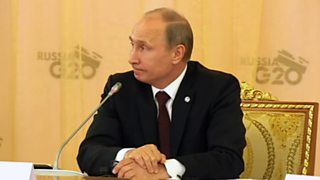
Russian President Vladimir Putin appears to have a speech impediment. For some reason he does not appear to be able to utter the name of opposition leader and Moscow mayoral candidate Aleksey Navalnyy.
During the campaign for the mayoral election on 8 September, the complaint also appears to have spread to the main government-owned TV station, Rossiya 1.
Not naming your opponent is a standard political ploy the world over. But Putin is providing a textbook example of the techniques required.
He’s been asked about Navalnyy a number of times since the blogger and anti-corruption campaigner emerged as a significant player on the Russian political scene in 2011.
During an interview marking the president's 60th birthday on 7 October 2012, a presenter on Gazprom-Media's NTV tentatively ventured: "Could I ask a question about someone who it is not quite the done thing to mention on air, but about whom I would very much like to quiz you? I mean Aleksey Navalnyy." Putin responded by saying he did not want to denigrate "any opposition leader" but that just because a "person" criticises something it does not mean that he is "capable of leading something".
Six months later, during his annual live TV phone-in, the president was asked about the embezzlement charges Navalnyy was facing (and which most independent observers believe are politically motivated). Putin replied by saying "people" fighting corruption need to be "squeaky clean".
Then a journalist asking Putin about Navalnyy at a pro-Kremlin youth camp on 2 August again found the president reluctant to name the man that many people were now speaking of as his main political opponent. Putin referred to him as the "second defendant" or more abstractly in terms of "each individual person".
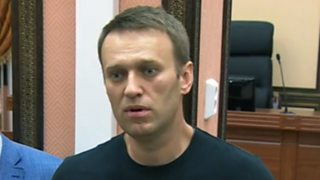
Aleksey Navalnyy
The interview was a joint venture between Associated Press and Russian state-controlled TV station Channel One, but so far the section about Navalnyy has not made it onto any of Channel One's bulletins.
Indeed, in the six weeks since Navalnyy was released on bail after his embezzlement trial and threw himself into the Moscow election campaign, Channel One news has mentioned him just twice - once in a report about the youth camp on 2 August and once in a brief item about an opinion poll that showed him trailing second behind acting mayor and hot favourite Sergey Sobyanin.
But Channel One has been positively effusive about Navalnyy compared to official channel Rossiya 1. While other pro-Kremlin media have been putting out a constant stream of reports accusing Navalnyy and his supporters of financial and sexual impropriety, Rossiya 1's bulletins have maintained a sepulchral silence about the opposition leader. Since he was released on bail on 19 July they have not featured a single report about him, according to data from media monitoring service Medialogiya.
Putin’s selective silence is starting to invite ridicule, and even speculation about psychological vulnerability. Writing in opposition newspaper Novaya Gazeta, columnist Andrey Kolesnikov said Putin appears to regard Navalnyy as a "god", because "in accordance with the Judaic law he does not pronounce his name".
And business daily Vedomosti suggests that the "intentional and blatant non-naming of the brightest opponent of the authorities" was a sign that Putin was "feeling danger". After all, it said, in Harry Potter the "only person not afraid of naming the Dark Lord was the one who could defeat him".
