Doubting Thomas’s apostrophe? Teacher knows best

Mark Shea
is the College's manager of English language development

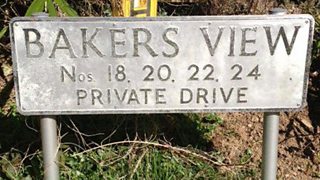
The little fella was in the news again recently. Following the controversial Waterstones decision to drop the apostrophe in the company name, Mid Devon council provoked further indignation by declaring that its street signs (including Bakers View) would no longer feature apostrophes. The Guardian’s Lucy Mangan was just one outraged commentator.
But many members of our audience care deeply about language usage and complain frequently about the topic. People expect the BBC to be a paragon of English usage, so it should be consistent. That means making decisions and forming conventions that hold across our output.
Whilst researching the guide to draw up these conventions, I found that most of us agree that we need apostrophes, but how to use them with singular nouns ending in s inspires heated debate. Should we write Thomas’s car, or Thomas’ car?
To answer this, I considered the following questions. What do most people think? Is pronunciation a guide to written form? What do academic sources and style guides say? And is there a rule that people can actually remember?
I believe any consensus on how language is actually used should form the basis of any instruction on how it should be used. For example, the battle to retain a distinction between less and fewer was probably lost decades ago, and there’s no point getting all Victor Meldrew about it. If you ignore this you are struggling to hold back the irresistible waves of linguistic change. And who wants to be King Canute?
So if we’d all agreed that would have been enough for me. Unfortunately I found no consensus on apostrophes; common usage is inconclusive. When I was researching the punctuation guide I asked a number of colleagues and friends whether they preferred Thomas’s or Thomas’. I found a 50:50 split. I also found an astoundingly passionate, and dogmatic, refusal to accept any alternative. Even worse was the reason they gave for their choice. Sceptical journalists who don’t normally accept statements at face value routinely insisted on a preference based solely on what their teacher had told them at school.
Although many argue that pronunciation should guide spelling, it doesn’t help us decide either. This is a shame because a rule based on pronunciation would be memorable. Certainly longer names are typically pronounced without the additional syllable. Who wants to add an extra syllable to indicate possession when you’re dealing with Mephistopheles (warning: have no dealings with Mephistopheles)?
This explains the exception given by many style guides that recommend s’s: Greek and biblical names, which are often lengthy and end in s, don’t require an s after the apostrophe. But for shorter words I would pronounce the possessive with three syllables - for example, Thom-as -es car.
In any case, English pronunciation is a notoriously poor guide to spelling. There are eight different ways to pronounce ough. Nobody suggests we find eight different ways to spell those, I hope, or insists we pronounce them all the same way.
So if there’s no clear majority and pronunciation doesn’t help, what about authorities on language? Here’s why we should choose Thomas’s. A clear majority of academic sources and style guides back the s’s version - from Fowler’s Modern English Usage to the Guardian Style Guide and the doughty Apostrophe Protection Society.
Also, any ‘convention’ should be easy to remember - ‘portable’ in pedagogical parlance. The most powerful reason to adopt a policy of s’s is its simplicity as a convention. Let’s compare how you might explain the two:
- Singular nouns take ’s to indicate possession, unless the word ends in s, in which case they take s’. Plural nouns take s’ even if they end in s.
- Singular nouns take ’s to indicate possession; and plural nouns take s’.
The second is far clearer, hence preferable.
But you might say we can’t just make stuff up to suit ourselves! We must adhere to the ancient rules. In other words, adhere to stuff our forefathers made up. Well, in that case s’s is still preferable.
Those who feel uncomfortable with change and venerate antecedence might be interested to know that it seems s’s was the more popular in Victorian times. The majority of instances I could find of s’ seem to have occurred since the 1960s, when all sorts of standards were dropping and the world went to hell in a handcart. But since this argument annoys me I’d add that this could mean that s’ is the future and that s’s is an anachronistic fossil condemned to go the way of ‘Ye Olde Shoppe’ (pronounced in exactly the same way as ‘the old shop’).
So I don’t claim that Thomas’s is right and Thomas’ is wrong. I simply suggest that if we have to choose for consistency’s sake we should choose Thomas’s. It’s preferable because it’ll elicit fewer complaints, as it’s what most authorities recommend - and it’s easier to remember. But mostly I like it because it’s what my teachers taught me at school.
BBC News online style guide (internal link for BBC staff only)
