Souvenir from Fiji: How to report from a new parliament

Tim Fenton
is a journalist, journalism educator and news media consultant
Former BBC correspondent Tim Fenton has been training parliamentary reporters in Fiji ahead of the country’s elections in September. As well making as making some new friends in not a bad location, he says the experience has left him with a clearer idea of how journalism can help promote the conditions for stable democracy.
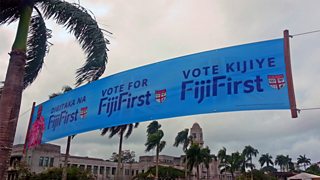
Fiji election banners
Around the capital, Suva, however, the sand tends more to a dirty grey colour, and near the main port the sea is occasionally patched with oil. Fiji’s politics, too, are less than pristine.
Left a tricky economic and social legacy by the decolonising British, the Fijians have not found it easy to embed a stable system of multi-party democracy. Since independence in 1970 there have been four coups, the most recent in 2006.
That triggered a series of further constitutional upheavals at the end of which the former head of the military, Josaia Voreqe Bainimarama, emerged as prime minister.
In the absence of elections, Fiji was suspended both from participation in the Pacific Islands Forum and the Commonwealth. The prime minister promised a new constitution and a return to multi-party elections before the end of 2014.
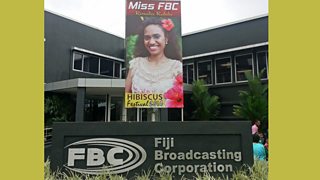
Fiji Broadcasting Corporation
Fiji’s news media is now crammed with reports about the election campaign. There are seven parties competing for votes. Their campaign rallies and policy proposals are covered in considerable detail, and party leaders and spokespeople are given space and time to set out their platforms. Election stories fill a greater proportion of column inches and broadcast minutes than is ever the case in the UK. Much of the coverage is at least as solid as you would find in a British city with a population similar to Suva’s 170,000.
But, while the coverage is comprehensive, there isn’t much critical edge. The media are regulated by a government decree and the government’s Media Industry Development Authority. Coverage of the election campaign is further constrained by an electoral decree issued earlier this year. The government buys a lot of advertising and the chief executive of the state-owned broadcaster is the attorney general’s brother.
The two main newspapers are the Fiji Sun and Fiji Times. The Fiji Times tends to be a bit more critical of the prime minister than the Sun, but is still very cautious. Beyond the influence of the government lie various blogs and Facebook pages. Some look like responsible critique. Some appear primarily interested in stirring things up. The situation is complicated by the fact that on issues such as race the prime minister has a reasonable claim to being more progressive than his main rivals. As usual with politics and the media, it’s all a bit messy.
Given the central position of the news media in Fiji’s contemporary history, it would make sense that journalists with experience of robustly contested political and media environments might have some useful thoughts to share. What I wasn’t quite sure of until I got there was what sort of thoughts would be most useful.
Patrick Gregory, a former BBC Westminster colleague, and I had put together a proposal for a project aimed at building parliamentary reporting skills ahead of elections in both Fiji and the Solomon Islands late this year. After various negotiations, the British High Commission in Fiji and the Pacific Centre of the United Nations Development Programme agreed to co-fund a three-day workshop in Suva.
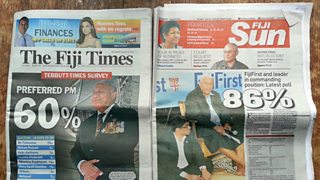
Reporting of Fiji polls
The workshop participants were fantastically welcoming and enthusiastic. Both main Fiji papers had sent reporters, plus we had senior TV journalists, a reporter with the leading local news website, and another from a regional business news magazine. Only one of the group had done any work in the old parliament when it last sat eight years ago. We were also joined by two parliamentary media officials from the Solomon Islands.
They were sophisticated, sharp journalists, so the first material to be ditched was some of the more basic, introductory, discussion of news values. They were well into coverage of the election campaign, so that also stayed on the memory stick. And while we all knew what was meant by independence and impartiality, we also understood the practical constraints under which Fijian journalists have to work.
The material that worked best was that relating to the practical reporting of a parliament. With just one chamber and 50 MPs, the new parliament of Fiji will look quite different to Westminster, but the basic processes of law-making and government oversight are common. Just as we would look for one sort of story at Question Time and something different during a committee inquiry, so it will be for Fiji’s parliamentary reporters. None of this would have worked without our having substantial, practical experience of reporting a parliament.
So what will the outcome be? Above all, we hope Fiji’s journalists will have a little more confidence in reporting the new parliament. If they can report accurately and engagingly the questions and criticism of opposition MPs and the responses of government members, they will be opening up the political debate. Without having to take the risks involved in publishing their own political judgements, they’ll be adding that critical edge. Good reporting will encourage better behaviour by MPs. Both will encourage the electorate to follow, support and sustain the parliament.
Patrick and I will be staying in touch with the reporters during the early days of the parliament. Only then will we know whether we have been of any assistance. If there is progress, it will be down mainly to the skill and courage of the journalists doing the reporting. But it will also confirm our belief that it is through a step-by-step, practical approach that the capacity to report robustly and well is best built.
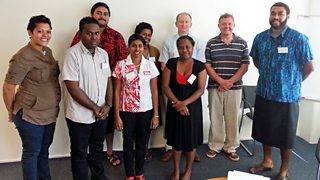
Fiji workshop participants (the author is second from right)
