
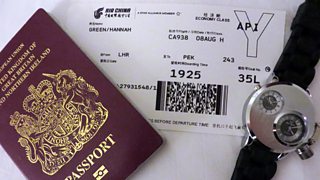
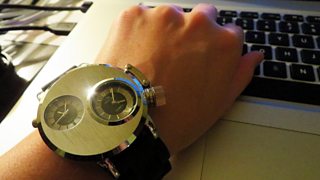
Firstly my watch has two faces - one set to London time, one to Beijing. (And, yes, it definitely makes me feel like some kind of secret agent!)
Secondly - and a more obvious difference - is that the editor who I've been producing for in the past few months, Carrie Gracie, isn't sat next to me. She's currently 8,000km away in China.
We won’t always be separated as I’m now heading out there for a few weeks - my first time in this role.
It’s a big role because Carrie is the BBC's China editor, meaning we have to provide material to all - TV, radio, online, on-demand, social media - often all at the same time. This gets particularly tricky when you are working on breaking news or a developing story. Managing all of the different output certainly keeps me on my toes.
The time difference is sometimes an issue too. For instance, if we are editing or, worse, doing a live for the News at Ten, it’s five or six in the morning in Asia with the sun already rising on a new day!
Yet being in two different time zones does have its advantages. For starters most of the working day in China has already happened by the time London even wakes up. That means we're first in the queue with our news and ideas for editors and programmes.
But I’m also incredibly keen to report China not just from inside China. Carrie will actually be based out of both Beijing and London - allowing us the freedom to report from round the world, because China’s influence and power extends far beyond its borders.
It is more than just a country: it is a phenomenon that is changing global dynamics. That’s something the audience is realising and is hungry for information on. It’s our job to help tell and explain the China story, often from a Chinese point of view. It’s something which is genuinely so exciting to be a part of.
As a rule, I follow up things that interest me. I studied development economics of China and East Asia, so I am already a bit biased (I’m a hoot at a dinner party) and constantly read books, articles, websites and newspapers about the region. Twitter is another great source of information, as news on social media will often beat the press wires, and also gives you a perspective from real people - who are ultimately the people you are broadcasting to.
Chinese social media is another great source of information, but unfortunately I don't speak Mandarin. This also proves hard when I'm trying to set up filming. I have to rely on colleagues for translation help: the Chinese service in London, local producers on the ground, but, most importantly, Carrie - as she is fluent.
I can't stress, or eloquently put into words, how useful this is! It allows us the freedom to do interviews in Chinese, make sure nothing is lost in translation and smooth any issues we may have. You can achieve so much more with people if you speak their language.
Anyway, my bags are packed for a month away, my passport has a shiny new journalist visa in it, and my Air China boarding card is printed. I'm addicted to travelling and will be very happy living out of a tiny suitcase, moving from hotel to hotel for the next four weeks.
I've been lucky enough to have visited more than 70 countries so far, and I'm so excited to see more of the country I've studied. Oh, and to eat my body weight in dumplings! Wish me luck!
The BBC College of Journalism’s Chinese websites: Simplified and Traditional
