Getting into journalism: Bring a different story - refugee Jamal Osman

Cathy Loughran
is an editor of the BBC Academy blog
The third blog in our series on alternative ways into journalism is about the inspirational experience of Jamal Osman - a former asylum seeker and now award-winning Channel 4 reporter and film-maker:
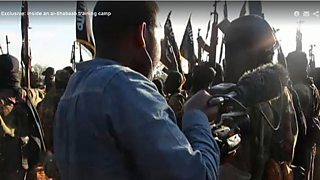
“Many of these migrants don’t make it - some end up in jail or back where they started. In a way I was retracing my own story,” says the Somali journalist who sought asylum in the UK in 1999.
“I’d left my home in southern central Somalia several times during the 1990s, getting as far as Djibouti, Kenya, even South Africa, but always came back - all the time hoping that the civil war and the unimaginable violence that had been raging in the region since 1991 would settle down. Eventually I decided that it wasn’t going to work out. It was still very difficult to leave for good.”
As the fourth of seven children, and with his older siblings having already fled the conflict, Jamal left school aged 10 or 11 and cleaned cars, polished shoes and washed dishes to help support his family. By 1999 he’d saved some money and got help from relatives to pay smugglers to get him as far as the UK, where he arrived aged 20 knowing no-one and speaking only a few words of English.
He gained refugee status after a year, working in a succession of low-paid manual jobs: “But I needed to send more money home to try to lift my family out of poverty. By 2002 I’d started thinking seriously about journalism, mainly because of what I’d experienced in my childhood: the violence, injustice, the many abuses. When I thought what I could do to help myself and my people, journalism seemed to me to be the best option, although at this stage I had still to meet a working journalist.”
It is hard to imagine a bigger mountain to climb. But after several failed attempts to pass the English test in order to return to formal education via a foundation course at his local London college, the would-be student’s sheer persistence wore the college authorities down: “I just wouldn’t take no for an answer. They let me in.”
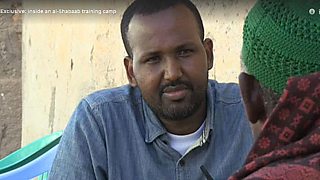
In 2006 - and by now a married father of two young children - Jamal was accepted on to a BA degree course in journalism at Kingston University. “I was the old guy in the classroom, and the kids on the course laughed at me. But a lecturer called Brian Cathcart saw how serious I was and took me under his wing.
“Within months I was sending off stories and ideas to local papers, even the Guardian, and unsurprisingly getting rejected. Eventually someone gave me a try out and I started writing bits and pieces for my local papers, the Wandsworth Guardian and South London Press. Some of it was rubbish, of course, but I never gave up.”
Jamal became news editor of the Kingston student newspaper - the stand-out candidate for the job, Brian Cathcart recalls. He was also using some of his student loan to travel in the summer holidays to Kenya, trying to interest newspapers in South Africa and beyond in original stories about East Africa. “That was unpaid at first, but later I was paid for the work I was doing.”
The ambitious mature student also applied for work experience at the Guardian, the Independent, the BBC and elsewhere, to no avail. But Channel 4 News had noticed a regional article he’d written for South Africa’s Mail & Guardian and contacted him to supply background on a story it was investigating in Ethiopia.
“I saw an opportunity and convinced the producer that if I were to come along too, with all my knowledge of the region, they’d be more likely to get the story. That was the beginning - the rest is history.”
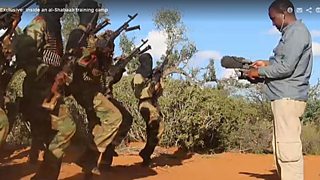
In the final year of his studies Jamal pitched stories to Channel 4 about Somali pirates and a proposal to get inside an al-Qaeda-linked al-Shabaab training camp in the Somali bush. “I did the first of the al-Shabaab stories in 2008-09, developing relationships and a certain amount of trust that has enabled me to return more than once.”
When asked what work is he most proud of, he doesn’t hesitate: “The big one for me was exposing corruption in the UN’s world food programme for Somalia. We saw desperate people in Mogadishu and then guys in five-star hotels in Nairobi. It was a long and dangerous assignment – these were really powerful people.”
That investigation was recognised by a top Foreign Press Association award. The winner adds: “I like going after the bad guys.”
Other prizes to have already come his way include awards from the Royal Television Society, the Rory Peck Trust and One World Media.
What would be his advice to aspiring journalists still waiting for their break? Jamal is asked that question a lot, he says, particularly by young members of ethnic minorities: “I tell them that some editors will recognise that you’re worth trying, especially if you’re an unusual character with lots of ideas.
“I realise that someone like me is in a unique position to do certain stories – not many people could hang out with Somali pirates, even fake ones - and the stories I do don’t come from newspapers; they come from inside my head. My success has a lot to do with my early experiences.
“But if there is something unusual about your approach it can work to your advantage as a journalist. My best advice is to think positively and don’t be deterred, even when it gets really tough. I remember walking the 90 minutes each way to university because I didn’t have the bus fare. Some things are just worth the sacrifice.”
Getting into journalism: Just go out and do it, says VICE maverick Tim Pool
Getting into journalism: Less doctor talk at the dinner table
How to become a BBC journalist
BBC director general Tony Hall announces new apprenticeship schemes
