Infra-red cameras expose hidden world of migrants at risk

Steve Holloway
is a senior camera operator for BBC South East
In the second of our posts on high-impact investigative reporting by BBC regional news teams, Steve Holloway describes how technical innovation eased the editorial process on a difficult and sensitive story:
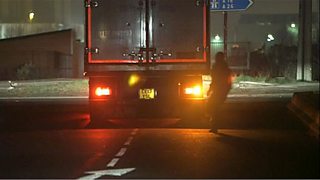
Together with a set of cheap DIY security cameras, the large-format Canon C300, which is new to BBC News, allowed me to capture the pictures and sound that really told the story. Our night time footage showed desperate migrants, most from Africa and the Middle East, clambering under trucks and chasing lorries along pitch black streets around the French port. Two migrants recently died attempting to reach Dover in this way.
With BBC South East special correspondent Colin Campbell and TV investigations producer Audrey Green Oakes, I was in Calais to investigate reports of a recent surge in migrants trying to enter the UK, thought to be fleeing conflicts in countries including Syria, Afghanistan, Iraq, Libya and Eritrea.
We met one lorry driver whose truck had been boarded by migrants without his knowledge and who allowed us to film his vehicle as he drove to the port. We attached our own cameras to another lorry which stopped, of course, as soon as the two migrants who’d climbed underneath were caught on film, so as not to endanger their safety.
From previous visits I knew that the areas I would be filming had little or no street lighting and there was no prospect of adding light without scaring off the people we wanted to record. And as we thought that the main thing we would be trying to film were people breaking into trucks in the dead of night, I packed some infra-red (IR) cameras.
The ones I strapped to various positions on the truck were just a cheap home security kit, powered with an inverter from the cab. These cheap IR cameras aren’t perfect - the LEDs glow slightly red - but the infra-red light they emit is invisible to the human eye.
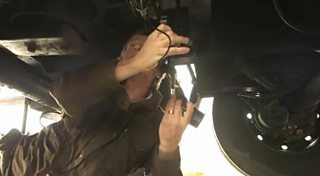
It soon became clear that covertly filming sleeping trucks wasn’t going to get us anywhere, so we turned our attention to trucks travelling close to the docks themselves.
Colin Campbell had done some filming years previously when a camp that became nicknamed ‘the Jungle’ had sprung up in Calais and desperate migrants were sometimes seen running after moving trucks. He and his cameraman had managed just a few fleeting shots by following lorries into the port and flashing up the main beam headlights to film - not ideal as the migrants would unsurprisingly disappear and the team got the odd rock thrown at their car for their trouble.
So, armed with the C300, we tried the same thing without the headlights. We didn’t need them. The first shot I got was of a man running behind a truck and ducking under the axel. The camera’s extra sensitivity meant I could see clearly in a street with virtually no lighting and we could drop back a long way so as to not put off our subjects. Critically, the Canon’s lenses have image stabilisation. Those shots would have been barely usable without it.
But the C300 I’d hired for this job really came into its own when it came to filming our subjects up close. We were in pitch darkness but the picture remains usable.
Because the camera had no top light, and without the silhouette of a large camera on my shoulder, it was much less intimidating. The people we shot knew I was filming but they weren’t fazed in the way I knew they would have been had I been using a conventional ENG camera.
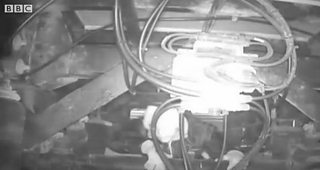
Back in Calais, when two men climbed on to the axel of our truck, attempting to stow away, the infra-red security camera in position recorded that too.
Dover-bound migrants filmed sitting on lorry axles
BBC South East Today on BBC iPlayer
Undercover investigation goes out on a limb to expose racist letting agents
