Has Libor changed the public debate about the financial crisis?

Steve Schifferes
is director of the financial journalism MA, and Marjorie Deane professor of financial journalism, at City University, London. Twitter: @saschiff
It has certainly been remarkable that up to now public anger at bankers – who are still blamed for the crisis – has lacked any real and enduring focus. Even the controversy over Fred Goodwin’s pension and knighthood was short-lived.
The Libor story does seem to have some of the key elements to make it a running story: a smoking gun (in terms of emails), real harm to individuals (if it resulted in higher interest rates), and light being shone into another dusty and unregulated corner of the City previously unknown to the public.
It has also sparked a public inquiry - if not on the scale of the Leveson inquiry, at least one that will keep the controversy in the public eye.
Such commissions can sometimes have unexpected results. After the crash of 1929, it was the Pecoria Committee, set up by the US Senate in 1933, which called the bankers to account in public testimony – in such an excoriating fashion that it led directly to the Glass-Steagall Act and the creation of the SEC (Securities & Exchange Commission).
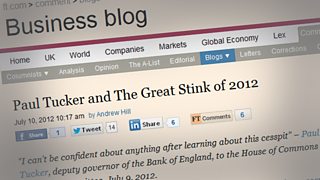
This time there has also been a remarkable change of tone in the financial press, with the cover of the Economist magazine emblazoned with the word "Banksters", and the Deputy Governor of the Bank of England widely quoted with his description of the state of affairs as a “cesspool” (echoed by the Financial Times blog on the “Great Stink”).
But the truth is that, despite the rumours circulating for years about the problems with Libor, the story was not broken by the media but the regulators. One reason, as Gillian Tett wrote in the Financial Times, is that in the past her attempt to investigate Libor “sparked fierce criticism from the BBA [British Bankers' Association] and the big banks; the word 'scaremongering' was used.”
Before the crisis, the regulators, who might have provided a source for investigative journalists, were remarkably negligent in their oversight. And the banks, as was recently revealed, are still spending large amounts in private lobbying trying to weaken or delay regulatory oversight with relatively little public debate.
Sources on this scandal were hard to come by in the financial world, and this had limited the scope of investigative journalism. Nor in the past would most editors have taken kindly to a six-month investigation of Libor fixing rates.
But this moment provides the opportunity for a more wide-ranging investigation by the press into what went wrong in the banking sector, and how it could be put right.
Although explaining Libor to the public is still a hard sell, the broad-based revulsion at the scandal could well be a turning point – especially if it were to trigger more investigations which revealed more wrongdoing. The impetus for reforming the banking sector has been given a push, even if it briefly deteriorated into a political blame game.
When we look back, I suspect this may well be the crucial moment when anger over the crisis turned to action – especially if there is enough oxygen of publicity to fan the debate.
