
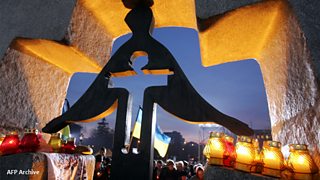
Monument to victims of Ukraine's Great Famine, Kiev, 2005
A native of Barry in Wales, Jones was determined to travel the world and find excitement. His groundbreaking journalistic scoop was to reveal the story of the Ukrainian famine in 1933.
Stalin’s forced collectivisation and industrialisation had horrific consequences and the Soviet regime wanted to keep them secret from the rest of the world. Even today it is not something widely understood, but more people died in Ukraine during that period than in all countries during the whole of the First World War.
Jones was also a sometime aide to Lloyd George. He died under mysterious circumstances on the day before his 30th birthday, possibly because the Soviet secret police were not happy with his revelations.
Jones had visited Russia before 1933 and, having heard rumours about terrible events in Ukraine, used his connections to arrange another visit, when he managed to reach the affected areas. He found streets piled with dead bodies and desperate starving peasants, abandoned by Stalin and his dogmatic policies.
But when Jones returned to the UK his story was not well received. Sympathy with the New Model period of the Soviet Union was still high and fellow travellers (including Lloyd George) did not want to believe stories about a red terror and the consequences faced by a suffering population.
The Manchester Guardian was one of the few to publish his reports. The press corps based in Moscow discredited the story and one journalist famously invented the phrase ‘You can’t make an omelette without breaking eggs.’
Many years later, the economist Amartya Sen won the Nobel Prize for his work on the relationship between famine and democracy. His analysis demonstrated that, contrary to conventional wisdom, famine is not the result of natural causes such as weather and lack of available food. The origins of famine are always social and political, based upon entitlements to food or, crucially, the lack of entitlement by a vulnerable group. And, memorably, Sen argued that there has never been a famine in a country with a free press.
The brave work of Jones showed in the 1930s how vital the role of reporting was to exposing the famine.
In recent years other authoritarian regimes have been responsible for other ‘hidden’ famines, notably in Zimbabwe and North Korea. Journalists have been kept away and widespread suffering caused by political failings has remained a secret.
In China, Mao’s so-called Great Leap Forward at the end of the 1950s was inspired by political pressures very similar to those exerted by Stalin in Ukraine. The result was a famine which was arguably the greatest catastrophe of the 20th century, causing the deaths of estimated 40 million people.
Yet the story has only been exposed in the past decade, almost half a century later. Even now the Chinese refer to this period as ‘three difficult years’ rather than a politically motivated disaster.
I have been interested in the relationship between the media and famine for some years, and have used the BBC written archives and Freedom of Information requests to highlight the role of the media in reporting the Ethiopian famine in the 1980s.
I am now finishing a book with the working title ‘Reporting Disasters: Famine, Politics, Aid and the Media’. The story of the young reporter Gareth Jones and his brave revelations is a fine example of the central role that journalism can play in uncovering the real story of famine and its effects.
