I have seen the future - in a little square above my right eye

Charles Miller
edits this blog. Twitter: @chblm
Arthur C Clarke famously said that a really advanced piece of technology “is indistinguishable from magic”. I think Google Glass qualifies - at least as the kind of magic you get in pantomimes. Except that instead of having to say ‘abracadabra’ to make it work, or even ‘bippity, boppity, boo’, Google Glass requires you to say “OK Glass” - in a nice loud voice.
I’m serious. It actually does. It’s kind of embarrassing the first time you say it - especially if you’re already feeling a little self-conscious because you’re trying out one of the very few pairs of Google glasses in the UK with everyone looking at you.
That’s probably just me being British - which turns out to be a problem in itself. It’s harder for Brits to make the device understand when they say the magic words because it’s programmed to recognise American accents. And trying to suck up to a gadget by saying “OK Glass” in a fake American accent really is embarrassing.
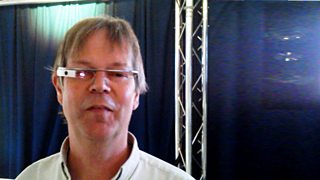
Say bippity, boppity, boo
They were the winners of a Google competition to suggest future uses for the technology. Bob’s idea was that it could give “situational awareness” to police and fire-fighters - telling them about the specific dangers of a location they’re working in by channelling online information through their glasses.
He’s had the glasses for a few months now and has been wearing them in the street - first in New York and now in London. In New York, he said, people were constantly coming up to him and asking about the glasses and wanting to try them; in London, “not one person talked to me”. He’s not paid by Google to enthuse about the product, nor to call himself a Glass Explorer, which he does. (That’s what Google calls its lucky winners.)
So what can they actually do?
There were little waves of appreciative noises and awed smiles from the group as Bob put his glasses through their paces for us. Here were some videos he made using the inbuilt camera as he was walking along the street. On the big screen (because the glasses were linked to a tablet via Bluetooth that plugged through to the screen) we saw some pretty respectable shots of London: a bit wobbly, because he was walking, but not impossibly so. It was 720p high-definition video stored in the glasses’ memory. Even the night-time footage was OK. And a shot through a train window was pretty steady.
There were a couple of short interviews where it was immediately obvious that interviewee sound is a problem - as you’d expect when the interviewee doesn’t have a mic. The pictures weren’t bad so it might be possible to give your interviewee a separate audio recorder and sync that output to your pictures, but it would be extra work.
Then there’s a human problem: the interviewer needs to remember not to nod encouragingly to the interviewee or they’ll make viewers seasick. And don’t use Google Glass if you have a list of questions on your lap that you like to glance at during answers.
“OK Glass, take a picture,” said Bob, obviously completely comfortable with the relationship. Glass responded with a still of what Bob was looking at (us). Within seconds it was up on Twitter.
If you connect your glasses to any Android device you can use mapping. “Get directions to Oxford Circus,” ordered Bob. The route appeared on his screen and oriented itself according to the direction he was facing. There’s already an app called Field Trip which offers information about nearby places. So, as we were in White City, Bob was shown a history of Television Centre with the option of having it read out as audio so he wouldn’t have to look at the text.
There’s no keyboard or mouse of course. You're just looking a small display above one eye. It's easier to focus on than you might expect, even to read from. I can already imagine the day when you worry whether the glasses wearer you're talking to is actually paying attention or just reading from the internet while appearing to be with you. To select items or move between pages, you rub the side of your glasses, which makes you look extra shifty.
There will be complicated security and privacy issues associated with the glasses. What if there was a facial recognition app so you could find out instantly who you were passing in the street? And if you lose your glasses or they’re stolen, everything in your Google account, including emails, is potentially accessible to whoever picks them up. But, as Bob said, many of the issues are the same as those associated with smartphones, just in a rather more vivid form.
Then there’s the whole question of whether you actually want your online life as a constant part of your field of vision. Bob acknowledged the dilemma, saying that today it’s not so much about trying to achieve a work-life balance but figuring out how to cope with the “work-life blur”.
But don’t get me wrong: looking through Google Glass felt like looking at the future. There it was - a little square of information above my eye. People left the demo wondering if they’d remember it for years to come as the moment they first encountered a technology that was to take over their lives. I wouldn’t bet against it.
The demo reminded me of something from the dim, distant past, and eventually I remembered what. Soon after I started work, I was a researcher on a documentary which included an interview with Peter Sellers. He was staying in a suite at the Dorchester. It was 1980. After we finished filming, Sellers entertained us with drinks and brought out a new toy none of us had heard of. We passed it round and everyone was allowed to try it out.
It produced the same kind of wide eyes and broad grins as Google Glass did yesterday. We’d never experienced anything like this. Would there be a time when we’d all be able to get one of these ourselves? Yes, the Sony Walkman once seemed like magic too.
