Lost in translation? What exactly does Russia mean by an ‘act of provocation’ in Syria?

Stephen Ennis
is Russian media analyst for BBC Monitoring.
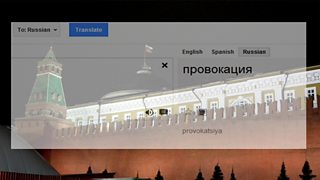
On Radio 4's Six O'Clock News on 17 September, the BBC's Moscow correspondent Daniel Sandford reported on the meeting between French Foreign Minister Laurent Fabius and his Russian counterpart Sergey Lavrov. Sandford said that according to Fabius the UN report published the day before "left no doubt that the Syrian government was responsible for August's chemical weapons attack". Lavrov on the other hand insisted that there were serious grounds for believing the attack was an "act of provocation by the rebels".
The phrase "act of provocation" is a translation of the Russian word "provokatsiya". But "provokatsiya" is a bit of a false friend, or at least a slightly ambivalent one.
The definition of "provocation" in the Concise Oxford Dictionary (COD) speaks of an "act or instance of provoking", a "cause of annoyance" or an "action, insult etc held to be likely to provoke physical retaliation".
This is subtly different from the definition of "provokatskiya" given in Ozhegov and Shvedova's Defining Dictionary of the Russian Language (1998). It speaks of "treacherous behaviour" and "inciting someone to actions" that may have "serious consequences for him". It also says that it can mean "aggressive actions committed with the aim of instigating military conflict".
In today's often murky world of media and politics in Russia, "provokatskiya" often refers to a stunt or hoax designed to compromise or embarrass someone (as discussed in an earlier feature on this blog).
These differences in meaning can lead to confusion.
For example, when UK political blogger Rob Marchant commented on the Russian Foreign Ministry's response to the Damascus chemical attack a few days after it took place, he had this to say: "Syria said they were not responsible. Russia said the opposite, that they were responsible but - wait for it - it was a deliberate ploy by the rebels to provoke them into action.”
But, Marchant continued, "Why anyone would want to provoke a chemical attack on their children is something beyond the wit of man to comprehend.”
Marchant referred to a piece on Now, a website specialising in Middle East affairs, which had quoted the Russian Foreign Ministry as describing the attack as a "premeditated provocation".
But the Russians were certainly not saying what Marchant thought they were saying. They have insisted all along that it was the rebels and not the Syrian army that had carried out the attack.
Radio 4 listeners familiar with the arguments raging over the Syrian conflict will no doubt know that when Moscow is quoted as accusing the rebels of an "act of provocation" it is suggesting they carried out the chemical attack for their own ends.
But less informed or attentive listeners might easily make the same mistake as Marchant and imagine that the Russians are accusing the rebels of somehow bringing the chemical attack upon themselves.
The problem is that there is no obvious English equivalent for the Russian term "provokatsiya", and that is why translators fall back on the phrase "act of provocation".
The English phrase has a clear implication of goading someone into retaliation, whereas the Russian word also has other meanings, including a ruse or stratagem designed to hoodwink, confuse or discredit.
For the sake of clarity, though, journalists reporting on the Syrian conflict might like to add a phrase or two to explain what Moscow has in mind when it uses the term "provokatsiya" - to stop their audiences from falling under the same kind of misapprehension as Marchant.
Source: BBC Monitoring analysis 18 September 2013
