Russia's public service TV channel launches under fire

Stephen Ennis
is Russian media analyst for BBC Monitoring.
Russia's first public service TV channel, OTR, which began broadcasting on 19 May, has received mixed reviews. The channel has been characterised, for instance, as "a fat not-so-young opera diva playing a light-footed youthful heroine" or the elderly Mr Burns from the US cartoon The Simpsons "dressed up as a teenager and using youth speak".
OTR's genesis dates back to the post-election demonstrations in Moscow in December 2011. The proposal to create a TV channel which, in the words of then president and current prime minister Dmitriy Medvedev, would be "free of excessive state influence" was one of a series of measures apparently aimed at placating metropolitan liberals.
But OTR's debut comes amid an authoritarian and reactionary backlash in Russia a year after Vladimir Putin returned to the Kremlin as a third-term president.
The original plan had been for the channel to be largely financed by voluntary subscriptions. Public indifference soon put paid to that. Instead, OTR receives direct funding from the state, as do the main state broadcaster VGTRK and the foreign-language station RT (formerly known as Russia Today) - both of which repay government largesse with doses of pro-Kremlin propaganda.
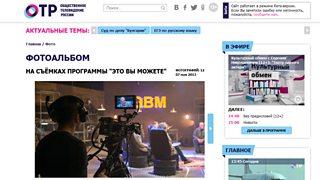
The fact that OTR (above) receives state funding has raised questions about its independence. And the fact that this funding has amounted to less than $50m a year has limited its ability to produce high-quality programmes.
Columnist and former TV presenter Olga Bakushinskaya (author of the diva metaphor) observes caustically that in "all OTR's programmes, guests sit around a table talking". This is an exaggeration, but only a slight one. On 22 May, a two-hour talk show about fantasy role-playing games was followed by a studio discussion about modern classical music and then an opinion slot featuring the editor of a political weekly.
Funding restraints have also meant that many of the documentaries on OTR are hand-me-downs from the big state-controlled channels or obscure provincial productions, such as one shown on the first day about spiritual life in rural Bashkortostan (a republic in the Volga region).
Bakushinskaya reports that within a few days OTR had reduced her to a "state of dumb stupor". Her fellow critic Irina Petrovskaya wrote ironically in opposition newspaper Novaya Gazeta that watching OTR sent her into a "sound and healthy sleep".
Petrovskaya's main gripe was with OTR's news bulletins which consist almost exclusively of feel-good apolitical stories from the provinces. The channel has set itself the task of being a window on the regions - helping Russians to know their own country. But news bulletins including stories such as that about an academic lecturing in a cafe in Novosibirsk or an exhibition of historical paintings in Dagestan struck Petrovskaya as oddly detached from reality - especially as they coincided with more dramatic events such as a bomb explosion in Dagestan's capital, Makhachkala.
OTR's news policy is symptomatic of what Petrovskaya called a "panicky horror in the face of the topical and contemporary".
Journalist and blogger Irek Murtazin said its air of "naive provinciality" reminded him of his days working on regional TV in northern Russia in the early 1990s. OTR is meant to be "public service TV, not a nostalgia channel", he complained.
Murtazin was one of several critics who detected the influence of 76-year-old veteran TV executive Anatoliy Lysenko whom Putin appointed to head OTR last summer. Lysenko is widely respected for remaking Russian television during the end of the Soviet era, but has not been active in the industry for the best part of a decade.
On 22 May, Social Network featured a pithy and balanced account of the trial of blogger and anti-corruption campaigner Aleksey Navalnyy on fraud charges widely believed to be fabricated. Co-presenter Vladislav Sorokin, an experienced TV journalist, reflected these concerns by saying the trial was more like a "street fight" than a proper judicial process. Two days later, the show was host to radical leftist writer Zakhar Prilepin who predicted that Russia would sooner or later face another revolution.
Content like this is unlikely to be seen on mainstream TV in Russia, and partly gives the lie to accusations that OTR is "just another state channel". But neither is it unique: it is the staple fare on niche liberal channel Dozhd, which recently celebrated its third birthday.
Lysenko has responded to his critics by pointing out that OTR is still in a "trial" phase (broadcasting eight-hour blocks repeated throughout the day) and is only due to become fully operation in the autumn.
But it is far from clear that the channel will last until then. As Lysenko admitted at a press conference to mark OTR's first 100 hours on air, the channel's current funding is likely to run out in August or September.
