Shooting for screen: cultural associations create subtle differences

Charles Miller
edits this blog. Twitter: @chblm
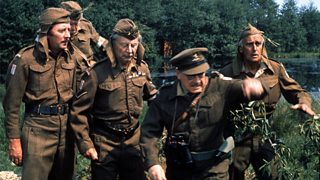
Progressive: Dad's Army on location
Do you favour progressive? I don’t mean Emerson, Lake and Palmer or Rick Wakeman’s concept albums (am I showing my age?). I mean progressive video.
Let’s start at the beginning.
Moving pictures on television or on a computer screen can be shot in two main ways: progressive and interlaced.
The difference is in how the individual frames (25 per second) are each made up of two video fields. (Stick with me, we’re almost there.) In progressive video, the two frames are captured at the same instant, whereas in interlaced they are captured sequentially.
That means there’s twice as much motion information in interlaced than in progressive video. So interlaced video produces smoother motion on screen.
You might think then, that if offered a choice, everyone would opt for interlaced rather than progressive. Why choose jerky when you could have smooth, more realistic motion?
But the choice is more subtle, more cultural, less technical than that.
In fact it’s so complicated that it was the subject of a talk by Chris Price, a BBC production support specialist, to a group of producers at the BBC this week.
The first thing to note is that film (as opposed to video) is always progressive: there are no fields involved - just individual pictures on a long roll, projected by shining a light through them, followed by a moment of darkness while the next frame is moved into place.
The rate at which film is shot - 24 frames per second - was a compromise between the desire for more frames per second, to make motion look more realistic, and the need to minimise the amount of film stock used because it was expensive. (Early film was shot at 18 frames per second, which really didn't look good.)
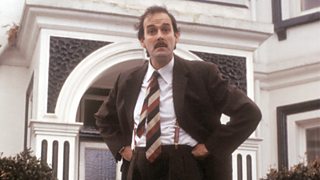
Basil Fawlty
So what is so great about progressive?
Well, it doesn’t just remind us of old sitcoms. It also reminds us of the movies - which have high production values, are beautifully lit and shot, and, let’s be frank, look expensive.
It’s probably this strange, vague association that makes progressive the style of choice of television drama and many documentaries.
And that slight jerkiness may also have a value in itself. In his talk, Chris showed a horse race in which the sequence switched from interlaced to progressive. You don’t usually see horse racing in progressive, but on this clip, it lent a kind of energy, drama even, to the shots. In the right hands that can add to a production in a subtle way. Think of it as a kind of visual effect.
So what has interlaced got going for it? Well, because it’s used for news and sport it carries associations of immediacy, factual truth and, somehow, reality. To me, it looks like ‘real television’.
Chris pointed out today’s fault-lines between progressive and interlaced: in Crimewatch the studio is interlaced (immediate, live, real) and the filmed reconstructions are progressive (dramatic, constructed, a different timeframe).
Most drama, including Casualty and Holby, is now shot progressive, with only EastEnders and Coronation Street holding out with interlaced.
Chris said that if a series switches to progressive, viewers will often complain that “it’s all gone blurry”. But, as he explained, it doesn’t have to be like that. For best effect, movement just needs to be shot differently in progressive. A shot that follows a moving object or person, for instance, can produce smooth motion and separate it from the background with an almost 3D effect that you couldn’t get with interlaced.
So, progressive or interlaced? It’s an unusual debate: of some importance to programme-makers but producing a result that most viewers won’t even be aware of. And, very unusually, one with no implications for the programme budget.
The final irony is that most modern televisions are set by default to override the progressive look, and randomly attempt to convert to an imitation of interlaced. You can switch it off by searching through your TV menu. Look for the motion processing option (called something like Clear Motion or Motionflow, depending on the manufacturer).
Then you can see what the director intended you to see.
