We need an international media strategy against the likes of Islamic State

William Horsley
is international director, Centre for Freedom of the Media
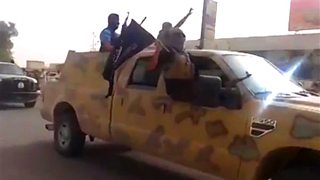
Islamic State fighters in Mosul in June
Maybe the world’s free media organisations should be holding their own strategic summit meeting, too. Because they also face common existential threats, and need to pull together.
There would be plenty to talk about.
Like how to recover working access to the virtual no-go areas where many mainstream media have been effectively shut out: places in the Middle East and Africa under extremist rule or racked by armed insurgencies. That drastic development has squeezed the flow of impartial coverage of events to the outside world from many war-torn and unstable countries.
And like saving lives. The two murdered US citizens, James Foley and Steven Sotloff, were highly experienced war reporters. Both also worked freelance for publications of global repute. When the risks are judged too high for a lot of mainstream media, freelancers are often ready to take the risk and bear the brunt of the danger. Most journalists who are killed on the job are local, not international, reporters.
And there’s the brutal fact that journalists and aid workers, instead of being protected as neutrals doing vital work, have become high-value targets to many combatants in today’s chilling version of medieval warfare.
The rising global toll of deaths among journalists - 62 since the start of this year, according to the UN agency Unesco - is a symptom of a wider breakdown of the rule of law across the planet. That calls for more joined-up responses from media organisations and governments than has been seen to date.
In the Middle East, the propaganda effect of the videoed beheading of two US journalists threatens to advance Islamic State’s attempt to seal its information monopoly in the would-be caliphate on both sides of the Syria-Iraq border.
That could change if the killers of those two journalists, and others, are eventually caught and punished. But the sources of extreme danger are here to stay.
The media also need to up their game in exposing the realities of ‘hybrid’ or asymmetric warfare. A feature of many 21st Century conflicts is that armies take with them a complete political and media ecosystem - often one that is violently intolerant of any voices that contradict their propaganda messages.
That is true of Islamic State. And something similar is unfolding in eastern and southern Ukraine where thousands of Russian troops have crossed the border to secure a chunk of Ukrainian territory as ‘new Russia’. In parts of Ukraine under the control of pro-Russian forces, local media have been coerced or taken over to ensure that a pro-Russian version of events prevails. Scores of Ukrainian journalists have been abducted and a dozen are still missing.
The events of recent weeks have shown how overstretched mainstream media are. They have been forced, by hostile environments and the squeezing of news budgets, to close foreign bureaux and reduce their coverage from regions that deserve to be more fully reported.
Are the personal risks for international reporters now just too high? The award-winning Times journalist Anthony Lloyd gave a sober assessment to the BBC’s Broadcasting House programme on 7 September. Lloyd was captured twice during his 14 trips to the Syrian war zone; he was beaten and shot but made near-miraculous escapes both times. Would he go back? He now feels the risk factors outweigh the benefits of what he could do as a reporter if he went again.
The complex factors that now need to be assessed by journalists and editors include the possibility of hostility from local people, governments and armed groups, as well as the severity of the fighting and changeable front-lines.
So what more can journalists and the media do to fulfil their mission to report and stay alive?
In practical terms, hostile environment training, equipment, safety protocols and local intelligence are vital. But in a hostile environment journalists will always be vulnerable to the unforeseen.
Anthony Lloyd wants to see a more unified Western approach to hostage-taking. He challenges the routine practice of maintaining news blackouts about kidnappings, and suggests that the UK and US governments are wrong to claim that their refusal to talk to terrorists reduces the risk of others being taken. In the horrific new ‘business model’ of abductions in the region, the lives of many journalists from other European countries have been traded for large ransoms.
If editors and journalists are serious about action to reduce the soaring risks to journalists on dangerous assignments, they must adjust their focus. They need to focus more energy on holding governments - both their own and others - to account for failing to live up to their public commitments to protect journalists and their work.
That may be uncomfortable. Media organisations have to deal with many governments, and they may be concerned about reprisals in case they probe and press in such a sensitive area. But it may now be the only way to reverse the tide of journalists’ killings. And isn’t journalism about investigating serious injustices wherever they occur?
Two years ago the United Nations launched a Plan of Action on the Safety of Journalists and the Issue of Impunity. Forty international media organisations, including BBC Global News, Thomson Reuters and the World Association of Newspapers, put out a London Statementcalling for all news media to monitor the actions of their governments and judicial authorities to stop targeted violence against journalists and to ensure that the killing of journalists is prosecuted and punished.
And only last December the UN General Assembly adopted a landmark Resolution urging all states to ensure a safe environment for journalists and to bring to justice those responsible for crimes against media workers.
Can it be a matter of indifference that the UN’s latest evidence shows the situation appears to be getting worse?
On 4 November, Unesco will invite all concerned organisations to review the UN Action Plan. Unesco reports that, out of 593 cases of the killing of journalists between 2006 and 2013, fewer than 6% have resulted in the killers’ conviction. The conclusion is clear: impunity is still the rule when journalists are the victims of murder.
On 20 November, at a public meeting in Paris, a key Unesco policy committee will reveal the results of the latest attempt to analyse the conduct of governments around the world in this regard. Out of 62 countries concerned, three-fifths have failed even to respond to requests for information about any judicial follow-up.
Unesco comments that society as a whole suffers from this kind of near-blanket impunity. “The kind of news that gets ‘silenced’ is exactly the kind that the public needs to know,” it says.
The Centre for Freedom of the Media (CFOM) is co-organising a symposium and inter-regional dialogue on legal protections for journalists in Strasbourg on 3 November to mark the first official UN International Day to End Impunity for Crimes Against Journalists. Details are on www.inter-justice.org.
Top image is from a BBC interactive video about the rise of Islamic State
The College of Journalism’s safety section
