How a LinkedIn jigsaw puzzle can reveal a bigger picture

Charles Miller
edits this blog. Twitter: @chblm
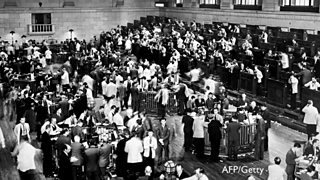
Linked in the old-fashioned way: traders on Wall Street circa 1929
I came across an example of a similar technique using LinkedIn rather than Twitter in Michael Lewis’s gripping exposition of the New York financial markets, Flash Boys.
Lewis investigates how technology lets traders buy and sell shares in microseconds. So-called high-frequency trading (HFT) allows Wall Street businesses to build systems which spot a forthcoming share order, and use the information to make their own instant purchases or sales to profit from the change in demand - and therefore price - produced by that order.
Front-running, as it’s called, is not illegal, but it works to the detriment of traditional investors and therefore isn’t something Wall Street wants to brag about.

John Schwall is a former product manager in the electronic trading division of Bank of America, a job that sat between the technologists and the traders. In Lewis’s story, he leaves his job to join a quest by Brad Katsuyama at the Royal Bank of Canada to understand exactly how modern trading works - both technically and in terms of the games played by investors, brokers, banks and high-frequency traders to outwit the market.
Katsuyama was suspicious of the relatively small HFT companies, but he also suspected that the biggest names on Wall Street, the established investment banks, were more closely tied up with them than they wanted to admit.
Schwall set himself the task of researching the personnel of one of the big banks, Credit Suisse, to test the assertion of one of its senior managers in front of a Senate committee - that the idea that Credit Suisse’s own private trading exchange was “somehow part of the HFT debate simply does not make sense”.
Schwall suspected that Credit Suisse and the other big banks were making money by allowing HFT on their own exchanges, the so-called Dark Pools. His way of finding out about this secretive world was by examining the LinkedIn profiles of Credit Suisse staff. He soon found a pattern, as Lewis explains:
“Schwall dug out dozens of examples of Credit Suisse’s computer programmers boasting on their résumés about ‘building HFT platforms’ and “implementing HFT strategy,” or of experience as a ‘quantitative trader on equity and equity derivatives: high-frequency trading'.”
The composite picture from the LinkedIn profiles led to only one conclusion: “Credit Suisse claimed that its dark pool had nothing to do with HFT, and yet it somehow employed, in and around its dark pool, a mother-lode of HFT talent. By the time he’d finished, Schwall had built the entire Credit Suisse dark pool organisation chart.”
Schwall’s boss was impressed with his work: “I was totally shocked when John started to pull out these résumés,” he recalled. “The banks had adopted a policy of saying as little as possible about what they were actually doing. They’d fire people for being quoted in the newspaper, but in their LinkedIn pages those same people said whatever they wanted.”
Katsuyama became so engrossed in flushing out what was really going on in the world of computerised trading that he left Bank of Canada, along with Schwall and some of his other colleagues, to start his own exchange. It’s called IEX and has been built from the ground up to promote what he sees as old-fashioned trading values and to make life hard for the high-frequency traders.
Kaysuyama is running a competitive business but there’s a moral side to it too. If high frequency traders take billions of dollars out of the market, they are reducing the rewards to ordinary investors without risking anything themselves, and are therefore undermining the original social purpose of a stock exchange in providing capital for successful enterprises.
There was a lively debate about Lewis’s book on CNBC: between Michael Lewis, Brad Katsuyama and William O'Brien, chief executive of rival exchange BATS.
