Election dispute divides Afghan media on ethnic lines

Amanullah Ghilzai
is a journalist and analyst specialising in Afghanistan and Pakistan
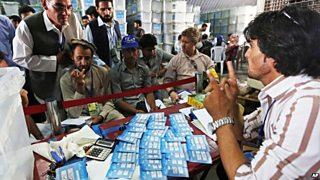
Afghan election
The newly expanded Afghan media played a crucial role in the 2014 presidential election. Analysts commented that one of the reasons for the success of the election on 14 June was that the media were united in supporting democracy - by holding live debates between candidates and encouraging people to vote, despite Taliban threats.
Before the first round of voting, the media focused on the policies of the presidential candidates and avoided discussion of their ethnicity. But a bitter dispute broke out over accusations of fraudulent votes in the second round and the media began to show open signs of partiality, mainly on ethnic lines.
It is now widely predicted that any backlash against the election results could further split the media on ethnic lines. There were signs of that when the powerful governor of the northern Balkh province, Atta Mohammad Noor, an ethnic Tajik and supporter of Abdullah Abdullah, suggested a parallel government if fraudulent votes were not separated from clean ones. This was interpreted by some sections of an Afghan media dominated by ethnic Pashtuns as an attempt to split the country on ethnic lines. Atta Mohammad Noor later clarified that he was advocating a non-violent social movement within the boundaries of democracy - but the media impact of earlier reports could not fully be reversed.
Afghanistan has 75 TV channels and around 200 radio stations, and hundreds of daily newspapers throughout the country. Although many Afghan media outlets are bilingual, Pashto and Dari, some broadcast mainly in only one of these two main languages. Except for the capital Kabul, where the media outlets are mainly bilingual, the southern and eastern provinces are dominated by Pashto radio and TV channels while the northern provinces are dominated by mainly Dari media outlets.
Abdullah Abdullah, though of mixed ethnicity, has the support of most Afghan Tajiks, who dominate some of the northern and western parts of the country and are the second-biggest ethnic group in the country after Pashtuns. Abdullah also has the significant support of ethnic Hazarahs, because a prominent Hazarah leader is one of his vice-presidential candidates.
Ashraf Ghani Ahmadzai is an ethnic Pashtun. Pashtuns dominate the eastern and southern provinces of the country, and are the largest ethnic group.
My own monitoring of media output reveals that, after the start of the election dispute, the vast majority of Afghan media outlets are now openly supporting one of the two main presidential candidates and are clearly split on ethnic lines.
With Afghanistan’s low literacy levels, radio and television dominate the media landscape. Sixty-three per cent of the population listens to radio. Many of these listeners also watch TV, but many others do not have access to it. Roughly half of the population watches television.
Tolo TV, part of the privately held Moby Group founded by Afghan-Australian brothers in part with US aid money, is now earning huge revenues, with more than a third of the population as viewers. Shamshad TV channel, which is mostly popular in southern and eastern provinces, mainly broadcasts in Pashto.
In my own monitoring of news analysis on Tolo TV after the start of the elections debate, I have noticed a tilt towards Abdullah Abdullah. Meanwhile on Shamshad, I’ve seen a similar move towards support for Ashraf Ghani Ahmadzai. Indeed, some supporters of Abdullah Abdullah consider Shamshad TV as no more than a propaganda tool of Ahmadzai. Similar allegiances can be identified in the output of several other television channels.
Interestingly enough, the state-owned TV network of Afghanistan, the RTA, remains one of the most impartial TV channels in the country, both during the election campaign and later in coverage of the election dispute.
When it comes to rural parts of Afghanistan, where radio plays a more important role than TV, the ethnic divide is also obvious. The vast majority of radio channels in southern and eastern parts of the country support Ashraf Ghani, while scores of radio channels in northern and western parts of the country appear to be backing Abdullah Abdullah.
It’s a shame that the praise Afghan media garnered during the election itself no longer seems deserved, as the long and increasingly bitter process leading to an agreed result grinds on.
