Is reporting Syria now an impossible assignment?

Stuart Hughes
is a BBC World Affairs producer. Twitter: @stuartdhughes
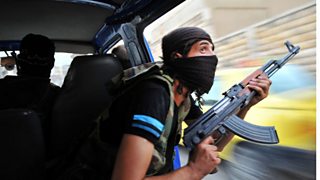
“You can’t get… information without going to places where people are being shot at, and others are shooting at you. The real difficulty is having enough faith in humanity to believe that enough people - be they government, military or the man on the street - will care when your file reaches the printed page, the website or the TV screen.”
Just over a year after speaking those words, Marie Colvin paid the ultimate price for bearing witness to the truth when she was killed by artillery fire in the Syrian city of Homs.
Since her death the dangers have multiplied. Alongside the growing strength of Islamist groups, kidnapping has replaced bombs and bullets as the primary threat. Some are now beginning to ask whether reporting from inside Syria is becoming, to use the title of a recent report by Reporters Without Borders, an impossible job.
The question of whether journalists will be able to continue operating inside Syria is one I raised at a recent debate at the Frontline Club. Panellists were in agreement that even the most experienced journalists cannot protect themselves fully against the kidnap threat.
“It’s an entirely different proposition from the potential of being shot or shelled,” said freelance journalist Emma Beals who has written about the dangers of kidnapping in Syria.
“You can’t necessarily guard against it. You can take all the precautions in the world but at a certain point there’s not much you can do. To me the concept of being kidnapped is entirely more terrifying than how close you go to the front line, which you have a degree of control over,” Beals said.
The increasingly unpredictable situation on the ground is forcing newsgatherers and their editors to consider different ways of reporting the conflict. “A civil war such as in Syria has a lot of implications for the civilian population,” said award-winning photographer Fabio Bucciarelli.
“We can think about trying to report a bit more from the refugee camps in Jordan and Turkey or talk to the people who have already escaped from Syria and are now in Iraq. If it’s too dangerous to go into Syria we can talk about Syria with the people that are escaping.”
Sunday Times associate editor Sean Ryan said his newspaper was in a “very privileged position” because its Lebanese-British correspondent Hala Jaber is able to obtain visas to travel to Damascus and government-controlled areas.
Elsewhere, though, Ryan conceded “Our reporting is going to be confined to the border… from Iraq, Lebanon and elsewhere.”
The Frontline Club panellists shared the sense of pessimism that permeates the recent Guardian dispatch by Ghaith Abdul-Ahad. None could see an early end to the fighting.
Nevertheless, they shared a commitment to continue telling the story of Syria’s people, wherever and whenever they remain able to.
“The pictures I like to do are ones that make people conscious of what is going on,” said Fabio Bucciarelli. “If there’s only one person who after seeing one of my images thinks about what’s going on in Syria then I’m happy with that.”
Photo:AFP/Getty
College of Journalism’s safety content
Paul Wood - reporting from the front line in Syria
Working in hostile environments
Unprepared, inexperienced and in a war zone
Freelancers at risk in war zones are responsibility of us all
Trauma in journalism: What every freelance at risk needs to know
