Russian media and the art of ‘provokatsiya’

Stephen Ennis
is Russian media analyst for BBC Monitoring.
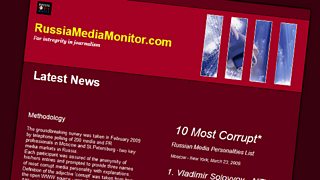
Russia Media Monitor website
Another is ‘provokatsiya’, which literally means ‘act of provocation’, but in a media context often refers to a hoax designed to embarrass or discredit someone.
Provokatsiya can take various forms. One ploy is to create a stir using a fake website.
Back in 2009, the temporarily out-of-favour pro-Kremlin TV presenter Vladimir Solovyev found himself the subject of reports in the media and on blogs that he had topped a list of Russia's top 10 most corrupt journalists. The reports quoted an organisation called Russia Media Monitor whose website said it was an "independent press freedom watchorganization [sic]" with offices in New York and Moscow.
The site is in English, but it is an odd sort of English riddled with the type of grammatical errors often perpetrated by Russians. It also contains very little material other than the corruption listing and a mission statement. It is clearly a fake but it managed to take in quite a few Russian journalists and bloggers at the time.
Another simple ploy used by provokatsiya-mongers is the doctored photo.
Before the 2012 presidential election, a paper distributed by supporters of Vladimir Putin in the Urals city of Yekaterinburg contained an article attacking anti-corruption blogger Aleksey Navalnyy, a prominent member of the opposition protest movement. The article was illustrated with a photo showing Navalnyy grinning in the company of the now-late tycoon Boris Berezovskiy, the man many Russians loved to hate. The caption said Navalnyy "has never hidden the fact that in the fight with Putin he gets money from oligarch Boris Berezovskiy".
Bloggers quickly smelt a rat and soon came up with the original photo that showed Navalnyy beside Mikhail Prokhorov, another oligarch, but one not tainted with Berezovskiy's reputation for skulduggery.
Navalnyy treated the whole thing as a joke, posting mock-ups of himself with a motley cast of characters including Hitler, Stalin and Arnold Schwarzenegger.
Grigoriy Melkonyants of the election monitoring NGO Golos came up with another amusing way of countering a provokatsiya. When just before the 2011 parliamentary election a crew from Gazprom-Media's NTV visited Golos's office clearly intent on no good, Melkonyants followed them around, repeatedly intoning the phrase "You are Surkov propaganda" - a reference to then-presidential aide Vladislav Surkov, the architect of the Kremlin's media strategy.
Melkonyants's YouTube video of the encounter got more than 650,000 views and for the next few days the phrase was the subject of dozens of jokes among Twitter users.
A few months later, though, NTV aired a film called Anatomy of a Protest which alleged that rallies in support of fair elections were funded and orchestrated by foreign governments. The film contained a classic piece of provokatsiya - a scene in which people wearing the protesters' trademark white ribbons were shown queuing up to be paid.
Once again, bloggers were on the case, pointing to a post on crowdsourcing news website Ridus.ru which described how a scene identical to the one shown in the film had been staged in Moscow a few weeks earlier.
More recently, the art of provokatsiya has been reaching new heights (or depths) of complexity and intrigue.
Attempts earlier this year to discredit and undermine liberal and opposition media, including the Russian version of Forbes magazine and newspaper Novaya Gazeta, featured fake companies, a bogus interview, dummy social media accounts, a glamorous "Mata Hari", and a free newspaper claiming to police the press and weed out zakazukhas.
According to Novaya Gazeta, it even involved a company owned by a Kremlin cook that had played a role in filming Anatomy of a Protest.
But even this bit of skulduggery was overshadowed by the strange tale of the fake resignation of the head of state-owned Russian Railways, Vladimir Yakunin.
On the evening of 19 June, an email sent from an account almost identical to the one used by the Russian government for press releases arrived in the inboxes of top news agencies announcing that Prime Minister Dmitriy Medvedev had accepted Yakunin's resignation and appointed his deputy, Aleksandr Misharin, to replace him. The agencies duly flashed what they thought was the day's big news.
The email arrived just as Yakunin was attending a function hosted by Putin and so was incommunicado. It was also just the right moment to appear as a newsflash on official TV channel Rossiya 1's main evening bulletin.
Half an hour later, the story was quashed. But for days afterwards search results on the popular portal Yandex appeared to show a version of the story on the government website.
The email's precise origin remains a mystery. Medvedev's press secretary told journalists the FSB had tracked it down to a computer in Moscow. But pro-Kremlin daily Izvestiya insists it has evidence it came from Irkutsk, where Medvedev was on an official trip at the time.
There is much debate about the motivation behind this provokatsiya. Yakunin said it was an attempt to "discredit" his plans to modernise Russian Railways. But Aleksey Venediktov, veteran editor-in-chief of Ekho Moskvy radio, thinks the real "casualty" is Medvedev and his team, who were made to look "scheming and impotent".
