Russian media just gets more bizarre - and occasionally uplifting

Stephen Ennis
is Russian media analyst for BBC Monitoring.
The first story I covered when I became BBC Monitoring's Russian media analyst in 2009 was the abrupt sacking of a popular TV presenter who was a staunch supporter of Vladimir Putin. It involved a fake international media monitoring body, a bogus website and speculation that the journalist in question, Vladimir Solovyev, had offended the then president Dmitriy Medvedev.
In the years that followed, I regularly found myself writing about strange and at times very disturbing goings on: Putin's sensational and sometimes bizarre publicity stunts, smear campaigns and cyber attacks against Kremlin opponents, unsolved killings or beatings of anti-establishment journalists, and the myriad forms of state-inspired censorship.
Putin's return to the presidency in May 2012 ushered in even more off-the-wall media behaviour. Presenters on official TV channel Rossiya 1 became increasingly outspoken in venting their anti-Western and anti-liberal viewpoints. One notoriously branded controversial female punk band Pussy Riot "blasphemers" for performing an anti-Putin punk prayer in Russia's main Orthodox Cathedral. On the same programme a reporter even suggested that the (now late) anti-Putin tycoon Boris Berezovsky was in league with the devil.
Another top Rossiya 1 anchor, Dmitriy Kiselev, called for the hearts of dead homosexuals to be burnt or buried so they would not infect people with Aids. He has also repeatedly likened Putin's opponents at home and abroad to the Nazis. But even this sort of thing pales into insignificance besides some of the media behaviour of the past few weeks.
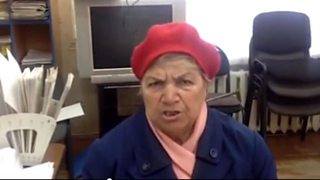
Take for instance Lidiya Arkadyevna - the grim-faced female pensioner in a red beret (above) who has become a minor cult figure among internet users with her YouTube denunciations of opposition leader Aleksey Navalnyy. She falsely accuses him of putting his wife in a mental institution, says he has betrayed his country for money, and even alleges that he orchestrated the opposition demonstrations in the Ukrainian capital, Kiev. He should be "shot or locked up for 25 years", she declares in one clip.
Then there was Kiselev's commentary on the stand-off between Russia and the EU over Ukraine, in which he showed excerpts from a Swedish TV show aimed at teaching children about their bodily functions. The excerpts featured two characters whose names are plays on the Swedish words for ‘wee-wee’ and ‘poo-poo’, as well as wind-breaking posteriors and ‘singing genitalia’.
This surreal interlude was meant to illustrate ‘European values’ and the kind of Western decadence that awaits Ukraine if its moves closer to the EU and turns its back on ‘orthodox’ Russia.
Finally, there was the weather forecast on the state-controlled 24-hour news channel which, instead of informing viewers about the meteorological conditions in Russia, told them that the protests in Ukraine were the product of climactic abnormalities. It featured the head of a psychology institute saying that drastic temperature fluctuations can provoke "surges of aggression and unlawful actions". You couldn't make it up.
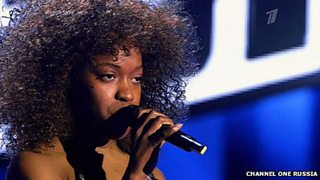
The line-up has included a young black woman from the USA (above), a tattooed diva from Uzbekistan, a Ukrainian-born Jewish songstress, and a handsome crooner from Georgia. "It is great that here on this stage and before such a wide audience we can show off different cultures," enthused one of the judges.
Russian protest at TV teddy’s lie down strike
More College of Journalism blogs by Stephen Ennis
