CIA does journalists’ research for them

Eloise McNaulty
is a digital content producer in BBC Archives @eloisemcnaulty
There’s information for 267 world entities, covering history, people, government, economy, geography, communications, the military and more. The Factbook is part of the library/publications section on the CIA’s website, and information is regularly updated, often weekly, from government agencies and sources.
All data and accompanying country images, for instance, are copyright-free. Just heed the health warning about reuse of the official CIA seal.
So whether you’re a journalist in need of an overview of the Philippines or a content producer wanting to confirm the national anthems of various countries, the Factbook is a surprisingly valuable resource. It’s also a good place to access more obscure information. You never know when you might need to find out which countries have airports with unpaved runways…
Each country profile provides information on geography, government, people and society, economy, energy, communications, transportation, the military and transnational issues. Information is broken down clearly in each category. So if you’re exploring geographical information on China, scroll to ‘natural hazards’ and you’ll discover several dormant volcanoes with names like Baitoushan and Kunlun.
If your query’s about tropical diseases (in ‘people and society’) you’ll find that a major vector-borne disease (think mosquitos and ticks) in the area is Japanese Encephalitis. If you’re looking at China’s record on people trafficking, go to ‘transnational issues’ where you’ll learn that the country’s been downgraded to Tier 3, although a plan has been released (as of 2013) to improve this.
Perhaps you’d like to compare one aspect of a country with another? Head over to the information within country comparisons. This allows you to view pre-sorted lists from selected Factbookdata fields like geography, energy and the military. Do you need to compare telephone use in China with the US? Select ‘communications’ and you’ll learn that as of 2012 the number of telephone landlines in China is 278,860,000, and in the US the figure is 139,000,000; while mobile usage in China is a massive 1.1 billion.
The Factbook includes an impressive regional and world map collection ranging from the physical to the political, including maps of the oceans and standard time zones. In addition, you can choose countries from a drop-down menu within additional CIA maps.
It’s worth checking the dates on these maps, though, as they can vary significantly. Algeria’s dates from 2001, for instance; while China’s is from 2011. You can download pdfs and jpgs of the maps for free, although you’re asked to remove the map number if you modify them.
The flags of the world section is useful for getting information on the design and meaning of each flag. Did you know, for example, that the eight-pointed star in the Azerbaijan flag represents the eight Turkic peoples of the world? Or that the orange in the Zambian flag refers to the country's mineral wealth?
The Factbook’s appendices contain useful lists. Would you like to know more about the member countries of a particular group or organisation, for instance? How about a cross-referenced list of geographic names where you discover that Angkor Wat (ruins) is cross-referenced as Cambodia, and similarly the Palk Strait is referenced as the Indian Ocean.
You can also get more detail on a wide range of international environmental agreements, from air pollution to whaling - including the Montreal Protocol on Substances that Deplete the Ozone Layer and the Convention for the Conservation of Antarctic Seals.
As with all research tools, it’s worth checking out the FAQs. And if you’re confused about meanings or acronyms, chances are you’ll find the answer on the definitions and notes page.
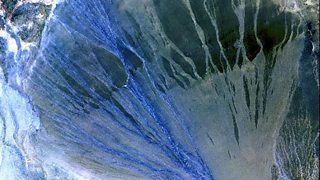
Top photo, courtesy of USGS: Satellite image of an alluvial formation in Xinjiang Province is one of 80 CIA Factbook photos of China.
A shorter version of this blog was published on the BBC’s internal research portal
Searching social media? Don’t miss what’s hiding in plain sight
Mine the data in the digits to find the scoops someone’s trying to hide
