News start-ups need to ‘cut through the noise’

Hasit Shah
is a senior producer on BBC World Service programme Newsday
It looks like it is easier than ever to start a media company - with the digital tools available, anyone can do it. But for that very reason it is very difficult to make money.
Potential entrepreneurs are dealing with a public that has become accustomed to not paying for content, and competing with thousands of people supplying it without any kind of commercial interest.
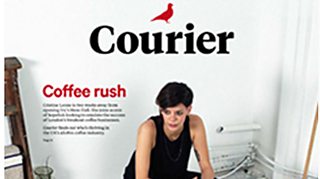
In this supposedly digital world, new print publications are perhaps an unexpected sight. But, as Courier co-founder Soheb Panja explains, it’s “less about the vehicle and more about the content”.
"There is an appropriate medium for the content that you have, for the audience you want to serve."
Courier is a freesheet focusing on the digital, fashion, creative, media and retail sectors which recently launched in east London. Its founders have decided that a free weekly, printed newspaper works best for their audience and, crucially, for their advertisers.
Publishers are successfully operating with different business models, Soheb Panja says: "It’s all about what works best for what you’re trying to deliver. It’s dangerous to make sweeping conclusions about media, tech and trends - you just need to make great content.
"If people don’t like your product they won’t even take it for free, let alone buy it."
Buzzfeed UK is not a British start-up and without a locally based ad sales team it doesn't even generate any direct revenue in the UK. But the successful US media company, which is rapidly and aggressively moving beyond dog gifs and Ryan Gosling pictures to serious, mainstream journalism, has chosen to locate its first overseas bureau in London.
"By contrast, if you share a Buzzfeed article it doesn't really say anything about you. It's more like: I enjoyed this, you should read it too."
In the US, Buzzfeed plans to hire an international editor and team of foreign correspondents. The site even got a name check from President Obama at the annual White House Correspondents' Dinner.
Its ambitions are clear. But it's too early for all that in the UK, says Luke Lewis: "In terms of diversifying into news and sport, a lot will depend on what the UK audience goes for. In the US they've had a lot of success moving into politics: we don’t know if that would be the case here."
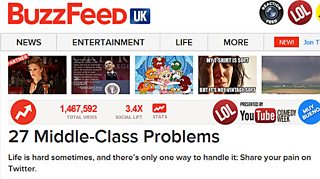
Less than two months after the UK launch, he says the audience has grown to around five million, with a recent post about ‘middle-class problems’ generating more than a million page views.
Those figures appear to make a compelling case for taking British advertisers on board but, although that's probably inevitable, Lewis again says there’s no hurry: "We're in a really good position - no pressure, no ad sales, no commercial element to what we do at the moment. My job is to build an audience, create content, and we'll see what happens."
Most British media start-ups are however under real pressure to attract funding to survive and hopefully thrive.
Blottr is a crowdsourced service that aims to enable anyone to capture and report news. Founder Adam Baker says the opportunity arose when he realised that not only were more and more people able to report events but many newsrooms were unable or unwilling to harness this avalanche.

Although based in London, also to the east of the city, he describes New York as the key location for any media company and has several investors there. "New York could be more important than London for us," he says. "If you look at the number of network broadcasters, in London we have one. In New York there are probably 10. We have five or six top publishers here - in New York you've probably got about 30."
But, regardless of location, Blottr's existence, as with Buzzfeed and Courier, is down to the content it produces. Although some large media companies can sustain an in-house team of journalists dedicated to user-generated content, that's not a viable option for everyone. So Blottr fills that gap by providing verified material, Baker says, to a growing list of paying newsroom clients.
"Journalists sometimes think we're disruptive to their jobs," he admits. "But it's the opposite - we complement what they're doing. We've got content that could help them do their jobs better."
In the UK there is both an appetite for distinctive, high-quality content and the talent to create it. Courier and Blottr have also managed to raise investment, proving that there is funding available, too, if you can find it.
Soheb Panja says: "When we were growing up all we had were newspapers, the odd magazine and the news on TV. But I see all these streams of content as an opportunity - if you can cut through that noise you might just be successful."
UPDATE: Since the interview with Luke Lewis in April, BuzzFeed says it has begun generating revenue from the UK, via its sales team in New York, and is now recruiting commercial staff in London.
Hyperlocal and happy to be in print
