Journalists in danger: signs of a breakthrough?

William Horsley
is international director, Centre for Freedom of the Media
Costa Rica is an oasis of relative calm in Central America, one of the world’s most dangerous regions for journalists. In its neighbourhood is Mexico, where about 100 journalists have been killed or have disappeared in the past decade.
In the Syrian conflict, since the start of 2013 several more journalists have gone missing, bringing the total of the ‘disappeared’ to at least eight.
Brazil, Nigeria and India have joined the ranks of countries where journalists are most likely to be killed for their work, and where the killers of journalists are rarely if ever brought to justice, according to the latest Impunity Index of the Committee to Protect Journalists.
But even in this oppressive landscape for free expression across large parts of the world, I found signs of hope while taking part, with 300 others, in the UN meeting, and in a debate at the Frontline Club in London, on Stamping out Impunity.
After years of hard diplomatic slog and rising death tolls among questioning journalists, the UN has created a wide-ranging Action Plan on the Safety of Journalists and the Issue of Impunity. And it is looking to include the safety of journalists and the fight against impunity in the revised Millennium Development Goals from 2015.
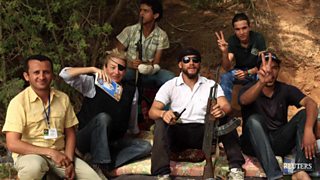
Much-publicised cases like the death in Syria of the war reporter Marie Colvin (pictured with Libyan rebels in Misrata, a year before she died) have prompted new moves to bring international law to bear against targeted violence, and states that condone it.
There is a new sense of urgency. The World Association of Newspapers has spoken out strongly for the ability of free media to hold those in power to account. And BBC Global News, along with other leading media, publicly supports the current efforts to create international frameworks to ensure journalists are protected.
‘Can no longer be tolerated’
Unesco opened the Costa Rica meeting by describing the death toll of 121 journalists last year - the worst on record - and the low rate of conviction for those responsible for those killings as “a situation that can no longer be tolerated”. Assistant director general Janis Karklins declared that the Action Plan aims to reverse that by combining the efforts of UN agencies, national governments and the forces of civil society, including the media.
A high priority is to protect the rights and lives of online journalists, bloggers and social media producers who, with the traditional media, can provide vital checks and balances on power.
The Human Rights Committee - the UN’s top advisory body of international lawyers - has declared that journalism is a function shared not only by professional full-time reporters but also bloggers and “others who engage in forms of self-publication in print, on the internet or elsewhere”.
Reporters Without Borders says that, in 2012, 47 citizen journalists and ‘netizens’ were killed for what they said or wrote. Internews, an international NGO, has produced a useful toolkit for safer online and mobile working, including how to protect data and defend against hacking and illegal surveillance.
I see two important new factors in this mix. One is a more dynamic engagement of the world’s media than before, in the face of severe threats in many countries and appeals from the UN to join in collective efforts to ensure a free flow of information.
The other is a focus on the underlying causes of impunity. The UN’s own concept paper for Press Freedom Day points to the troubling conclusion that murders and other attacks against media workers often serve as a shield for corruption and abuses of power within the states concerned.
War crimes prosecution?
At the Frontline Club meeting on 8 May, photojournalist Aidan Sullivan spoke of the efforts being made as part of the global campaign called A Day Without News? to bring a war crimes prosecution over the deaths of Marie Colvin and French photographer Remi Ochlik. The indications are that the makeshift press centre in Homs where they died was targeted by Syrian forces.
One of the campaign’s goals is to persuade the UN Security Council to strengthen Resolution 1738, adopted in 2006, which states that any deliberate attack on media workers in conflict zones, as civilians, may constitute a war crime. So far the resolution has had little effect.
And the UN meeting in Costa Rica provided some startling examples of links between targeted attacks on the press and wider failures of the rule of law.
Joaquim Barbosa, the chief justice of Brazil, admitted that the “dysfunctionalty” of Brazil’s criminal justice system was the main cause of the recent increase in attacks on journalists - including four murders since late last year - and of the failure to bring the killers to justice. Journalists had been targeted, he said, for reporting on local corruption or drug trafficking.
In the Philippines, none of those responsible for the deaths of 32 journalists who were among 57 people massacred on a single day in November 2009 have yet been convicted. Instead six potential witnesses have been killed since the trial began three years ago.
And in Pakistan, where more than 90 journalists have been killed in the past decade - several of them abducted and tortured before being killed, a representative of a media NGO said the government and security forces were “part of the problem and not part of the solution”.
The Pakistani government recently agreed to consider special measures, including the appointment of a prosecutor to pursue violent crimes against journalists. Much will depend on the goodwill of the new incoming administration.
These examples from different parts of the world illustrate how journalists in many places lack the basic protection of the law and an independent justice system, and often depend heavily on international pressure to achieve their goals.
The UN Action Plan is just six months old. And there is a heck of a lot to do.
Europe guilty too as World Press Freedom Day targets growing threats to journalists
London symposium on the safety of journalists - video
Global media to monitor a UN plan to protect journalists from assassination
Iranian journalists face growing threat of imprisonment in pre-election crackdown
Censorship in Burma: ‘one cage opens’ but caution remains
