Chinese media censorship: all-pervading, increasingly challenged

Raymond Li
is BBC Chinese editor
The recent public protests by journalists of Southern Weekly, a newspaper based in Guangzhou well known for investigative reporting in China, has once again highlighted the issues of media censorship in the most populous country in the world.
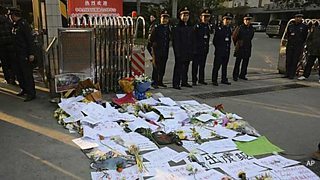
Readers left flowers at Chinese Southern Weekly offices in support of striking journalists
In many respects China is arguably a country with one of the most comprehensive and sophisticated systems of media censorship. First of all, all the traditional media including television, radio and newspapers are owned by the government, or, more precisely, the ruling Communist Party. As a result, all the key posts at these media organisations are held by party members, so as to ensure that the party has a tight grip on the day-to-day operation of these media outlets.
Secondly, the Communist Party has a Central Propaganda Department to keep close eyes on the output across different media platforms in China. In fact, all the state-owned media outlets receive directives from the CPD on a regular basis.
Such directives would be very specific and detailed, telling you what you can’t cover in your news output, or how to cover it if you are allowed to do so. Such directives are not only directed to state-owned media but also privately owned media such as commercial online sites. It is therefore fair to say that the censorship of traditional media platforms in China has been largely very effective as the punishment for ignoring these directives can be extremely severe.
However, the rapidly developing social media have posed an unprecedented challenge to the Chinese media censors. Although the authorities have been able to block access of all the major international news and social media sites such as Twitter, Facebook and YouTube etc and restrict most Chinese users to China’s own social media platforms within the Great Firewall, the censors certainly can’t have full control over social media as they have been doing successfully with traditional media.
It is true that media censors from time to time instruct social media operators to filter out politically sensitive words and phrases. At one time all the names of senior Chinese leaders such as Hu Jintao, Xi Jinping etc were censored and users simply couldn’t publish or search any postings containing them.
Similarly, Southern Weekly and its abbreviated names were also censored when the news of protests broke out.
Meanwhile, authorities have deployed tens of thousands of ‘cyber cops’ to monitor all the content published on online sites and Weibo, China’s variant of Twitter. They will delete any content and messages regarded as ‘harmful’, including politically sensitive ones.
And those users who repeatedly publish ‘forbidden’ content could end up with their accounts being closed by the operators, under pressure from the authorities.
When Xi Jinping and the new generation of Chinese leaders came to power last November, the hope that media censorship would lessen was muted among some Chinese journalists, as the new leaders emphasised transparency and listening to people. Actually, the unprecedented public protests by journalists of Southern Weekly reflect, to a certain extent, their belief that it is the time to challenge the long-standing censorship - although the reality proves them wrong.
It is worth pointing out that this is not the first time journalists in China have confronted the country’s media censors. Even at Southern Weekly, a number of former chief editors were sacked or removed from editorial posts when articles they published angered the authorities.
There is increasing demand for press freedom in China following the rapid economic development. There is no doubt we will see more confrontation between Chinese journalists and media censors - as happened with Southern Weekly - unless the new Chinese leadership really changes its attitude towards the media and journalists by allowing more different voices to be heard on media platforms.
