When Twitter’s ahead of the wires it pays to be ‘Live and Social’

Kevin Young
is a senior broadcast journalist in the BBC Newsroom

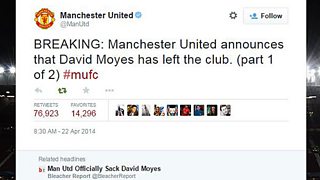
The first photos of the comet landing (above), the disappearance of flight MH370 and the crash of flight MH17, the sacking of David Moyes (below), the Duchess of Cambridge's pregnancy - some of the biggest stories of the past year, with one thing in common: they were all confirmed first on Twitter.
We've known for some time that eyewitnesses break news on social media. It's six years since photos of a plane forced to land on the Hudson River in New York emerged in this way. And the shootout on Ottawa's Parliament Hill was a more recent, powerful example.
But high-profile individuals and organisations are increasingly making announcements on Twitter too. And if news organisations can spot these tweets quickly and effectively you don't have to wait for the wires - or anyone else - to stand up the story.
Here at BBC News we’ve been piloting a ‘Live and Social’ desk embedded in the heart of our main newsroom at London’s New Broadcasting House. It has become a critical part of our operations: making sure we move swiftly and surefootedly to break news accurately on air and online.
For the past 12 months I’ve been leading this effort, overseen by newsroom assistant editor Rob Lawrence and social media editor Chris Hamilton.
Our aim? To ensure the newsroom maximises the value of strong tips and stories emerging on sites including Twitter, Facebook and Instagram, using the expertise of existing producers within the UGC Hub and social news team.
We verify and flash the most significant announcements and quotes on ENPS - our internal communication and copy-management system - and share unconfirmed tip-offs with editors.
Successes include beating major wires to break all five of the above stories, by quickly distributing the tweeted confirmations. We also regularly find source material that elaborates on one-line wire flashes, eliminating the need to wait for a second wire before we can run a story.
And we distribute reaction to notable events, particularly the deaths of famous figures, that is frequently used by our rolling TV output (the BBC News Channel in the UK and World News channel internationally), rolling radio output (BBC Radio 5 live) and digital platforms (the BBC News website and social media channels).
So how do we find it all?
TweetDeck is our main source for tweets - a fantastic tool for filtering Twitter so that we’re immediately alerted to the most relevant messages.
We've compiled comprehensive lists covering a variety of topics. (If you've never used a list before this one from @BBCBreaking is a good place to start. You can find more of our @BBCBreaking lists here, @BBCNews lists here and @BBCWorld lists here).
When we know a story is imminent, or want reaction to one that has just broken, we can instantly turn to the most relevant accounts or create targeted searches of key terms.
And we’re monitoring hundreds of influential journalists and organisations around the world so we know what they’re tweeting about.
We also work with Dataminr: a US company with a sophisticated algorithm that analyses the 500 million tweets sent per day.
This alerts us immediately to eyewitness accounts of breaking stories and allows us to quickly obtain photos, videos or quotes for use in our output.
Explosions in Nigeria, Islamic State beheadings of journalists, the Spanish king’s abdication, fighter jets scrambled over Manchester and the deaths of celebrities such as Maya Angelou - Dataminr has tipped us off about all of these stories, well ahead of the wires, in the past year.
But even the most up-to-date technology can’t beat old-fashioned journalistic skills.
Since its creation after the Indian Ocean tsunami in 2004, our UGC Hub’s hugely experienced team has sourced, verified and disseminated stories on a daily basis for the whole of BBC News. The material published by the social news team, meanwhile, has approaching 50 million followers across platforms including Twitter, Facebook, Google+ and Instagram.
While speed is important, clearly accuracy is essential, as demonstrated at the end of last year when UGC Hub expertise cast doubt on a widely shared video of a boy supposedly rescuing a girl from gunfire in Syria, before the BBC Trending team exposed the fakers behind it.
Combining our expertise for this ‘Live and Social’ desk ensures social media is very much at the heart of the BBC News 24/7 and Digital Development departments’ strategy of ‘digital-first’.
In such a fast-moving environment we’ll be keeping a close eye on the way we develop this role to provide the best possible service in the future.
Social media verification: UGC Hub
How to make the most of user-generated content
How we discovered the truth about YouTube’s Syrian ‘hero boy’ video
Twitter basics for journalists: Q&A with Mark Frankel
Our section on investigative journalism
Using Twitter to find people at the scene of a breaking story
Our other blogs by internet research specialist Paul Myers
