Local news is a product that needs innovators #localjournalism

Jasper Westaway
is chief executive of Borde.rs, a local news app. Twitter: @JasperWestaway
In another in our series on innovation, we asked news entrepreneur Jasper Westaway for a follow-up to the blog he wrote for our recent conference The Revival of Local Journalism. Here he describes how he came to start his business, and how he approaches innovation in a tech start-up.
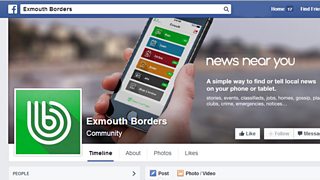
Exmouth Borders Facebook page
That product is now coming to the end of its lifecycle. In the five years to 2014, UK regional newspaper revenue contracted at an annual rate of 9%, down to £2.2bn. This is only the start of the transformation of local news.
Fortunately, if you exercise the right discipline there are enormous opportunities for creating amazing, innovative new products within local news. This is the story of how my most recent company, Borders, has evolved over the past year.
Within 48 hours of selling my oneDrum business to Yammer in April 2012, I was thinking about my next business. Start-ups are a drug, and I mean that in a broadly negative way. The purchase of Yammer by Microsoft two months later freed me to travel with my family for a year, and gave me time to back away and think more deeply about what that business should be. I started with very simple reasoning:
1. Mobile devices are more accessible and powerful (courtesy of their hardware features) than desktop. Therefore the future is mobile
2. Apps win over web on mobile because interaction needs to be customised around small screens and touch
3. Rethinking digital products by exploiting these new features, such as GPS and cameras, was a huge opportunity.
Local news appeared to sit well at the junction of so many of these features. However, after several months I pulled away from it because I could not find my angle of attack.
Modern start-ups are single-feature businesses: take a narrow and well-defined problem that a small section of users experience; solve it brilliantly by testing different solutions, measuring the response and iterating the product; build and maintain velocity. Great examples of this approach are start-ups like DropBox and AirBnB. But local news, as we are familiar with it, is a rather soggy product addressing many poorly defined problems.
From Canada, I started teaching myself to program on the iPhone, and experimented with an idea called SnapSnap. This focused on local classifieds as the problem: what is the fastest way to put something up for sale? Can it be done in under 30 seconds? Can you post 10 items in under eight minutes? Again, the camera and GPS features allow for great product innovation.
Start-ups are momentum creatures. Ideas are easy, but creating and maintaining momentum is hard.
By the time I returned to England I had a prototype and I was seeking a team. Finding your founding team is pretty much the hardest problem you have in a start-up (tip: don’t compromise, only hire the very best, fire fast if someone doesn’t work out).
The prototype helped articulate my vision to people I trusted. By autumn there were four of us building a new prototype. Each step built momentum.
A quirk of my approach is that I like everyone in the company to participate in branding and messaging exercises before coding starts. It helps everyone focus on the features that create value and cuts out features that fail to support what can be sold.
But that first messaging workshop described a different product from SnapSnap. So I told everyone: 'let's build that instead.' The 'that' was a tool for discovering and telling local news - a form of local newspaper but simplified with the use of village notice boards as a metaphor. Everyone gets what a local board is for.
Actually, no. We released a prototype in December and spent two months watching customers use it. Around 33% were confused about what it was and how it worked.
It takes a lot of discipline to expose yourself to customer feedback and learn from it. In weekly iterations we reduced the number to 25%, which is still too high for a consumer product.
So we radically simplified the product, layering features behind each other to achieve ease of use and depth of experience (a classic Apple trick).
But now is the really hard part: on day-one you have no users - so anyone checking you out for the first time has nothing to read. If there is nothing to read then there can be no readers, so who would publish a story.
I call this the ‘brokerage problem’ because you need buyers and sellers to make a market. A start-up typically lacks the capacity to chase both, so you need to fake one side of it. AirBnB did this by focusing on renters and scraping destinations from Craigslist.
We started scraping local content from the web. We thought it would be hard to find local content for any arbitrary location, but it was easy. So easy in fact that a more serious problem emerged: how to sort and filter it. Again we kept releasing tweaks each week and it slowly improved.
In the meantime we spoke to a large number of local businesses about how they use social media in their marketing. The answer is that almost none do.
We hypothesised about pushing Borders stories back out to a subset of destinations that we already scraped from, such as Facebook groups that were tied to places. Facebook becomes 12 channels, not just your timeline.
For example, I live in Exmouth. If I sell an old snowboard on Borders, it will publish it on Borders and then into the Facebook group Buy & Sell in Exmouth on my behalf, and any other relevant page or group.
Users can suggest other local groups. When someone suggests a local group we can recommend it to other users. Borders will publish it on the @exmouthborders Twitter account with #exmouth #buysell hashtags to optimise search. We also publish it to the Exmouth Borders Facebook page, and the Borders website which is optimised for local searches on Google.
We didn’t build this feature. We pitched it to a few local businesses as part of the next release. They were all incredibly excited - and suspicious when we said it was free. We had achieved a critical stage in the development of a start-up: market fit. This is the process of fine-tuning a product to a well-defined group until they can’t live without it.
This allows us to create marketing and sales campaigns that generate inorganic growth. But the real upside is that every time a business publishes content on Borders and out to Facebook, Twitter, and so on, they are creating an opportunity for a new user to discover Borders. We typically think of this as viral growth and it is usually measured by a formula, from epidemiology, called k-factor. A k-factor greater than one (meaning a self-sustaining virality) is the dream of every consumer start-up.
We remain in our infancy and start-ups are very high-risk. We have a handful of great customers publishing and reading stories. What I hope is clear from this story is how little the initial idea counts. Ideas need to be a constant process, and start-ups need the culture and focus to constantly question and rebuild what they have, to get to the next major step in their evolution.
Local news is an amazing space for product innovation, precisely because the local newspaper has evolved so little over several hundred years, and is so badly positioned in the contemporary world. Unpick what newspapers do, understand their various markets, and experiment.
The nice thing about unpicking a product is that alternative financial models become clearer. It was very noticeable at the recent BBC conference on local news that the audience were uncomfortable thinking in fresh terms about revenue sources because they were bound by an old-fashioned understanding of the news product.
We don’t know what our final financial model will be, but we have lots of options. There’s affiliate marketing (eg. Ebay pays .30c for each sale that comes via an affiliate link). We could charge businesses to promote themselves on Borders. For example, a wealth management firm approached us to be the business associated with wealth management in Exeter. And we’re thinking about charging businesses to publish daily deals by extending the publishing functionality to a special daily deals widget.
While we hope that we’ll offer opportunities to journalists and create great local content as we advance, many journalists should recast themselves as product innovators, testing and expanding the bounds of news and how it is distributed.
This blog post is the third in an occasional series about innovation:
How should digital journalists mark the centenary of World War One in compelling new ways?
A licence to innovate: How the BBC’s e-books team works under the radar
