How does it feel? What journalism can learn from online marketing techniques

Charles Miller
edits this blog. Twitter: @chblm
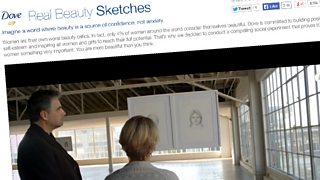
Dove's Real Beauty Sketches
Mark Adams is a director of theAudience: a “social publishing company” that represents “the lives, loves and conversations of a billion consumers worldwide”. The company was bought by the William Morris Agency and operates 700 ‘social channels’ for celebrities, plus the odd brand. They create 6,500 pieces of content a month which reach a billion consumers, and get 12 billion page impressions.
Twelve billion!
Adams, and some of the other Chinwag speakers, proved that social media is far more than a kind of handy add-on to draw people to traditional media outlets. Social media isn’t a signpost: it’s a destination. Adams claimed that “most of the five hours [of media] a day that millennials consume is user-generated.”
When professionals like theAudience step into this world, the numbers can be staggering: Dove’s Real Beauty Sketches, a film that theAudience worked with, has been seen more than 200 million times. The BBC’s News at Ten takes more than six weeks to clock up that many viewers.
What makes this kind of content take off - in other words, get shared - is a strong element of emotion. In the Dove film a woman is asked to describe herself to a forensic artist, who sketches her without seeing her. Then another woman describes her - and the artist does another drawing. When the subject of the drawings is shown that someone else has described her more flatteringly than she did herself, it’s a moving moment. “Success in social is about emotion,” said Adams. (And there’s no mention of soap in the whole thing.)
So what does this mean for journalists?
Some news stories are naturally more emotional than others (try generating a lump in the throat over the latest trade figures). But there’s no doubt more that can be done in the telling, if not to heighten emotion (which sounds worryingly manipulative in a news context) then at least to maximise impact through careful storytelling.
And that’s where another of the conference speakers comes in: Sarah Walker is head of neuroscience at Millward Brown, a marketing and advertising research agency. She described storytelling as a “hot topic” in marketing at the moment.
Marketers are trying to work out how to ‘activate emotion’ at the exact moment that someone is exposed to a brand. Brands need to be integral to their marketing campaigns, and can have various ‘roles’ within them: as enabler, reward, as a character, or as the way to solve a problem (brand as hero). But if the campaign fails to generate feelings no story will work.
In the new world of content sharing, journalism competes with friends’ holiday photos, funny videos made by people we don’t know, a politician or brand’s message or, god forbid, the Dove soap film (or even parodies of the Dove soap film).
It already feels like journalism has a lot to learn from the marketers. But there may be another new dimension the commercial world is exploring that will also be relevant one day.
VisualDNA is a London tech company (strapline: ‘psychology + big data = understanding’) which boasts “the biggest psychographic database in the world,” according to business development director Ed Weatherall. So what exactly is a psychographic database when it’s at home?
Well, it’s a system that tracks, in this case, 300 million online profiles of internet users in terms of their individual personalities, measured by the ‘big five’ traits psychologists have identified: openness, conscientiousness, extraversion, agreeableness and neuroticism.
VisualDNA’s system depends on some of its 300 million people taking its personality quizzes to score themselves as particular types - and then watching how they behave online in relation to their personalities. Others who behave in the same way are then taken to have equivalent personalities.
If it all sounds a little sinister, the example Weatherall gave appeared benign: people in developing countries who wouldn’t otherwise be able to borrow money because they didn’t have a credit history could get a loan because banks would be confident that their personalities would make them likely to repay it.
On a more mundane level, people in VisualDNA’s database can be shown the right ads for them at the right time: it’s about “understanding personality at scale”, said Weatherall.
Personalisation is nothing new online (‘if you liked that, you might like this’), but this kind of psychological profiling takes it to another level.
Could we be heading for a world in which the emotional tenor of news stories is matched to the personality of each online recipient? And then perhaps factoring in that they don’t want anything too stressful this evening because they’re got a big day at work tomorrow?
While it must be good to focus attention on the needs of our audience, I hope we don’t end up with editorial meetings where we start hearing calls for ‘any ideas that will appeal to neurotics tonight?’

VisualDNA personality quiz
