How bands get onto the radio: the art of the record plugger

Ben Toone
is a digital producer, BBC Academy
The second annual BBC Music Awards take place in Birmingham this evening (December 10 2015) on Radio 2 and BBC One, starting at 20:00 GMT.
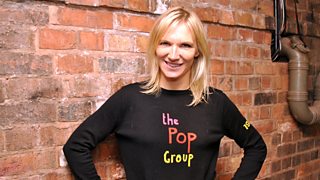
Jo Whiley chaired the BBC Music workshops panel
"Is there much difference between selling music and selling power tools?"
"No, not really."
Promoting music to radio stations has been Rich Perry's job for longer than he cares to remember. As a ‘plugger’, he's promoted the likes of Damien Rice, Scouting For Girls and Rick Astley.
Rick became a five-week chart-topper and was Rich’s first act after he left his Midlands job selling DIY equipment. "My job is to persuade presenters to play records. I'm the copper wire between the record labels and the radio stations."
Rich was talking as part of a panel hosted by Radio 2's Jo Whiley, with Laura Brennan, the Radio 6 Music producer who heads up their playlist meeting. She was joined by band manager, A&R and former BBC Music Introducing presenter Ally McCrae and Nikke Osterback, digital strategy consultant for musical artistes.
In a dark comedy club in the heart of Birmingham's Chinatown, they revealed to an audience of young hopefuls – musicians and those wanting to work in the industry – some of the secrets of getting that song on the radio. Or, more specifically, how to get ‘playlisted’ – which means you’ll get played more than once.
The session was part of the celebration of the BBC Music Awards, an annual event celebrating UK music and the BBC's commitment to nurture new talent through schemes like BBC Introducing and BBC Inspire Young Composers’ Competition.
In the spirit of that commitment, sessions on everything from How to Make Money in Music to Having a Career in Radio have taken place in Birmingham.
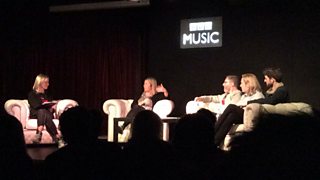
The music panel
It was revealing to hear how tracks get selected to be played on air. ‘Old school' pluggers are still very much alive and well. They work by building up personal relationships with their band and with the radio presenters. You might have thought all that would be over now that bands can send their music straight to shows through uploads, schemes like BBC Music Introducing or simply by emailing or linking to a music website.
And with this other world of music sharing out there - Facebook, Spotify and numerous other channels through which bands and artists can go direct to their audience - is radio really that important anymore?
Very, according to Rich: it can still "make or break a record".
Nikke Osterback, who has masterminded the digital promotion strategy for acts like Lykke Li, Paolo Nutini and Plan B, said he could see the spikes in digital traffic and sales when an artist was played on the radio.
And for Jo Whiley: "radio will always have a place in people’s hearts. There's so much [music] out there you really want a trusted voice to guide you through."
It's not an easy ride to getting on air. For every thousand acts, Rich might only find one that makes it through. And for Jo, the industry has never been more competitive.
All the more need then for events like this to inspire and help that British creative talent to blossom.
