Nepal: Why are some disasters bigger stories than others?

Glenda Cooper
is a freelance writer and PhD student at City University’s Centre for Law, Justice and Journalism
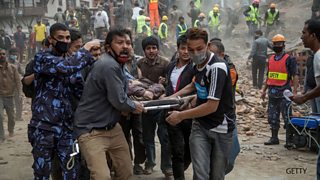
Academic studies have tried in various ingenious ways to put together what has been dubbed a ‘calculus of death’. Put simply, it’s not just how many people have to die to make it a big disaster for the media but crucially how ‘important’ those deaths appear to be.
Hence you get the apocryphal arithmetic that one UK death in the same street equals 10 in the next town equal 100 deaths in France and 1,000 in India. While such equations tend to be tongue-in-cheek, and are certainly not written down or codified by news organisations, there is more than a grain of truth in them.
Even though it can be expressed in that kind of ludicrous form, the idea has real consequences = because the amount of media coverage a disaster gets may have a direct effect on how much money and aid is given to a country in crisis.
The Disasters Emergency Committee, which brings 13 leading UK aid agencies together, has said that its joint Nepal appeal comes second only to the 2004 tsunami in the amount given in the first 24 hours after the committee’s appeal’s launch.
So how big a story has Nepal been against all the competing national and international claims on our attention, and how does it compare with others?
A basic search of the Nexis cuttings service reveals that 500 stories in UK newspapers had ‘Nepal’ in their headline between 25 April (the day the quake happened) and 2 May, a week later. That compares with 217 for Haiti’s quake (12-19 January 2010) and 411 for Japan’s 2011 quake (11-18 March 2011).
Yet these statistics do not reflect the magnitude of the disasters. So far it’s believed around 7,500 have died in Nepal (although it’s likely it will rise to around 10,000), while the Japan quake saw around 15,000 lose their lives. These are both small figures compared to Haiti where death tolls have been put at anywhere between 100,000 and 300,000.
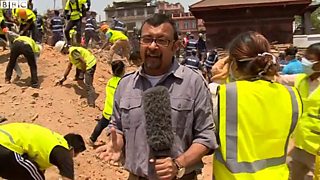
Sanjoy Mazumda reporting on the rescue effort in Kathmandu for BBC News
So why has Nepal got so much coverage despite the relative small loss of life compared with the other two?
Well, as with the tsunami, there were Britons caught up in the crisis in Nepal. What’s more, the UK has a strong emotional pull to Everest because of the Sir Edmund Hillary and Tenzing Norgay conquest of the summit back in 1953. There is also a strong Nepalese diaspora, in particular the Gurkhas, who won a long campaign led by the actress Joanna Lumley to be able to settle in this country. Many Brits have also trekked through or visited Kathmandu on holiday.
And there are other factors. In 2007, two Swedish researchers looked at the US government response to disasters that occurred between 1968 and 2002 to try to work out what makes a story ‘newsworthy’. They found that the type of disaster - whether it was dramatic as opposed to long term - had a direct effect on its newsworthiness and the amount of aid donated. They concluded: “For every person killed in a volcano disaster, 40,000 people must die in a drought to reach the same probability of media coverage.”
“We always see more giving after a sudden, dramatic disaster - and earthquakes and tsunamis are top of the list,” says Brendan Paddy, head of communications at the Disasters Emergency Committee.
Added to that is the fact that earthquakes are seen as ‘natural’ disasters (although many experts would contend there is no such thing). For the media, they are less complicated stories to tell, and for the public to respond to, than stories like the recent tragedies of migrants drowning in the Mediterranean or the ongoing humanitarian crisis in Syria.

A YouTube video shows a survivor emerging from beneath an avalanche at Everest base camp
In the case of Nepal new technology meant that pictures of the moment the quake hit emerged over several days, sustaining the story. As Mark Frankel, assistant editor of social news at the BBC, points out, there were many dramatic videos of the avalanche posted on YouTube. “It was a massive story,” he says. “Usually by the third or fourth day, a story like this starts to fade from view, but at this point we were still getting user-generated content from Tibet that was being shared and viewed.”
One BBC Facebook page reached a staggering 20 million people. And like the 2004 tsunami the coverage was changed by new ways of reporting. Frankel mentions that there was some extraordinary drone footage posted. And reporter Nick Garnett from BBC 5 live used the new video streaming app Periscope to record the devastation in a village in the Sindhupalchok district on his phone.
“Periscope is still very much the new kid on the block,” says Frankel. “But it does allow reporting right at the centre of the story.”
Other innovations went beyond newsgathering; a tie-up between the BBC and the chat app Viber meant that public safety announcements could be transmitted to the three to four million Viber users in the country.
Finally, what was the effect on coverage of the timing of the Nepalese earthquake - occurring as it did on 25 April?
A story can find itself being ignored because of another huge event occurring at the same time and capturing the media spotlight more effectively. The fact that, despite expectations, Princess Charlotte of Cambridge did not make her appearance until a week after the quake, and the general election did not come until nearly two weeks after, meant two huge stories did not crowd out the very real need to report on Nepal.
Glenda Cooper is a lecturer in journalism at City University London and is completing a PhD on how new technology has affected coverage of humanitarian crises.
Aid workers file stories while journalists treat the injured
