
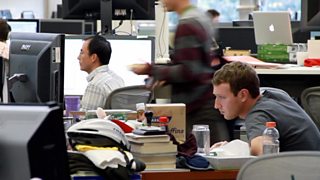
Zuckerberg at work. We're all geeks now
So far, so familiar.
But it was a false reassurance. We were soon hearing about “fusion tables” (a kind of “pivot table”, since you ask), “data wrangling skills”, and were being encouraged to go on “data expeditions”.
This was Data Day for BBC journalists, a series of talks to bring us up to speed on the emerging field of data journalism.
The College of Journalism’s Jonathan Stoneman brought the possibilities into focus with some examples to show the potential rewards for the likely pain involved in mastering those fusion tables.
There was the ingenious work of journalists on the South Florida Sun Sentinel who demonstrated the dangerous driving of off-duty policemen by analysing records from highway tollbooths. They revealed the incriminatingly short time it took cars to get from one booth to the next - and won a Pulitzer Prize for their efforts.
There was a touchy-feely model of changes to monthly temperatures in Helsinki over the past few decades to demonstrate climate change.
And there was the map of pedestrian deaths in the US which could reveal interesting trends.
Nobody’s done that with the UK’s accident stats, said Stoneman encouragingly. “How many Ford Escorts driven by students have been involved in accidents in Northampton?” he asked. It was all knowable, and could be a goldmine for local radio news.
All this was recognisably journalism, but at times it felt as though we’d strayed into a conference at some Silicon Valley start-up: visualising data on the web is “a really exciting space”. It was all about “surfacing up” the right stories and “we want to have conversations with the data.”
We knew we were still at the BBC when endless problems with the PowerPoint remote control were solved by the radical solution of speakers requesting “next slide please”, a technique which has always worked well in village halls.
There are two sides to data journalism. One is gathering data from the big wide world and extracting stories from it. The other is applying techniques to an organisation’s news output to get more value from it for audiences.
On the latter, Zillah Watson from BBC Research and Development introduced us to the World Service Radio Archive, a prototype which offers access to more than 50,000 English-language radio programmes.
So far the programmes have only been categorised by computer. But visitors to the site are invited to make them more useful by listening and tagging them. It seems to be an amazing collection: I searched for Microsoft (one of my favourite subjects) and there are about 250 programmes which refer to it. With listeners’ input over time, I would be able to narrow down my search by specifying more detail and producing a more manageable list.
Of course, just because data can be analysed, that doesn’t mean it’s worth doing. I was sceptical about another site Watson showed us, Dramaonlinelibrary.com, where you can search for a suitable play to perform, if you have, say, six children and two adults, one of whom is a man over 50 and the other a woman below 30, neither of whom wants to say more than 1,000 words in Act 2. But, hey, if someone wants that kind of thing good luck to them.
Robin Pembroke, head of product for BBC News, took us back to Silicon Valley with news of a forthcoming BBC News Labs Hackday - presumably an all-nighter with non-stop pizzas and Mark Zuckerberg in attendance.
But Bill Thompson, the tech writer who was chairing the day, brought us down to earth by reminding us that “we’re all used to working with rich and complex data sources already: they’re called interviews and press conferences.”
There’ll be blogs by some of the speakers at BBC Data Day here next week.
