Working with Nick and Margaret: Why two presenters are better than one

Will Yearsley
is a documentary producer and director in BBC Factual
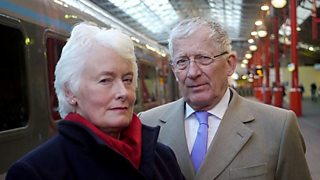
Will Yearsley produced and directed Nick and Margaret: The Trouble with our Trains which was shown on BBC Two on 29 April.
When I first began working with Nick Hewer and Margaret Mountford I was more than a little nervous. Would I feel like a hapless Apprentice contestant directing one of those dubious advertisements? Would I fall victim to a well-timed shake of the head, or those terrifying raised eyebrows? I needn't have worried - Nick and Margaret were the model of kindness, civility and professionalism.
As a production team we did immediately pick up on one, to us at least, unfamiliar problem: there are two of them.
We’d all worked with one presenter - or none - on this style of single-subject specialist factual investigation. Dealing with two was an interesting learning curve. All sorts of new options presented themselves: scenes could be filmed with one or the other, or - where it felt a good use of our presenters’ limited time - both of them.
And there were more predictable changes from our usual routines: we found ourselves filming with two and sometimes three cameras rather than the more usual single-camera shoots.
But other challenges were more unexpected. The biggest effect of having two presenters was on the usually humdrum task of scheduling. Finding a date for filming our big scenes ballooned into the greatest challenge since Sisyphus was asked to do battle with the many headed hydra armed only with his boulder.
The programme was based on painstakingly arranged access, around which the rail organisations could only be so flexible. They would suggest a date. We would compare it to what we knew of Nick and Margaret’s diaries, only to find that of course they were now not available (they were unfailingly generous with their time but they are busy people). We would then go back to the railway company to agree a new date, which we'd then pencil in for a couple of weeks… until the railway company changed its mind and the whole process began again.
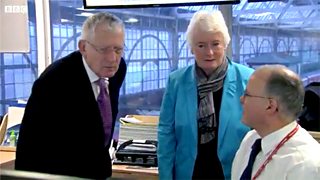
Nick and Margaret brought different views on the railway, which made their interrogations far more engaging. But it meant more imaginative thinking was required when plotting the story arc.
This was designed as an investigation rather than a more traditional TV lecture or report. With these kinds of investigations the story is to follow one person's evolving opinions as they find out about a subject. But with two investigators would the story go off in two different directions? When they came to opposite conclusions, how did that fit into a satisfying narrative? And would we be forced to include extra scenes in which they laboriously compared notes on what they had seen?
Fortunately their views evolved in a genuinely interesting but complementary way, allowing - we felt - an ending that had some pleasing convergence on some issues while retaining differences on others.
Finally there was the question of voiceover. Would they hand over from one to the other as each was featured in the film, so each could tell their own story? In fact, we went the other way, with each narrating the other's activities. That seemed to allow a bit more scope for humour - although we were wary of it getting too Location, Location, Location.
For key parts of the programme we asked both to film the same sequence and intercut between the two. We then fine-tuned how frequently to switch between the two, avoiding disorientating the viewer while at the same time retaining the many advantages of two different perspectives.
It was a new experience for me, but a great one. Nick and Margaret are a brilliant double act, and were the perfect investigators of our railway. But, their unique abilities aside, having two presenters can inject more pace and variety than is possible with one.
But next time we’ll choose a subject for which the scheduling doesn't also depend on railway timetables.
