How ‘new’ is the new iPhone 6s and, more to the point, how will journalists use it?

Marc Settle
specialises in smartphone reporting for the BBC Academy
Apple announced a slew of new products (in California on Wednesday) but here I want to concentrate on the ones that are most relevant to mobile journalists: the updated iPhones. (I should add that almost no-one at the BBC will be getting their hands on either the iPhone 6s or iPhone 6s Plus for quite some while yet; indeed, a good number of staff are still using an iPhone 4 which came out in 2010.)
This review will also be done somewhat ‘blind’ - I haven’t actually had the chance to try the new devices out myself, so my assessment will be based on reading a lot of reports about them, combined with my own judgement.
Cosmetically, both of the new phones look just like the current top-of-the-range models (albeit there’s a new “rose-gold” coloured shell) and they are the same dimensions, give or take a few millimetres. All the buttons, ports and cameras are in the same places, so any third-party cases or lenses acquired for the current 6 and 6Plus will fit, if you’re lucky enough to upgrade soon.
Inside the devices, Apple would want you to believe that there is a plethora of must-have changes that render last year’s models oh-so last year...
Well, some of the changes do indeed look impressive, but on closer inspection they either aren’t that new or could pose challenges for journalists looking to use them.
Camera upgrade
Let’s start with what’s changed for photos and video. The new phones have higher resolution cameras, finally. The one on the back, which had resolutely stayed at a resolution of 8 megapixels (mp) since the iPhone 4s of 2011, is now 12mp; the front camera is now 5mp, up from 1.2mp.
Owners of Android and Windows phones will also be saying 'finally' to themselves, as many of their smartphones have long had cameras with as many megapixels (and on some models many, many more).
The way the pixels react to light has been improved and they can focus more quickly, all with the aim of giving sharper photos with better colours and not so much grainy ‘noise’ in low light. It is doubtful though whether the pictures taken will be dramatically better than those on the flagship smartphone competitors, given they almost all produce equally good images.
One major change is with video: the back camera can record at 4K, which is really high resolution and very good quality. (On a technical level, it’s perhaps worth pointing out that it’s not actually 4K but 3840 x 2160, so is in fact UHD, or ultra high definition.) Again, this is a feature touted by Apple as exciting and innovative, yet is one already available on high-end Androids like the Sony Experia Z3+, HTC One M9 and Samsung Galaxy S5.
You win some…
There are both positive and negative implications here for mobile journalism. On the credit side, it means a shot could be filmed wide and later, during editing, zoomed in on, yet the quality remains very high.
The scenario could be a police news conference about a missing school pupil: the iPhone could take a wide shot of the top table with the investigating officer flanked by the local headmaster on one side and the worried parents on the other. Recorded at 4K, news clips from each speaker could be extracted at broadcast-quality 1080p HD. (With such a wide shot, though, being taken from far away, the quality of the sound being captured needs to be considered too.)
Another potential use for 4K video is that it would allow high-quality footage of different orientations to be cut from it. This would mean that both landscape and portrait shots could be taken from the same single recording. The challenge for the journalist, though, will be to frame shots appropriately.
…you lose some
The debit side to all this is the sheer size of the file recorded: every minute of 4K video equates to around 350MB. If that press conference lasts more than a few minutes, anyone with all bar the largest capacity 128GB iPhone will struggle.
There are also implications when it comes to sharing a video of such a size. One of the main benefits of mobile journalism is being able to send video quickly from the scene of a story. That advantage could soon be lost thanks to these huge files, so here shorter may be better if you really insist on 4K. It also needs to be asked where 4K video can actually be watched in all its glory: I don’t know anyone with a 4K television and I’m betting you probably don’t either.
All is not lost though: the 4K video recording is only an option, so it may be wiser for most mobile journalists to stick to 1080p HD on most occasions, as this is plenty, or even drop down to 720p if running low on space. (See iPhone 6s specs.)
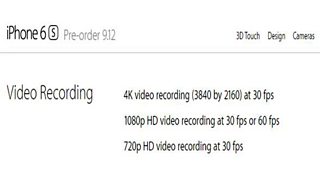
One major downside with video on the iPhone still remains, as mentioned in my blog about iOS 9. There’s still no option to record at 25 frames per second, which is what is needed by broadcasters in the UK and beyond (much of the world except the USA, in actual fact). So it's still useful to install third-party video apps like FilmicPro and MoviePro on the device.
Live and lovely?
A traditional aspect of these Apple events is spotting which old tech has been taken up by the company, repackaged into its devices and heralded as all new and sparkly. So it is with ‘Live Photos’.
These are photos with 1.5 seconds of video and audio integrated into them before and after you snap. Numerous third-party iOS apps such as Cinemagram and Echograph have long let iPhone owners do this, while Nokia’s Lumia phones first sported this function several years ago. Twice the size of a normal photo, the option to capture one can be toggled on and off.
How journalists use this function will be intriguing: short bursts of video sound interesting in theory but the short duration will preclude using them for soundbites. So they might be more useful to convey the flavour of an event.
They can also only currently be viewed by someone with an iOS 9 device or a Mac running El Capitan. Without those the animation is lost and they arrive as plain JPEGs like usual.
Facebook is working on supporting the feature and it would be no surprise to hear soon that other major players like Snapchat, Instagram and Twitter are doing similar work behind the scenes. But will news organisations adapt their systems too so they can be displayed embedded into news pages? Unless and until they do, the impact and usefulness of Live Photos may be limited.
Live Photos can only be taken with the back camera (no doubt the iPhone 7 will come with the new and improved ability to take Live Photo selfies). It can also now take 63mp panoramas.
The front camera though has had a few boosts: as previously mentioned, it’s now 5mp, which should lead to better quality photos and videos for pieces-to-camera recorded by a journalist working on their own. When using the front camera for a photo, the screen briefly lights up as a quasi-flash; not quite as good as an actual flash on the front of the device but better than nothing.
Not one of the numerous reviews I’ve read in the past few hours has even mentioned the quality of the microphone, let alone reviewed the Voice Memo app which many journalists use to record reports and interviews. This omission might be because nothing has changed, or it might be because recording audio seems much less of a priority than video or photos.
But for many reporters it’s a crucial aspect of how good their mobile journalism is, so my assessment of whether the in-built microphone is any better than on earlier models will have to wait until I get the chance to try one out.
Hard pressed
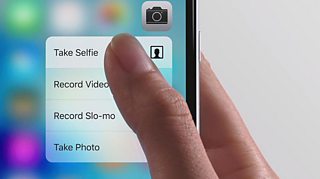
Other changes which could have implications for journalists (and others) include 3D touch: the new phones can respond differently depending on how hard they are pressed. For example, you can preview a website from a link in an email without actually opening the page fully; you no longer need to open the camera app to start recording and can use 3D touch instead to bring up a number of options.
The phones also have another 23 bands of LTE and LTE-A support, which translated into English means they’ll work in more countries - to the benefit of the travelling mobile journalist, it’s to be hoped. Wi-fi has also been upgraded and can support data transfer speeds up to 866Mbps, although good luck in finding that kind of speed.
Regardless of all these changes - those which are new or merely touted as new - how developers combine iOS 9 and the new iPhones to bring out innovative new apps over the coming months which will be equally interesting. And it’s worth keeping an eye on those advances, as Apple will no doubt also be watching them very carefully before selecting the best ones to integrate as part of iOS 10 and the iPhone 7 in 2016.
Our other mobile journalism blogs by Marc Settle
Our section on smartphone training for journalists
Our mobile journalism blogs by Nick Garnett
Focus iPhone, record and send - instant video hit from storm-lashed Sardinia
