Reporting disasters in a connected newsroom: The evolution of BBC News

Valerie Belair-Gagnon
is executive director and research scholar at the Information Society Project at Yale Law School. Twitter: @journoscholar
Valerie Belair-Gagnon has spent several years researching crisis reporting and, in particular, how social media has changed such coverage at the BBC, for a forthcoming book, Social Media at BBC News: The Re-making of Crisis Reporting.
In early 2011, I spent time in the BBC multimedia newsroom in London to observe daily news reporting. I took copious notes about processes and stories. I interviewed senior managers and correspondents about their daily activities and their use of social media in crisis reporting, whether for news acquisition or distribution. Journalists spoke about crises they had covered in their career so I could construct a detailed history of the evolution of social media at the BBC.
As my research progressed it became clear that the July 2005 London bomb attacks, including survivor Alexander Chadwick’s camera phone picture of the London underground system (below), was a watershed moment for journalism at the BBC.
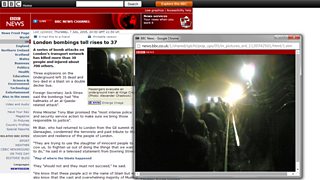
BBC News online report of the London bombings
Since then the BBC has undergone a transformation in its relationship to user-generated content, including:
- The emergence of a new generation of tech-savvy journalists (2004)
- The birth of the institutionalised BBC UGC (user-generated content) Hub following the 2005 London bombings
- The move of the UGC Hub from the 7th floor of the BBC Television Centre in White City to the middle of the Television Centre multimedia newsroom (2007)
- The publication of BBC social networking editorial guidelines (2009)
- The appointment of a social media editor (2009)
- The creation by the College of Journalism of a one-day social media course called Making the Web Work for You (2009)
- The development of BBC Twitter guidelines (2011).
Each of these changes occurred as the BBC learned by trial and error how to deal with social media and, from a broader perspective, as some segments of the public wanted greater involvement in the formal journalistic processes.
A series of crises played an important role in the BBC’s use of UGC.
During the 2008 Mumbai attacks, the BBC reasserted its approach to accuracy and impartiality. During the attacks, under the leadership of Steve Herrmann, editor of the BBC News website, the BBC incorporated social media into its output. On the second day of the attacks, one tweet stated that the Indian government was trying to silence journalists and Twitter, either by blocking access to social media from inside the country or by asking Twitter to filter out tweets relating to Mumbai, out of fear that the coverage might help the gunmen.
Lloyd Shepperd, an Australian blogger, added this unconfirmed report to his blog:
1108 Indian government asks for live Twitter updates from Mumbai to cease immediately. ‘ALL LIVE UPDATES — PLEASE STOP TWEETING about #Mumbai police and military operations’, a tweet says.
The BBC sourced this information from Shepperd’s blog and posted it on its live page at 11:08. Other news organisations, including CNN, also published the tweet on their digital news portals.
But later that day the Indian government confirmed that this tweet was no more than a rumour.
The BBC had therefore mistakenly circulated unverified and inaccurate information - creating turmoil in the journalistic world.
In response to the impact of this unverified tweet, the BBC went on to develop a series of forensic verification practices, such as lateral checks, adding new technical rigour to the norms of impartiality.
As a result, at the BBC, the concept of impartiality now encompasses a greater degree of openness, verification and transparency. The results were evident six years later.
During the 2011 uprisings in Tunisia, Andy Carvin, then at US National Public Radio (NPR) (and now at First Look Media), acted as a ‘human router’, crowdsourcing and gathering information through the Twitter public timeline.
While following the story online, Matthew Eltringham, who at the time was working at the UGC Hub (and is now editor of the College of Journalism website), found a tweet by Carvin claiming that staff at Tunisia's TV7 had turned against President Ben Ali.
Curious, but unsure about the accuracy of Carvin’s claim, Eltringham set about verifying the tweet using BBC Monitoring services. In a matter of minutes he was able to confirm that TV7 was still under government control. He tweeted back to Carvin to let him know that the information he had tweeted was wrong. Carvin subsequently retweeted Eltringham’s post, annotating the tweet with the words “A protest, not a takeover.”
The BBC had performed public service journalism beyond the traditional newsroom and established forms of broadcasting.
From the emergence to the integration and subsequent consolidation of social media in its approach to journalism, the BBC has strived to retain its journalistic authority. My study of the news coverage of crises shows that social media has had an impact on the development of verification policies, newsroom organisation and workflow practices, allowing a restructuring of relationships between the BBC and key stakeholders, including a formerly more passive audience.
With the support of senior management and an institutional need to engage with audiences, new structures have emerged, with tech-savvy journalists instrumental in shaping social media within the BBC’s traditional journalism. As these journalists acquired more knowledge of social media and the need to manage social media content increased, they gained legitimacy and credibility in the newsroom.
Media organisations construct their accounts of global crises. The enhanced role of social media in crisis reporting has allowed the BBC to engage in more sensitive reporting, embedded in its traditional public broadcasting vision.
The new ‘connected newsroom’ blurs boundaries between reporters and the audience. As journalists continue to engage with social media, the BBC will continue to report global crises in a more personal and ‘ground up’ fashion.
My book, Social Media at BBC News: The Re-making of Crisis Reporting, offers a historical account of how social media changed cultures and practices at the BBC and lays the groundwork for future work on the question.
