Google’s ‘right to be forgotten’ tour comes to London

Charles Miller
edits this blog. Twitter: @chblm

Eric Schmidt, executive chairman, Google
The legal problem for Google is the European Court of Justice’s ‘right to be forgotten’ ruling earlier this year which forces it to ‘unlink’ search terms from particular stories at the request of people who don’t want the stories to be found. Google must unlink if it thinks the person making the request has a good case.
But how would Google know? Well, that’s what the roadshow is about.
This all started three years ago when Spain’s Data Protection Agency heard a complaint from an attorney who was upset that searches for his name produced links to old newspaper stories referring to his debts. Since he was no longer in debt, he didn’t want these references popping up when people ‘Googled’ him.
The Agency ruled that the newspapers could leave the stories online (after all, they were true), but that Google must stop linking to them when people searched for the attorney’s name. This year the case landed up in European Court of Justice, which upheld the decision.
But the ECJ went further, defining in a directive that search engines shouldn’t link to items that are “inadequate, irrelevant or no longer relevant, or excessive in relation to the purposes for which they were processed and in the light of the time that has elapsed”.
As a result, Google has taken on a quasi-judicial role in processing 150,000 requests so far from people wanting to stop its search results referring to 500,000 websites.
In this, Google finds itself out of its comfort zone, by at least two zones - which is why these public events are being staged.
Firstly, it likes to think of itself as a neutral ‘card index’ of what’s on the web (rather as eBay tried to shuffle off responsibility for listing dodgy goods by saying it was just a marketplace, not a trader). The court didn’t accept that and set in motion the unlikely process that Google now operates to deal with complaints.
And, second, Google is a company built on data and efficiency. So a complex process involving endless human judgement and lots of lawyers isn’t what they call ‘Googley’.
Schmidt says in his new book How Google Works that tech companies need to beware of slipping into a comfortable middle age where “the suits become more important than the lab coats”. The ECJ has given work to plenty more suits at Google.
But Google is resigned to dealing with the ECJ ruling and, as Schmidt said, “that’s why we’re having this process”.
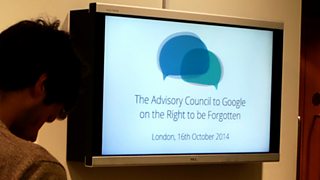
So there he was presiding over an itinerant panel of European lawyers and academics, grandly named the Google Advisory Council. Their job is to take ‘evidence’, like a parliamentary select committee, and next year come to some conclusions about how Google should handle the issue.
In London, seven ‘experts’ were presented to the council: each invited to give their views and be questioned by council members. It was all rather formal - more ‘Mr Schmidt’ than ‘Eric’ - and three and-a-half hours long. But there was plenty to ponder on.
At first it seemed as though the experts were only chosen to agree with Google’s opposition to the ECJ decision. Emma Carr of Big Brother Watch thought it was a “dangerous precedent”; David Jordon of the BBC said he had “every sympathy with the difficulty you face”; and Gabrielle Guillemin of Article 19 thought it was an “unfortunate decision”.

And he suggested that Google’s form in which requests for unlinking are made could ask for more detail, such as whether the publisher of the website in question has been asked to remove the information, and, if so, what their response was. He also suggested some kind of confidential sharing of information, with the petitioner’s permission, between the website publisher and Google, to allow Google fuller information on which to make its decision.
Guillemin saw the ECJ judgement as symptomatic of an increasingly “blurred” line between defamation, data protection and privacy. Each is different, but, both legally and in human terms, they risk getting confused.
The other side of the argument came more clearly into focus in the testimony of Evan Harris, the former MP and now with Hacked Off - the organisation that speaks for victims of press intrusion. Harris mentioned a local case he’d come across where Google had responded to the request from someone to delist a story about a shoplifting conviction. In accordance with its current practice, Google informed the newspaper in question, which promptly republished the story - presumably leading to Google’s web crawler soon picking it up again and leaving the complainer no better off. In a case like that, Harris said, most people would not want to go to court to pursue the case. Perhaps Google shouldn’t be informing the papers of delistings.
Chris Moran of the Guardian put the newspapers’ involvement in perspective. The Guardian had only been told of 27 removals from search so far, against 20 million referrals from Google to its website each week. And the Guardian is “currently” not republishing stories when it’s told of a Google delisting.
Questions from Julia Powles, a researcher in law and technology at the University of Cambridge, elicited more detail from Google about its process: 90% of the cases are simple to decide, either yes or no. But that’s already left 15,000 difficult ones. She also found that the council members aren’t allowed to see individual cases. They evidently hadn’t asked to, as one council member admitted this was news to him.
And in response to questions from the audience, Eric Schmidt said that in the UK so far 35% of decisions had been made in favour of the applicants and 65% rejected.
The British media has on the whole been sympathetic to Google on this issue - in the ratio of nine favourable articles to one negative, according to Harris. What’s been absent from the debate, and was from the London meeting too, is the voices of the 150,000 people who have tried to get links removed. Of course their whole effort is directed to making their stories less well-known, so that’s hardly surprising. But it did leave the proceedings a little abstract and academic.
It’s a subject full of complexity, legally and technically. For instance, it’s often implied that by agreeing to unlist a page Google is removing it from its search engine. In fact, it only means that the page won’t be offered as an answer to a particular search term (usually someone’s name). And the unlisted terms will still connect to the page if you search on Google.com rather than one of Google’s European domains. Schmidt was careful not to recommend that people switch to Google.com, “but some people have reported that people are doing that.”
A ruling like the ECJ’s is unlikely to be made in the US. As the New Yorker crisply put it: “In Europe, the right to privacy trumps freedom of speech: the reverse if true in the United States.” And the balance towards privacy is probably even stronger in continental Europe than in the UK.
Nobody could accuse Google of not taking the ruling seriously, but the long days of listening to testimony in European cities are almost over. The council will then deliberate and, as Schmidt put it in closing the London meeting, “I for one cannot wait to hear the answers to these questions.”
Google’s form to request unlinking