Public broadcasting in Iraq – a project doomed by ‘American state-building?’

Haider Al Safi
The former US president George W Bush, who led the 2003 invasion of Iraq, said: “All successful democracies need freedom of speech, with a vibrant free press that informs the public, ensures transparency, and prevents authoritarian back-sliding.” Bush may have held those beliefs in a free press, but was that what his administration offered to Iraq? To answer this question certain events need to be recalled.
With the end of the Iraqi regime, the US claimed publicly that it was willing to rebuild Iraq’s national broadcasting system - including two radio and two television channels - and create a national newspaper. Media development experts raised doubts about such a mission. “Imposing a system like a public broadcasting service in a country which was run by a savage series of dictators for a long time is impossible. It is a process which needs time and a capable team to tackle such a mission,” said Simon Haselock, a media expert and former UN spokesman in Kosovo.
The British Foreign and Commonwealth Office and the Coalition Provisional Authority assigned Haselock to work on structuring media policies and regulations in Iraq. But when he wanted to repeat his experience of the Balkans in Iraq he discovered this was not possible; nor was it the intention of the occupying power. Haselock was told by Secretary of Defense Donald Rumsfeld’s aide Larry Di Rita during a visit to the Pentagon to discuss the framework: “Forget how you did it in the Balkans, the Pentagon is in charge, and they intend to do things their own way.”
In January 2006 a secret document signed by Rumsfeld was declassified. The ‘Information Operations Roadmap’ considered information operations as a “core military competency” and urged the launch of psychological operations using defensive and offensive strategies. The report suggested expanding information operations through 57 recommendations. However, because the US Department of Defense was short on in-house media experts, the DoD turned to private contractors.
These contractors were not notably efficient and proved more focused on profits than providing the services they were paid for. In a hostile environment or war zone, however, it is almost impossible for anyone to assess whether a media contractor has fulfilled the requirements of the contract or mission they have been asked to carry out.
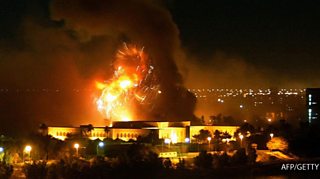
The DoD started handing out contracts to reconstruct the Iraqi media more than a week before the start of the bombing (above) campaign and the invasion in March 2003. The Pentagon contracted the Science Applications International Corporation to reconstruct Iraq’s national media, following the Pentagon plan. The Pentagon specified in the contract that SAIC was going to be in charge of creating a “free and independent local media network” and to provide “training of a cadre of independent Iraqi journalists to go with it”.
One potential reason for SAIC’s lack of success in Iraq was its company focus on information control. The SAIC website offers a programme for “Information Dominance/Command and Control”, which includes “Battlefield Control”, and ends with “Information Warfare/Information Operations”. SAIC’s contract with the Iraqi Media Network was ended in December 2003 amid complaints about the company’s performance and accusations that it had made what was theoretically a project for a ‘Public Broadcasting Service’ a propaganda tool for the occupying forces.
Most of the projects turned out to have been used as a means to make huge profits by relying on a cheap, inexperienced labour force. The contractors were not paid according to the level of success that the project they were building would achieve but according to the theoretical workload for which they claimed. For this reason the DoD contractors and many of the other organisations which worked in Iraq ended up following a ‘box-ticking’ culture.
SAIC, the main contractor used to build Iraq’s Public Broadcasting Service, was criticised by the Pentagon auditors, who judged that the company was “paid for work not completed, electronic equipment was missing, and that SAIC paid top salaries to executives and security officers, but skimped on equipment for journalists”.
The US allocated a $100m budget for the media project in Iraq. The final cost was closer to $200m (spent between 2003 and 2005) - representing the largest attempt ever in any country, or by any other country, to build a ‘free’ media.
The whole project was almost a complete failure in its first year, when it was run by the Pentagon. Local Iraqi journalists, US officials and trainers now confirm that the project was money-wasting, amateurish and counter-productive.
Iraqi Media: From Saddam's Propaganda to American State-Buildingis based on Dr Al Safi’s PhD research thesis at City University, London. It is published by Askance-Publishing.com.
