BBC launches first social media-only news service - for Thailand

David Cuen
is social media editor of the BBC World Service. Twitter: @davidcuen
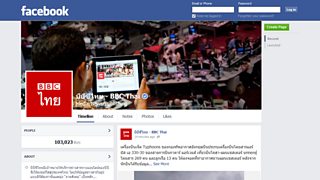
BBC Thai service on Facebook
It was clear then that, to fill the international news void, people in Thailand were turning to social networks like Facebook, Twitter and Instagram to share news, discuss the events unfolding in their country and connect with people around the world.
One of the missions of the BBC World Service is to provide impartial, accurate news to audiences around the world, particularly in countries where there is a clear need to receive independent news. Thailand ticked all these boxes so we began to discuss possible responses.
We looked at the Thai market and quickly realised there was a young, active audience which was consuming news not in mainstream media channels but in social networks. That was happening before the political unrest, but the military coup seemed to have accelerated this behaviour.
On top of that the audience was 'mobile first' - using portable devices to access news. Thailand has an extraordinary 96 million mobile subscriptions among a population of 67 million.
In terms of social media, the platform that was getting most of their time was Facebook. And of the 26 million Facebook users, 23 million use it through a mobile device.
We had two possibility strategies. The traditional approach would be to create a temporary website for BBC Thai on a BBC platform. Then we would need to try to build an audience and convince them to come to us.
We chose a different way: to go to where the audience already was.
We decided we had an opportunity to be innovative and launch a 'social first' news operation, using social media only. There were many advantages. Firstly, over the past few months we've been working hard to put social newsgathering at the heart of our language services. BBC Turkish and BBC Brasil are actively using social media at the heart of their operations: their experience was used in this new project.
Second, by using Facebook we could launch quickly and cost-effectively. Because a social network is a different platform, attracting a new audience, we could also experiment with new formats and interact with our users in different ways.
Once the project was approved by the BBC Trust and the foreign secretary - as set out in the operating licence governing the relationship between the World Service and the government - we put together the core team at BBC Thai and started intensive training with the help of BBC College of Journalism International.
The editorial offer was set to provide local, regional and international news in audio, video and text, always optimised for the mobile market. The content is published in Thai and English.
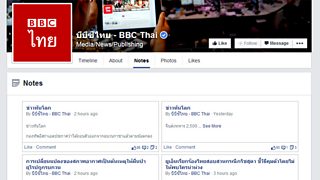
BBC Thai's use of Facebook Notes
On Audioboo we created a channel for BBC Thai where we upload audio clips and interviews that are produced on a regular basis and then connect them to Facebook.
Once everything was set up, the team was ready and training had finished, we soft-launched (in private mode) the whole operation to give us time to iron out any problems and face any issues we may not have considered.
The producers from BBC Thai, who are after all the heart of this operation, quickly became digital journalists and enthusiasts telling stories with a mobile and social mind. They have also become advocates of the users and are constantly seeking innovative ways to improve their storytelling.
One of the key elements during the launch was to adopt a start-up mentality. We never assumed people were going to welcome us or like our proposition. From the beginning, we carefully thought about what stories could make an impact and how we needed to present them. As the project is a three-month pilot, we knew we had to listen to audience feedback.
BBC Thai, our 'pop-up' news stream, wouldn't have launched without the help and collaboration of many people and teams within the BBC. It's a true reflection on how we can collaborate and work as ‘one BBC’ when a challenge arises. I couldn't write this without acknowledging all the work done by Giang Nguyen, head of the East Asia Hub, and James Sales from BBC Technology. Both were key to the success of this project.
One month and 18 days after the political scene changed in Thailand, we were able to offer impartial news. At 18:30 Thai time on Thursday 10 July, we officially launched BBC Thai. It's been less than a month and, as I am typing this, we've gathered more than 100,000 fans, reached more than 5 million people and generated more than 450,000 interactions (comments, likes or shares).
The audience has been welcoming and is constantly providing feedback on our stories. We've even got loyal listeners from the Thai service that closed in 2006 after more than 60 years on air.
The whole process has been an interesting journey. This is what the BBC World Service is all about: bringing impartial and accurate news to countries that lack it.
But this is also the first time the BBC has launched a news operation in social media only. It's a 'social first' initiative, not only because we are treating social media as a news platform in its own right but because we are constantly interacting with the audience, listening to feedback and following up its stories.
It's a significant milestone for the BBC to launch a social news stream, and recognises how important digital media has become.
If that's where our audience is, it's where we need to be.
The College of Journalism language websites
More on innovation:
How BBC News covered the Indian elections on WhatsApp and WeChat
