Reporting the Scottish referendum v UK election - you win some, you lose some

Adam Barr
is a freelance video producer @admbrr
Over the past year I’ve reported on the Scottish referendum and the UK general election with fellow journalist Ryan Ramgobin. They could scarcely have been more different experiences and now, having had time to pull them both apart, I’ve come to a few conclusions.
Our referendum project had an amazing reception with more than 300,000 views (and counting), won the Hugh Cudlipp award and featured in several online publications. Our coverage of the general election failed to get a reaction.
How did this happen, and how can I now learn from it?
Success: Referendum Boys
Days before the Scottish poll on independence, Ryan and I boarded a Megabus in London bound for Glasgow. We knew we wanted to tell a story of what was happening on the ground, but didn’t have any real idea of what format this would take.
On the bus we set up the Twitter handle @referendumboys and surveyed the political landscape. The Yes (pro-independence) campaign totally dominated the online sphere with blogs, satirical Twitter accounts and an army of activists and supporters. People who’d never been interested in politics before were engaged and passionate; the campaign had tremendous energy.
On the ground, the passion was just as intense. Locals in Scottish football shirts roared at passers-by in the street, urging them to ‘vote yes’, and no-one batted an eyelid. We’d never seen such enthusiasm for politics in London, but it had become normal in Glasgow as the referendum drew nearer.
So what worked for us?
Location
George Square was the epicentre of the Yes ground campaign. There were bagpipes, dancers and placard-wielding activists mingling, dancing, singing - all happy to talk to non-traditional media. We didn’t have to leave the square to find compelling content - it was all there on tap.
Yes was strong online
The Yes campaign was generally more popular with younger people, who were already active on social media and ready to engage with our DIY online videos.
Social media
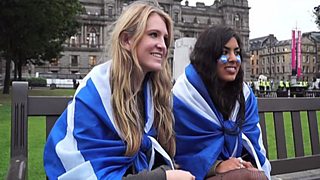
The Square became our base for the duration of the project and its inhabitants quickly became our audience: supporters who featured in the videos (like Eva and Nina, below) became influencers who would share content and spread the word. We made sure to tag interviewees in our tweets, which were retweeted by friends and family or shared on Facebook, growing our audience.
Flexibility
We had a crucial advantage over the mainstream media because we weren’t limited by fitting our coverage into a news bulletin. Our viewers were coming to us to see and listen to voices from the centre of Glasgow.
Not the mainstream
Often being an unrecognised media organisation is a disadvantage, but in Glasgow it worked to our advantage. As a Yes stronghold, Glaswegians felt they didn’t see their views reflected in the regular media. Rightly or wrongly, broadcasters were frequently accused of showing a ‘No’-vote bias, which created an appetite for a different style of reporting. The Yes vote lost by just 400,000 votes, but traditional media struggled to understand why people supported independence.
The power of vox pops
Our channel focused almost exclusively on vox pops, a technique dimly viewed by many in the broadcast industry. For people who felt their views weren’t being represented in the mainstream, this was the perfect antidote: a visceral, human display of political engagement.
Vox pops work brilliantly online. They might not appeal to a mass audience, but those who want to watch and listen will seek them out and give their time.
Controversy
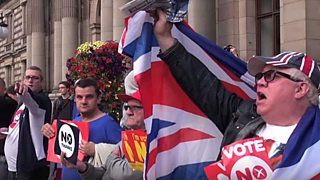
Our second-highest viewed video is of No voters chanting songs about the British empire and saluting (above). This appealed to our viewers and gained media attention, featuring in a Daily Mail story.
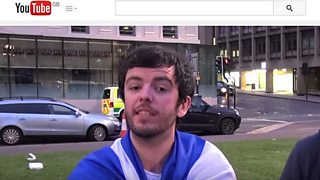
The most viewed video came on the morning of the results, courtesy of a drunken Scotsman (pictured top) whose expletive-ridden rant against the Conservatives and austerity went viral. This video was the epitome of what our audience felt and wanted to share - we always knew it would do well.
We left Glasgow with more than 180,000 views, 300 subscribers on YouTube and 180 Twitter followers. We were later awarded the 2014 Hugh Cudlipp Award for our coverage.
Failure: Is This England?
Six months later, with the success of Referendum Boysbehind us, we set our sightson the race to Downing Street. It was expected to be the closest general election in decades; the nation was on a knife-edge.
We wanted to have a well-planned, long-term project. Our team doubled in size, and we had more resources and manpower to push the project forward.
Each member of the team scoured election results, demographics and likely outcomes. We knew we wanted to cover one constituency and in March and April it seemed possible UKIP could take several seats. A UKIP gaffe would be guaranteed to generate hits and we wanted to learn about UKIP’s growing popularity. This meant looking beyond London.
We chose Thurrock, less than an hour’s train ride from central London. In 2010 the Conservatives had beaten Labour by 92 votes. UKIP’s candidate, Tim Aker, was well liked by many Thurrock residents and looked likely to cut into both support bases.
New project, new name. We wanted to ask whether England was as divided as Thurrock, and under threat from UKIP. We chose Is This England?
We bought the domain isthisengland.com and renamed our Referendum Boys YouTube channel and Twitter accounts as Is this England? social media channels.
On results day the Conservatives held the seat with a majority of 500 votes - Thurrock proved to be a perfect bellwether for the country.
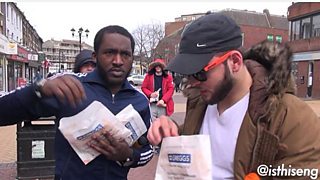
So why did our most watched video (below) get 344 hits?
Local engagement
Simply put, there was not the same passion for politics in Thurrock as in Glasgow. We failed to find our audience partially because we just didn’t meet as many people as in Glasgow and those we did meet weren't as socially connected as those in Scotland, or as likely to share political content online.
Being there
In contrast to Glasgow, we had a month to cover the build up to the general election and had four people contributing to the project. However, none of our team lived in Thurrock (three in South London, one in Essex) and all but one had full-time jobs. This caused problems.
The intensity of spending every living waking moment covering the referendum in Glasgow actually meant we were able to constantly create content in a way that occasional weekend forays to Thurrock could never achieve. This is probably the clearest failure of the project. As a team, we weren’t in the constituency we were trying to cover. I went to Thurrock three times - that was never going to be enough.
Disengaged social media followers
Using our Referendum Boys YouTube and Twitter pages meant we instantly had followers, but they weren’t engaged with our content. They were interested in Scottish independence and Scottish politics - not the minutiae of an Essex constituency.
We may have been better off starting again and building a new Essex-based audience. Having the numbers already there gave us a false sense of security and didn’t push us to reach out to those in Thurrock.
The ‘nothing’ election
Like many journalists, we struggled to get access to the real campaign. We were keen to avoid becoming a propaganda outlet for UKIP but weren’t granted access to either the Labour or Conservative campaign trail.
UKIP proved easy to access. We attended an event and interviewed several councillors and the candidate Tim Aker. This then made it tricky to balance our videos/political affiliations. We ended up interviewing a Cannabis is Safer Than Alcohol candidate to get an alternative view to UKIP.
So what would I do differently next time?
Build a new audience from scratch. Trying to interest Scots in an Essex constituency was a mistake and disrespected our existing viewers. We should have spent more energy building a new audience.
Be there. It was almost impossible to cover the mood in Thurrock without being there. We lost the authenticity we had in Glasgow. Next time this has to be a full-time job.
Focus on a story. In Glasgow we didn’t realise it but we were covering the groundswell of support for independence. Our reluctance to cover UKIP’s growing support base proved costly.
As you might guess, I’m waiting with bated breath to see when the European referendum is called and looking forward to putting these lessons into practice.
Adam Barr graduated from City University’s broadcast journalism MA last summer.
