Is it true about Final Cut X? My three-day conversion

Charles Miller
edits this blog. Twitter: @chblm

X man: Simon Lloyd
Our trainer, Simon Lloyd, turned out to be a sceptical convert. “Most of the editors I’ve spoken to HATED it for the first two months,” he said, “but a year later they wouldn’t want to go back.”
For many of them, and for me, going back means Final Cut 7, which was released in 2009. It’s a clever system that can do lots of sophisticated stuff but lets you make enough progress as a beginner that you’re encouraged to keep going and learn more. After several years of using it, I’ve found there’s always more to learn. But I now have my own well-practiced habits which I didn’t want to have to abandon for some trendy new system.
As for Final Cuts 8 and 9, they don’t exist. Simon said Final Cut 8 was being built while a separate, secret team worked on 10, or X, which was released instead. (Calling it X rather than 10 reminds me of Google’s X Lab, so named because what comes out of it is supposed to be 10 times better than current technology. You need to know a bit of Latin in Silicon Valley these days.)
Final Cut X doesn’t just look different from 7 - black rather than white backgrounds - it’s radically different in how you need to think about and organise material you’re working with. For a start, instead of two viewing windows - one showing what you’ve got in your film and the other what you are planning to add to it - in X there’s only one. But you soon find that actually makes sense, because you were never playing two clips at once anyway, and the more screen space you can save the better.
One advantage taken of that extra space is to let you view rushes more easily. Instead of clicking each shot to bring it up in a window to view, as you did on 7, here you just scroll over thumbnails, which brings them to life and lets you quickly see what’s in them. That’s particularly handy when you have lots of little shots. On 7 you’d probably join them together as a sequence just for viewing purposes.
The biggest conceptual leap is in how the finished film is presented as you edit it. Instead of picture tracks above and audio tracks below, here the default arrangement is for each clip to be presented with its picture and sound in a single block. In theory there are no tracks in X - although what you get still looks suspiciously like them. But they aren’t really tracks: they’re just shots connected together, with a single, central ‘storyline’ being a kind of backbone for the whole thing.
Simon thinks X short-changes the audio side of things in favour of the pictures. He claims that’s because Apple consulted two groups when designing the system: students (who wanted to use it to edit for YouTube) and Hollywood film editors. What they have in common, says Simon, is that they’re much less interested in sound than pictures (because in big budget movies all sound recorded on location is redone in a dubbing theatre afterwards). The influence of the students is apparent when you’ve finished your film, because, instead of ‘exporting’ the finished product, you’re invited to ‘share’ it - which you can do direct to YouTube, Vimeo or Facebook, among other destinations.
While I’m on the subject of language, it feels as though Apple has gone out of its way to confuse anyone familiar with Final Cut 7. What you used to call a timeline, you now call a project; what you used to call a project, you now call a library; and what you used to call a bin, you now call an event. Why?
I’m glad that Apple isn’t getting it all its own way on the matter of language. Simon introduced us to what seems to be a semi-secret function (“to be used with great care”). It’s accessed through the tilde (~) button, and is known by insiders as ‘the god key’. I’m not sure if I’m really even allowed to mention it, but what it does is “override connections”. Since the whole system is built on the idea of connecting clips to the central storyline, rather than just plonking them on tracks, there’s a subversive ring to the god function.
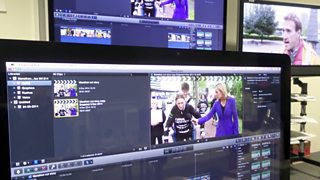
Final Cut X
As for X’s reputation, Simon said the software is actually much better than it was at first. Fourteen new versions have been released already. In the process Apple has corrected major omissions, like making it able to read timecode, as well as many smaller improvements.
Despite the PR disaster X turned out to be among professional editors, it’s reportedly been a commercial success, selling more already than all the previous versions of Final Cut. I’m ready to join the YouTubers and give it the benefit of the doubt, even though I don’t think I will ever get used to calling my project a library.
