BBC Academy’s Arabic website is ‘number-one training site in Middle East’

Najiba Kasraee
editor of the BBC Academy's language websites
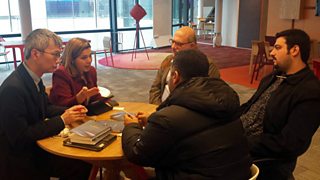
The BBC welcomes Al Jazeera to New Broadcasting House
We were delighted when the Qatari website Sasa named the BBC College of Journalism’s Arabic site the number-one training site for journalists in the Middle East. Sasa looked at 10 leading training websites in the Arabic language for journalists and decided that the BBC offers the best quality as well as a unique selling point:
"Based on our survey, where we looked at 10 sites available for journalists in the Middle East, we found that the BBC training site in Arabic is the best, as it is not only focusing on skills training for TV, radio and news content, but the site is a rich source for learning correct Arabic language.
“The teaching points start from how to write news in Arabic to tips on mastering the language itself, as well as advice on translation from English to Arabic."
Second place went to a media support training site from Egypt, and third to the International Journalists’ Network from Washington.
Elsewhere, the BBC Academy’s Hausa site, which recently launched a bite-size guide to correct language, has been called by journalists in Nigeria a "language traffic warden", indicating the site’s function as a guardian of the Hausa language.
This language guide, which is regularly added to by the journalist and linguist Sulaiman Ibrahim from the BBC’s Hausa service, focuses on mistakes in translation, spelling, grammar, and the challenge of creating new words.
More feedback for our bespoke language content came from India following the launch of the BBC Academy’s Hindi site. Professor Ratnesh Dwivedi from the India Today Media Institute, an academic arm of India’s largest media group, says: "I can say that the BBC has done a remarkable job through its College of Journalism."
Professor Dwivedi particularly likes our Hindi language guide on impartiality and accuracy, which he sees as an important tool for journalists who would like to write in a language which is not the formal Sanskrit but at the same time it is not a street language.
The next planned additions to the languages portfolio are three new sites to be launched next spring: in Kinyarwand, Kirundi and Uzbek.
Finally, another proud moment for the BBC Academy last month was a visit from al-Jazeera's training department. Aref Hijiawi from the quality control team at al-Jazeera’s training academy wanted to learn more about the BBC’s training modules. He praised our Arabic spelling glossary and said, with a smile, that he made full use of it in his guidelines for new recruits. We’ve been told the glossary is useful because there is often disagreement on how to spell the name of countries and capital cities in Arabic.
