The Steadicam alternative for self-shooters

Charles Miller
edits this blog. Twitter: @chblm
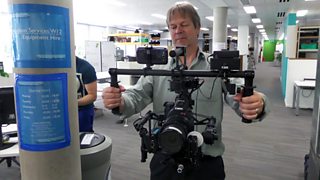
Charles Miller tries the Freefly MÅvi M10
Take Steadicam, a brand that’s been so successful since its launch in 1976 that its name has defined a category. It’s a great way to get tracking shots without tracks.
The drawback with Steadicam is that it’s a big, heavy rig whose operation is a specialised job. You don’t just want a professional camera operator; you probably need a specialised Steadicam operator.
So I was surprised to see an invite from the BBC’s Production Services team for programme-makers to come and see how self-shooters could get the same kind of shots by operating a new piece of kit for themselves.
It’s the Freefly Mōvi M10 - a motorised rig which fits around the Canon C300 camera that a lot of BBC producer/directors are using.
It works by using fast-responding motors to compensate for the wobbles you get in handheld camera shots. The results, as I found in my first try with the kit, are impressively smooth.
For self-shooting factual programme-makers, it’s ideal for walking pieces to camera (as long as you can get someone to check that your backward walk is safe and stays on track).
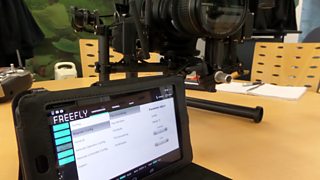
The Freefly MÅvi M10 comes with a tablet to set its operating parameters
Once the rig is ready to use, it’s quite simple to operate, but Matt Crowther from Production Services, who was showing it to me, did warn that even when you know what you’re doing, setting it up can take half an hour. The exact position of the camera needs to be balanced so that the motors are always returning it to the right equilibrium position.
And for self-shooting directors, Matt explained, you’ll need a proper, detailed, two-hour session to learn how to do your own setting up before you take it out. Oh, yes, one other down side: by the time you’ve disassembled the Mōvi you need a massive case to put all its components in - which won’t do your excess baggage budget any favours.
But in the end I’ll be signing up for that two-hour session as I think the results will more than compensate for the necessary but tedious techy tweaking and the big case.
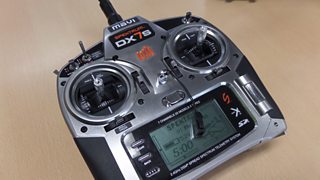
Remote control
