Philippines cybersex abuse exposed - but will it make a difference?

Tony Smith
is a BBC News video journalist. Twitter: @tonynewscamera
The Irish broadcaster RTE was one of my best clients. So I loved Irish people. You could find them anywhere in the world. And an ‘Irish angle’ meant an almost certain sale.
So this is how I first came to the door of Father Shay Cullen, a likeable Catholic priest who ran a children’s home in the city of Olongapo in the Philippines - then a den of brothels and go-go bars serving US servicemen based at the nearby Subic Bay airbase. Father Shay showed me bars where children as young as 10 were offered for sex. I rigged a makeshift camera inside a backpack - my first ever secret filming assignment - and left with footage which I was sure would shake the world’s conscience.
Of course my report on RTE made little difference. Some bars closed down, others opened. US servicemen were replaced by American retirees, who continued to flock to the Philippines for cheap sex long after Subic Bay closed down, engulfed in the ash from Mount Pinatubo.
As for me, I just got older, wiser, lost a little hair… and eventually joined the BBC.
Fast forward two decades and a newspaper article in the Kettering Gazette caught my eye. A British man had been convicted of abusing children in the Philippines via webcam. Interesting, I thought. I rang CEOP, the online protection arm of the National Crime Agency, which confirmed this was a huge and under-reported issue. I tried to remember the name of the Irish priest who had been so helpful. I tracked him down - Father Shay was still there, still rescuing children, and, like CEOP, he confirmed that webcam abuse was a growing problem.
Father Shay promised to set up interviews with victims of what Filipinos call ‘cybersex dens’ and put me in touch with NGOs in other parts of the country where the trade was rife. And so, alongside colleague Angus Crawford, I found myself retracing my own steps, on a plane to the Philippines.
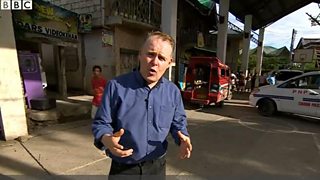
Father Shay soon put paid to that.
He didn’t look a day older than when we’d first met. He was just a lot more cynical.
“You journalists,” he laughed. “You come over here promising that you’ll change things. But the sex bars are as bad as ever.”
He was fed up, he said, with the media promising to “raise awareness” of these problems. What he needed was cash, he said: cash to fund his orphanage; cash to pay for the minibus in which we toured a ‘strip’ of dubious looking bars; cash to pay for social workers to rescue more children from more brothels.
So he insisted on being interviewed in front of a banner advertising his children’s charity; a logo for the fair trade mangoes he sold as a side line prominent over his shoulder.
We worked with a number of NGOs in the Philippines and used Father Shay’s interview sparingly - we thought it important to speak to Filipino as well as expat charity workers. In every case NGOs gave up a huge amount of time and energy in arranging our visit (at a particularly busy time immediately after the typhoon), for which we were enormously grateful.
This all brings me to the essential question of whether we can justify interfering in people’s lives in the name of journalism. Do we really make a difference? On countless occasions I’ve been guilty of trotting out the glib phrase, promising that my report will raise awareness. It rarely changes anything.
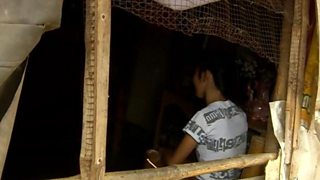
Father Shay took us to meet Lani, a 17-year-old girl (pictured top) who had been forced to work in front of a webcam for several years. She was happy to be interviewed and we spoke to her anonymously and, I hope, with sensitivity.
But where do you draw the line?
Later, in another part of the country, we were introduced to a nine-year-old girl now being counselled at a children’s home. In a side room, we were told how this girl had been horribly abused; raped in a manner which I couldn’t possibly describe here.
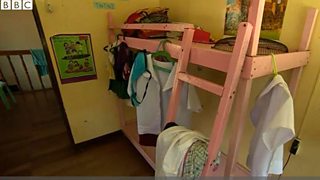
A younger version of me would have pushed for an interview, filmed a tear trickling from an eye, thought about the awards we might win. But Angus and I looked at each other. We couldn’t even bring ourselves to ask. Perhaps it’s experience, or working for the BBC (which ought to hold up higher values than our more tabloid rivals), or just common human decency. But there was no way we could put this girl through any further trauma for the sake of a television news report. We grabbed a couple of shots of her, discreetly, from a neighbouring room, and then left.
So did our report change anything? It’s hard to say. Broadcasts on BBC World News were picked up in the Philippines and the government there promised to crack down. Whether it will remains to be seen. Widespread coverage in the UK might make some men think again before paying for this kind of abuse, who knows?
There’s also a wider motive in that the world ought to know that these things are going on.
And if that doesn’t make a difference, I’d say one last thing: Father Shay is a good man. I can’t recommend his mangoes highly enough.
